Category: Robbed Series

Notes on Being Robbed in January 2006

  • Robbed at Gunpoint #10: What If They Steal Your Mp3s?

    When I filed my insurance claim, my first thought was, “I wish I could file a claim for the thousands of mp3s I lost too.”

    I wasn’t that worried really. I had lost 2 40 gig hard drive mp3 players. The two players had about 50-55 gigs of mp3s (that’s about 1300 mp3s). Although I used both machines occasionally for audio recording, I’m happy to report that all of the original recordings had already been transferred to my PC.
    Here’s how things broke down on my 2 40 gig iriver mp3 players:

    • about 2 or 3 gigs were commercial songs I downloaded (illegally) through p2p networks in 2001.
    • another 5-10 gigs consisted of  commercial music from Asia I downloaded through this incredible (and  illegal) music service called Audiogalaxy (now defunct). These are mp3s I would have never found in any other way, music totally unavailable in the US.
    • about 10 gigs came from mp3 scraping program called Irate Radio. I had interviewed the lead developer two years ago, and this was one of the first programs that allowed people to download massive amounts of music legally.
    • about 10 gigs of stuff I downloaded by hand. Came from dmusic, iuma.com, webjay.org, chron.com, amazon.com. I spent a long time downloading these things.
    • 4.3 gigs of mp3s from a legal torrent of SXSW music from musicians performing at the event.
    • about 12 gigs worth of creative commons stuff (maybe as much as 15). Mostly electronic stuff, but also a lot of classic blues/fiddle music that apparently archive.org is distributing. A lot came from legaltorrents.com too.
    • 7-9 gigs of mp3s I burned from CDs. About half of them came from CD’s I owned, while the other half came from CDs I checked out of the library (I’ve recently been on a jazz kick–btw, you really need to check out Fats Waller, Art Pepper and Herbie Hancock).
    • special mp3s I paid for on sites by individual artists. Namely Kristin Hersch, Trancecontrol, Serena Matthews and maybe one or two others.

    Out of them all, I will miss the SXSW torrent mp3s the most (because there’s no way of recovering them, aside from running into someone who downloaded the same torrent file). (Update: Apparently the torrents are still available!)Also, I am really angry at losing the files I downloaded by hand, although I might have copies elsewhere on an old server. I think the Bollywood/Asian stuff is stored safely somewhere, and I bookmarked the archive.org files in two different ways (here’s one of them). I’m not sure that I’ll be able to obtain the files from individual artists I bought mp3 files for (although these guys might cut me a break).

    I can easily redownload the mp3s from the Houston Chronicle site, but it would be a royal pain; while the Chronicle has been gracious enough to distribute these files for free (all fantastic!), chron.com hasn’t really made it easy or convenient to download. You still have to do it by hand (I had seriously contemplated trying to repackage these files into a torrent file–assuming I could obtain the right permissions).

    Right now, we have a power struggle going on between content supported by ads and commercial mp3 hosting services. Myspace, dmusic, amazon.com etc. do a great job of distributing content by artists for free. On the other hand, their revenue comes from advertising eyeballs, so it’s in their best interest to make the process of downloading an mp3 as long and tedious as possible. I complain, but without this miniscule revenue stream, perhaps music hosting services wouldn’t survive at all. Frankly, aside from archive.org and ourmedia.org (which have ftp/torrent access), not a lot of options exist for downloading massive amounts of mp3s legally and safely.

    Have I left out anything? Oh, yes, iTunes, yahoo, walmart, the “minor players.” As a matter of principle, I’ve been avoiding them, although I don’t reject them out of hand (as long as their DRM framework doesn’t mess with my CC/free/legal mp3s).

    But what happens if my mp3 player (or my laptop) is stolen? Will any of these companies compensate you for your loss? In other words, are you allowed to download the mp3 files only one time, or do you have the ability to access/download them as long as you want?

    For iTunes, the answer is no. The onus is on you to make backups of your music files you paid for. On the other hand, you can import these backed up files onto any system that is authenticated for your use. And you can “de-authenticate” the stolen devices for use. (Read more information here and here ).

    That sounds like a fair-enough solution. But is this the best way really? The problem is you essentially need to keep 3 copies of all of your files (one on your PC, one on your ipod, and one on a data DVD). Chances are, your data DVD won’t be up-to-date, although that will definitely minimize the loss.

    Even with a reliable backup solution, you could still lose lots of files (and in a catastrophic event like a fire or flood, you wouldn’t have any backups). What if itunes maintained a central authentication server? Merely by changing your password, you could de-authenticate a device easily and plus have the ability to access any/all files you already paid for. Yes, there are offline scenarios and technical problems to deal with, but they could be worked around somehow. Really, we only need the files to exist on a centralized data locker for downloading, and transfer would be painless.

    From Apple’s point of view, making an authentication server would mean more hassles and possible breakins. On the other hand, it would offer consumers an “insurance policy” against theft and upgrades. I’d certainly appreciate the peace of mind of knowing that things I bought would continue to be available simply by logging in. When high-speed internet becomes ubiquitious, maybe the streaming model would become fashionable again. Maybe not for portable devices (although you never know!), but why should you need to keep anything locally anymore? The only issue Apple needs to address would be concurrent usage on more than one machine, and guess what–the software world has already solved that problem.

    For the individual collector of independent music, the biggest challenge isn’t authentication; it’s simply remembering what you downloaded (and finding time to do it again). To tell the truth, I simply can’t remember what I used to have on those iriver players.

    This reminds me of a dream related to me by a graduate student attending school in California. He made a trip from Texas to California in a car loaded with books. When staying overnight at a motel on the way, he dreamed about his car being robbed. In the dream he came out to his car and found his books completely gone (stolen!) and replaced with a different cache of books (put there presumably by the robber). My friend, though disappointed, started thumbing through the new titles, finding them mostly uninteresting, though some were esoteric enough to whet his curiosity.

    You lose some, you win some. When I buy a new mp3 player, I probably will be so busy finding new stuff that I will hardly think about my losses. Music is everywhere (and so are podcasts, apparently). Losing a few thousand music files won’t change my love for music or prevent future enjoyment. Ideally individuals should not need to worry about getting mp3 files stolen. This is a technical problem which is easily solvable (and in a few years, it will be). But sometimes it helps to start over from scratch without being bogged down by the burdens of a music/movie collection. One needs to remember that in a time before mp3s (or even recordings), people’s tastes in music were just as adventurous, just as passionate.
  • (Note to Readers)

    Perhaps it would have been better to allow comments for my recent columns about being robbed. Unfortunately, I haven’t had time to install WordPress’s spamfilters yet, though I will do so soon. For now, though, if you want to make comments, just send them to me and I can add them manually: idiotprogrammer @fastmailbox.net

    For now, a comment section is available on Dwight Silverman’s techblog.

  • Robbed at Gunpoint #9: Finding Out about the Neighborhood

    A few years ago I was looking at some apartments and found some lovely old apartments in the Gulfton area (approximately near Bellaire and Chimney Rock). Driving around during the day, I was impressed by the neighborhood’s charm and the proximity of parks and libraries.

    But my parents were horrified. “The Gulfton area is a den of crime,” they told me. They saw all sorts of crime reports and murders on the local news as well as in the Chronicle newspaper. I didn’t really know, but a quick check of the newspaper revealed some basis for their belief; also, apartment locators (who tend to be pretty well-informed) seemed to agree.

    There is perception, and there is reality. Watch the local news, and you’d think that this city is teeming with murderers, child molesters and carjackers. At the same time that local news provides new evidence for paranoia, national (and even local) crime statistics seem to be relatively stable or even declining. When you live in a metropolitan area of over 3 million people, there will always be more than enough incidents to fill up a newspaper or 23 minute newscast. It would make anyone paranoid.
    Instead of Gulfton apartments, I moved into Walden of Westchase, a small geek apartment complex that was relatively quiet and crime-free. During my three year stay, there were “incidents” and flyers put on our doors to notify us. For a while, there was a string of robberies by the same person around the neighborhood (not just that complex). Luckily no murders or violent assaults. Sure, there were car breakins, looting of the vending machines and random acts of vandalism (my bike was vandalized in my last month there). All this for a relatively safe and quiet complex.

    But 3 years later I was ready for a change in scenery and found an apartment complex 4 miles west with outstanding recreational facilities, a competitive price and a nearby park. I was sold. Yet the neighborhood was close to the Alief high schools (translation: lots of teenagers running around), and the apartment was just bigger (probably 2 or 3 times the size of my old one). Instead of attracting single yuppie geeks, it attracted families and immigrants. So yes, it had more activity, more people out and about, more social interactions, both friendly and dangerous.

    But does that translate into more crime? Compare the situation to my parents, who live in a gated retirement community in west Houston. They felt much more safe than before (and in fact, they moved there to escape a deteriorating neighborhood in Mission Bend). But the price they paid was isolation. The neighborhood was new, and deed restrictions prevented younger couples from living there: it was only for retirees.

    So is buying a house in a gated community the only way to be safe? Actually though, my parents (who follow local crimes more closely on the TV) feel even less secure than I do; Whereas a crime incident may seem to a young adult to be just a normal consequence of city living, older generations may feel more threatened by it, more burdened by its inconveniences and more helpless to take countermeasures. But personal security often depends on perceptions rather than reality; how then can an individual find out about the realities of crime in a neighborhood?

    The Houston police department publishes crime bulletins by neighborhood, which is immensely helpful. But my apartment complex didn’t have a single incident in 6 months (even though the neighborhood itself probably has a higher-than-average incidence of crime). Who really knows how to interpret the data? For example, a complex twice the size of another might have twice the number of crime incidents.

    Another way to ascertain a complex’s safety is to walk around with the leasing agent and notice things. But during the daytime, there’s only so much you can tell. At one apartment complex I was considering, I visited at night (walking through the gate after a car). I walked around a bit and noticed the amount of activity and noise level. In this case, all kinds of cars were out and about; gangs of teenagers were congregated everywhere. Based on their appearance, they looked like thugs…or could they simply be minority National Merit finalists chatting about science projects? Really, you can never know.

    Apartmentratings.com gives excellent ratings from residents about each apartment. But can you trust them? This rating board tends to attract “sour grapes,” usually people who have been robbed or had squabbles with the apartment management. It’s hard to form conclusions based on feedback which is almost uniformly negative. Some of the commenters are outright bigots (complaining about the number of minorities or influx of New Orleans people, for instance). Still, it gives you something to look for when inspecting a property.

    The minority issue is a touchy one. Yes, there are Mexican gangs here in Houston, and certain African-American teens (judging solely from their outfits) are either gangsters or could play one convincingly on TV. Then again, what do I know? I no longer have a clue about what kind of look already was “mainstream” and what outward signs were genuinely meaningful. In my high school days, potheads wore Van Halen and Black Sabbath T-shirts, but so did the geek crowd (sometimes); even then I had trouble figuring out who really was “dangerous” and who simply was dressing the part. In this neighborhood, the African-Americans were really from Africa; they were Nigerian immigrants studying for pharmacy school or working at network administrators. Surely, that’s not an indication that the neighborhood the place is “going downhill”?

    The best way to find out about the neighborhood is to ask people who live there. In the past, I have stopped random residents before they enter the complex and ask them for an opinion about the area. (The information is not THAT helpful. Almost everybody gives basically upbeat assessments; remember, they are the ones who haven’t yet fled the place).

    I’ve lived in apartment complexes for almost 20 years (both here and overseas). It’s rare that I talk to my neighbors (except if we have a blackout or some emergency that brings us outdoors). Aside from apartment incident reports (which tend to be vague about details), it’s hard to know who’s getting robbed and why and what the apartment complex is doing about it. If you don’t know your neighborhood, how on earth will you find out when they’ve been robbed? Really, the only way to know is to see the police car in the parking lot.

    One idea I liked at my old apartment complex was that someone set up an email mailing list for residents (remember, Walden of Westchase had a lot of geeks with webservers!). Managing a mailing list can be a pain, and it probably could bring community issues to the forefront that others don’t want to confront. But in an age where we’re more likely to keep up with the day-to-day affairs of a blogger in Canada than those of our next-door neighbor, sometimes the only way to find out about what’s happening under your nose is to read about it in your Inbox.

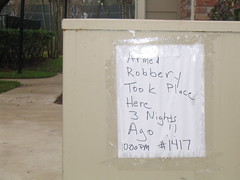
    Robbed at Gunpoint

    (homemade sign I made to warn my apartment neighbors).

  • Robbed at Gunpoint #8: The Price of Carrying a Weapon

    A man at a social event, after hearing of my “incident,” launched into a speech about how I should have carried a Smith & Wesson gun precisely for this reason.

    What an idiot, I remember thinking. The man was liberal and reasonably educated; frankly, I was surprised to hear him express such an attitude. Doing so might contribute to my sense of security, but also my sense of paranoia. For this suggestion to work, you’d have to carry the damn gun with you at all times, wherever you go. And you’d need to be ready to use it at a split second. The grim sociological fact is that if you make an attempt to reach for a weapon, the assailant has no choice but to shoot you preemptively. And that makes a scary situation even scarier.

    On the other hand, legalizing concealed weapons has been shown to have a deterrant effect on crime. Criminals may not really fear going to jail (they know about the slow-moving and often incompetent nature of the justice system). On the other hand, the thought that the victim has a handgun and knows how to use one is a genuinely frightening thought for them (Of course, the assailents have the advantage of surprise and choosing the context). Handguns actually would make sense in public settings (like schools and banks and parks) where the gun-wielder is a bystander instead of the primary victim. 100 people may be in a park, and the assailants have no way of knowing which witness would carry a concealed weapon. But in a one-on-one assault, the victim is the sole focus of the assailant’s attention; it just isn’t a realistic option.

    On the other hand, each person has his own standard of security. Women for example may have fears of being raped. (Interesting fact: did you know that sexual assault dramatically increases the likelihood of divorce for the couple? So there are two victims here, not just one). And there may be contexts where the potential victim has a few seconds to become prepared. Even though I don’t necessarily approve of it, keeping a handgun in your house might be an effective defense. That is, as long as you are trained well enough to have a rapid response time while still able to avoid firing at the wrong intruder (neighbor, child, etc). The problem is, most breakins don’t occur at night; they occur during the day in which you wouldn’t be at home anyway. That means you’re providing another valuable good for the criminals to steal, another untraceable firearm for the intruder to use in future assaults.

    Possessing a gun poses other domestic risks. Household members could use it for suicide or crimes of passion; a child could play with it and accidentally fire it at someone. Guns are means to be used, and so they will be used sometime, somehow.

  • Robbed at Gunpoint #7: Critical Moments

    After reading Michael Blowhard’s thoughts on important events, I realize now that the 45 seconds in which the teenager held a gun to my head was in fact an important event (although neither he nor I realized it at the time). At the time I was more surprised than frightened and never seriously entertained the possibility of being shot. Simultaneously, the Mexican with the gun never seriously thought about getting caught and incarcerated. He had a gun and knew that (for a few minutes anyway) he could control anyone around him.

    And yet when eventually he is caught and is hopelessly ensnarled in the legal system (not because of me, but whichever victim happens to bring about his arrest), he will look back at those moments and recoil. How could he have risked for so much for so little? Truthfully, I had a life full of security and comfort; I even had insurance to cover my losses. I had a reasonably stable future. But this individual with the gun–one thing will lead to another–he may gain things, but never be able to value them, never able to enjoy them with a modicum of satisfaction. If by some chance I were to be shot, I could say that yes, I lived a reasonably fulfilling life; I had many opportunities, many joys, many adventures. But if this individual were to be shot or receive a long sentence as a result of his misdeeds, the result would be a tragedy–not only for himself but the world as well. No one would know who he might have been or what he might have done if given the right opportunity and set of circumstances. No one would know the joys he could might found or provided to others.

  • Robbed at Gunpoint #6: Dreaming, Dreaming, Dreaming

    As ashamed as I am to admit it, even though I have no functioning credit cards and no certainty of receiving an insurance settlement, I am already eying new replacement gear. The leading contenders: Nokia 770 Internet Tablet and Marantz PMD660 .

  • Robbed at Gunpoint: #5

    After tallying up the loss, I realized that in 60 seconds I lost more than $1500 worth of crap. Honestly. I had a high end PDA and 2 high end mp3 player/recorders. Then, I realized that I had also bought accessories for the PDA: a 1 gig memory card, a leather carrying case and an extended battery. I never realized that I had invested so much (and let me tell you: for the first time in a long time I finally feel that I am keeping tabs on my personal data better than ever). I also bought software specifically for the PDA (which should also be factored into the loss, although not for insurance purposes).

    So we have people walking around with lots of small devices costing between $100 and $400, just ripe for the robber. If you must know the truth, these devices bring a trail of accessories which you have to lug with you if you’re on the road. People are becoming easy targets at the expense of insurance companies. Ipods are easy to snatch and easy to resell. How can we reduce the allure of stealing these kinds of portable devices?

    Actually though, the crooks here cannot use my devices. They probably won’t be able to resell them for much at all. Why? The backpack contained the devices only but not the chargers. They would have to buy the chargers themselves to sell them. And my products are somewhat exotic; it would take some hunting and forethought to obtain the chargers. For this reason, the pawnshop or ebay will be unlikely to pay much. Without the battery, these devices are nothing.

    Therein lies the protection. The battery charger can serve as a kind of “token” to authenticate the owner. Perhaps the purchaser will be able to create an encrypted code for the battery charger to work and only for the purchased device. Trust me, this idea is brilliant! So brilliant I won’t be surprised if Dell or Apple start offering such a feature soon. Ok, Cory Doctorow may scoff at the proprietary nature of the accessory (didn’t he have a beef with Lexmark?), but that’s a win-win here. Companies win by selling their own secure accessories; consumers win by lowering the attractiveness of stealing things like iPod. Insurance companies win too.

    Reality dose here. First, any secure feature can be circumvented, and actually consumers may want circumvention hardware simply to undercut the primary vendor’s exclusive lock on the accessory (if it’s half the price, for example). Maybe consumers would view these restrictions as meddlesome. (The DCMA forbids backwards engineering, so such things are going to exist in the gray market).

    Secondly, teenagers who steal don’t pick and choose what to steal. They steal whatever they can get their hands on, worrying about the functionality of it later. My thiefs wanted everything in my pocket and backpack, regardless of what they could sell it for. One wonders whether reducing the resellability of portable devices would also reduce stealing or simply reduce the number of items on ebay.

    On the other hand, look at how credit card agencies protect themselves against theft easily and effectively. Individuals who steal wallets know that after a few hours the credit cards are going to be invalidated. The backpack retrieved out of the dumpster actually contained a number of credit cards which the thiefs didn’t bother to try using; when they saw that the main card stopped working, they just assumed that the others were cancelled as well (when in fact I had forgot to cancel some cards even after 20 hours). On the other hand, that is a good reason to kill a consumer or at keep him tied up in a corner for a day or so).

  • Robbed at Gunpoint: #4

    A homeless man named Verne found the stolen backpack two miles away from the scene. That was where the thiefs bought gas with my credit card. Verne called to tell me the news, and I jumped for joy. I simply forgot what I had in there. When I received the backpack (emptied of the electronics), I found several things I totally forgot about. The abandoned packpack still had a software CD belonging to my company as well as an old literary magazine I edited in college, Nada magazine. That magazine will be a collector’s item someday (or maybe not), but it was my last remaining copy. It was priceless. I wouldn’t have realized I had lost it until weeks or maybe even months later.

    Vernon is a former trucker who lost his license because of DWI’s. Now he’s living in a small closet at a gas station. His life seems pathetic to outsiders; he holds a sign to beg for food and hasn’t taken a shower or found a job. I’d worked with homeless people before and have an idea of the challenges they face, the biggest being communication and basic hygeine. I gave him a $30 reward and offered to take him out to lunch on Sunday. For him, it was a nice windfall, and I’m glad to provide it. He was a nice chap, reasonably intelligent and not a psycho, one of the people who can easily escape homelessness with the right system of support. Amazingly, he said that he is a frequent target of theifs…a homeless man! Why would anyone steal things from a homeless man? But I knew what he was talking about. By standing outside, he remains highly visible to passersby; behind a car window, nobody knows who you are or knows how to talk to you (or if you will even open the window).

    I grew up and went to school in Alief (which is located in southwest Houston). I know the neighborhoods well. I moved to a part of town slightly seedier than before to live at an apartment with topnotch recreational facilities. And yet as I drove to where the homeless man was staying (at a janitor’s closet at a Citgo gas station), I noticed several other people roaming the street homeless as well. Things have changed; one starts to wonder, why? Is it because the schools or city facilities have deteriorated? Or that the demographic has become poorer and less educated? Is it because of gentrification of both physical structures and inhabitants?

    If you had money to spend fixing the problem, where would you spend it? Some say police; others say schools. Others say that if city infrastructure were well-managed, businesses would be more likely to locate here (as well as the high-paying jobs). Alief is a residential suburb. There’s not going to be new colleges or technology centers springing up anytime soon. On the other hand, real estate is still plentiful and cheap; mass transit and tollways are branching out here, so it’s easy to rent an office and start a business.

    Also, inside the loop Houston seems pretty yuppified, but west Houston has rich pockets of ethnic groups. I used to live near a Chinatown section (which actually contains lots of Vietnamese people). Besides that are Arabs and Pakistanis and Indians. Lots of nondescript stripmalls with terrificly ethnic shops. I shouldn’t overlook Mexicans and African-Americans here. They were always a visible minority, and now it seems they are no longer on the bottom rung of the immigrant ladder (although ironically the teens who robbed me were Mexican and African-American).

    A neighbor once complained that her (white) daughter was a minority in her Alief high school. She said that with disdain, as though this were sufficient proof that the schools were going downhill. But ethnic diversity is supposed to be a community asset; if so, why is it associated with so much crime?

    Suburbs often lack public spaces or events to bring people together. In Houston (as in most major cities), artistic groups reside inside the loop; ethnic diversity notwithstanding, west Houston has always been a kind of cultural wasteland. Cineplexes, shopping malls, apartment complexes, fast food restaurants. Where should one go to hang out?
    (Sidenote: although I didn’t really set out with this intention, I have a feeling that my video projects might use settings in Alief/West Houston. Stay tuned.)

  • Robbed at Gunpoint: #3

    Although the actual “transaction” didn’t seem that scary, as the day went on, my senses became alert to peripheral threats. People in peripheral vision–if they turned as though to come from behind me–suddenly became a threat in my eyes.

    I had a similar sense of shell shock when in the middle of gunfire in the Albanian civil war. For weeks in the USA I would instinctively react to sudden noises even though intellectually the source of them were harmless.

  • Robbed At Gunpoint: #2

    I spent all day yesterday cancelling credit cards and getting replacement ID. A good 12 hours after I reported the incident I realized I had completely forgotten to call in the corporate Amex card (which I rarely use).

    Although I have access to my bank account now, I have neither debit nor credit cards, so it is impossible to buy anything on the web until I receive my new cards (7-10 days). Somehow, I think modern technology is capable of more celerity.

    When you call in to report your cards as stolen, telephone reps will start off by asking, “Do you know your card number?”

    “Well, no,” I reply. “I just had the cards stolen, so how would I know that information?”

    They ask that question every time, and every time I give the same reply, a ritual exchange repeated practically everytime someone calls in. Realistically, the companies must know it’s unlikely for consumers to have this information at their fingertips, but there is always that hope.
    My assaulters had a chance to use the card to fill their gas tank, an oversized pickup truck. That vehicle’s gas tank must require a lot of robberies.

  • Robbed at Gunpoint: #1

    Last night I was robbed. More to follow.