Category: Social Sciences

  • The flaw of libertarian economics

    The flaw of libertarian economics is that it overlooks or discounts the predatory aspects of power. You can say that we should get government off our backs or that taxation is an unjust burden or that the free market provides an optimal creation of wealth. But without oversight or interference, more powerful businesses can easily  avoid compliance with contracts and avoid compensating  people who have been harmed by their behaviour. Libertarians refer to the court system as correcting major injustices and disparities between parties, but it ignores the fact that justice is often very slow and  many  victims  are  rewarded  only after considerable waiting (and suffering). A few months ago I complained  that it took the multi-billion dollar company  Comcast more than four months to refund me $20 which it already admitted that it owed me. Comcast, like many Fortune 500 companies,  has the legal infrastructure to fend off legal claims about such malfeasance, allowing it to nickel and dime the American consumer to death with impunity.  A  well-crafted regulation, if applied uniformly with adequate phase-in time, can be easy and  inexpensive for companies to implement; it can also correct injustices promptly  and minimize drawn out court battles  between parties with  unequal power.  I understand that unchecked public agencies can sometimes handicap legitimate business activity without good reason, but at least they are accountable to public pressure.

    The laissez faire policies advocated by libertarians   enable the private exploitation of public resources with the potential to cause pernicious  effects. Libertarians often paint the struggle as government agents encroaching on the house and property rights of an individual, but the more common scenario is a giant company whose injuries to others avoid  public scrutiny by virtue of its economic might, with government  agents (woefully outmatched and underfunded) unable to figure out if the company has done anything wrong.

    Mexican poet Octavio Paz once wrote that capitalism is efficient at creating wealth but wretched at  assigning it a purpose.  Wealth creation for its own sake is not really a public good  if citizens fear for their safety and economic well-being and  if investment in “social capital” and public resources is minimal. It is not enough for Chevron to pay to build a public park or Walmart to  support food kitchens. There needs to be an entity committed to managing this “social capital” at all times regardless of whether it helps a company’s bottom line at a particular moment.  This entity needs to be accountable to all Americans and needs to have an organizational framework dedicated to treating all people equally and fairly. This entity is called a government.

    Related: see my piece on libertarianism and the health care system (which touches upon a lot of general issues about how to measure libertarianism as a philosophy) and an excellent book  which argues for “soft paternalism”: Nudge: Improving Decisions about Health, Wealth and Happiness by Richard Thaler and Cass Sunstein (See the Nudges blog).

    Postscript: Here’s an interesting question to pose to libertarians: “do private  contracts always take precedence over liberties?”    Can a prostitute sell her obedience for a price?  Can an intern enter a contractual arrangement where he or she receives no compensation but has to follow the contract’s obligations?  If I bought a piece of property with the intent to exploit its mineral rights, are those mineral rights unrestricted and perpetual regardless of what any later government decides and regardless of  any later safety findings?  Libertarians believe that the ability to make contracts is a sign of liberty, but at some point, this contract can threaten the liberty of  one of the parties (or even a third party, as with the case of environmental harms). By their philosophy, the  liberty claims can be pursued only  after the damage or taking has taken place, making redress impossible for the aggrieved party.  You can’t on the one hand grant one party the right to damage another’s life or liberty and at the same time admit that it is impossible for the damaged party to seek redress. That is tantamount to admitting that one party has the absolute right to deprive the party of liberty. The success of the free libertarian state depends on the ability for weaker parties to receive protection from stronger parties. But if you admit that no such protection exists, you are admitting that liberty no longer is an absolute right in your system.


  • Time Magazine Person of the Year should be… the Lone Gunman

    (This was written a few days after the mass killing by a lone gunman at a Connecticut elementary school which claimed 27 lives).

    For the past few years, my mom and I have been busy guessing who will be picked as person of the year by Time magazine. So far I had selected John Roberts (for trying to manage a polarized judicial system and political system) and Steven Colbert. Colbert is my personal favorite; he is an American original; his satirical edge is always on-target and takes Poe’s law to its extreme. Conservatives would  probably enjoy him too (even if  they recognize that he is poking fun of him). I think  the presence of Colbert and Stewart (and probably others)  contributes to political culture without poisoning the discourse.  We should all be thankful for rhetoricians like Colbert. I never cease to be amazed at how effectively Colbert conveys his ironic message underneath the apparently conservative rhetoric. 

    Over the weekend, though, I’ve decided that this has to be  the year of the Lone Gunman. Yes, GunMAN (these types tend to be males – although not exclusively). The Lone Gunman has the potential to move society at will; he has some  personality malady and lives in a society that not only permits the ownership of gun for personal protection – it encourages it.

    It’s a personality type; I lose track of which individual is which – how many calibers are their weapons and how many rounds are fired – even how many have died.  As gracious as  presidents are when giving these eulogies, I almost wish they  weren’t there to do that. The president’s primary role should be decider-in-chief, not comforter-in-chief. The schedule of the decider-in-chief ought not to be set by the Lone Gunman.  Yes, I realize that comforting the afflicted is politically expedient and it’s a natural role for a president to fall into.  It is society’s way of recognizing the enormity of a tragedy. It also happens to be counterproductive for society as a whole. 

    Politicians can and should enact laws to solve problems. They should be held accountable if they don’t or if they fail to support the correct policy.  When politicians offer comforting words during these times of mourning,  it obscures the fact that the politician is not in fact aggressively fighting for laws to combat the problem.

    Update: Tom Tomorrow dramatizes the pattern of these kinds of events.

    Update #2. Looking at the previous winners, I realize that very few women have won the award, no entertainers have won the award, many international politicians have won the award and that “gimmicky” awards to groups or things tend to occur roughly once very 5 years (and since last year the winner was The Protester, it seems unlikely to happen 2 years in a row). I still vote for Stephen Colbert – who would be a nice change of pace.

  • Tufekci on Twitter, Chilean miners, wikileaks, ipad, etc.

    I am still behind on blogging, but here’s some nuggets from  Technosociety blog, a  fresh blog about the relationship between technology and society by Zeynep Tufekci. Lots of deep thinking here. Here’s her take on the Nobel Peace prize announcement and Twitter:

    The Internet is not a game-changer in the sense of a cat-and-mouse game because, yes, it empowers both the cat and the mouse. It is a game-changer because we are not cats or mouse but people, and people care deeply about what other people think of them and how they conduct their lives. In the 21st century, it is not sustainable for a governing elite to be both repressive at home and welcome in the world — and most elites deeply desire the latter as much as they may still cling to the former. One can point to apparent exceptions like the Burmese Junta but I think the formulation holds for most.

    People almost never win over a repressive regime because they are better organized or better equipped or better able to get things done. All the examples one can point to are going to be rare remaining weak states or regimes from the past: the modern repressive state is just too powerful.  People win over repressive regimes because the elites in those regimes are also people, and as people, they also crave the sense of belonging and legitimacy that people everywhere, even the most powerful, crave.  People can win not because they can beat back force with force (they rarely can), but because they can withdraw their consent and undermine the standing the rulers have to repress, as the repressive apparatus itself consists of people. I think the collapse of the Soviet blocs is an amazing example of how the seemingly strongest state can wither away after being hollowed out through lack of legitimacy. (Pick your example: Apartheid South Africa, East Timor, etc.)

    Here’s her thoughts about the Chilean mine rescue narrative:

    My unease with the portrayal of this story isn’t just about the fact that this mine, like many others around the world, had an appalling safety record and the miners would have been out by themselves in 48 hours had the mine owners installed the safety ladders in the ventilation shafts as they were, by law, required to and warned about. And I do realize, as others have noted, that we copiously consume many mined metals and minerals as if they do not come at a huge human and environmental cost – costs which have been increasing as the easy pickings have long been picked over and we are now drilling deeper and deeper to extort the earth to give up these precious elements. Miners around the world are treated as discarded lives (thousands were dead just in China just last year) and suffer from a wide-range debilitating diseases.

    The problem is that this rescue was a spectacle of technological confidence. The message was that with enough money, determination, technological savvy, gadgets, NASA, experts, smarts, we can solve these problems which are of our making. Yes, we can, for small problems (and we should) like one collapsed mine. However, our bigger problems, climate change, resource depletion can’t be solved by just-the-right-amount-of-tech-wizardry. There are hard choices and inevitable compromises ahead and we should get ready for a (global) discussion on how to finally start ameliorating the unavoidable upheaval that is headed our way.

    There is one part of the message, however, I believe is crucial. The spirit of solidarity and camaraderie that the miners held onto under very difficult circumstances will be key. Paradoxically, such a spirit is often easier to hold on to under grave conditions that threaten survival and require sacrifice from all. Metaphorically speaking, we as humanity are already trapped in mine, a big blue and pretty one but still one that confines us and is under threat, and our technology is not going to provide us with a magical phoenix capsule that will solve everything without much sacrifice or pain and there will be no extraterrestrials who send us glucose drinks and video-feeds through ingenious tubes.

    She argues that wikileaks is interesting because it reveals the disparity between what insiders and outsiders know:

    So the multiple pronouncements by many pundits that there is nothing shocking here actually expose the heart of the issue: the jaded insider game of hypocrisy and cynicism involves much of the established media and punditry. Most diplomats and journalists already know, for example, that the U.S. has been spying on United Nations officials––this had actually been exposed but received fairly little media attention, certainly less than Dancing with the Stars. Most “insiders” know how the game is played. That nations go to war for interests and resources. That, around the world, the U.S. is not seen as a pure purveyor of democracy. That lobbyists dominate policy-making. That there is a scientific consensus around global warming and that almost all the dissent is financed through the oil-coal interests. That big nations often try to use multinational institutions to advance their own narrow agendas under the cloak of high ideals.  That many politicians are corrupt, ignorant and self-interested. But most of this is rarely discussed in an open and serious manner.

    There are many other issues that Wikileaks raises (such as the consequences of the corporatization of our social commons, which I had previously written about) and the relationship between the relatively open and distributed nature of Internet’s infrastructure and its ability to support a dissident public sphere (DDoS attacks cut both ways and I believe that they are counterproductive as they derail the conversation away from the real topic, transparency and accountability of the modern state, into trivial questions). However, I believe that Wikileaks also points to the way forward for civic journalism to survive as a relevant force — by first becoming an outsider to power. Without major newspapers’ role in acting as active intermediaries in focusing public attention to the revelations in these cables, these would likely get lost in a sea of confusion and clutter.

    (She has written several pieces about wikileaks, dictatorships, Jaron Lanier and other things which I will get around to later).

    One of the more intriguing posts was her pre-ipad piece about how consumption devices like the iPad may end up devaluing writing or at least   the ability of readers to respond:

    That is a consumptive mindset and before the Internet, that was the most easily available way of spending free time. Over the years, as the Internet has taken over my world, I have done less and less of that and I suspect that is true for many people.  I find it hard to just consume without being able to say something. I want a keyboard nearby.A large part of what made the Internet such a breakthrough for the public sphere that was previously dominated by one-way conversation from the powerful, the rich and the slickly-produced is the fact that interactivity through writing was built into the device that we used to access it. Computers came with keyboards, not touchscreens and not speech recognition . So, the issue is not just that typing on a screen is clunky. And I suspect soon these devices will come with speech and natural language recognition. That’s fine if you want to tell your mobile device to call home or pull up recipes for oatmeal-raisin cookies. Not so fine if you want to comment on a blog post, fire off a tirade, or write a lengthy email. Very few people can dictate as if they were writing — and often those rare types are professional writers.

    Writing, especially writing at length is a different modality of thought than talking and it also allows a different kind of exchange and discourse. (I refer specially to the scholarship of Neil Postman and Walter Ong.) As Postman argues, writing and the spread of the printed word through literacy and the printing press created a culture in which it is possible to debate ideas at length and produce analytic thought which can be produced, advanced, discussed, refuted, rejected, improved and otherwise churned through the public sphere. As Postman writes in Amusing Ourselves to Death: “almost all of the characteristics we associate with the mature discourse were amplified by typography, which has the strongest possible bias toward exposition: a sophisticated ability to think conceptually, deductively, and sequentially; a high valuation of reason and order; and abhorrence of contradiction; a large capacity for detachment and objectivity; and a tolerance for delayed response.” (p.63).

    Even though my pasting of the relevant passage included the same hyperlinks, I have not checked the hyperlinks and have not gone to the trouble to determine whether they are relevant or interesting. Is it obligatory for one blogger to include these hyperlinks as is? Sometimes I disable them, sometimes (like now) I leave them as is.  In this case, I trust that the blog author will link to things which are intrinsically interesting; on the other hand, I have noticed that    academic discourse often uses  footnotes and references to other scholarship to buttress (and possibly to distract from) an analysis. Perhaps it is important to allude to Postman here; on the other hand,  can the thought be adequately conveyed without making this allusion? For academics it is important to convey a thought’s provenance, but for plain old writer types, this is less important (and possibly distracting).  Blogger types   constantly refer to things and updating threads. So is hardly surprising that a blog would throw in links everywhere (especially when  citing economic or scientific analyses).

    On the other hand,  it can be cumbersome for the reader to travel though  passages detailing such provenance. Maybe these links will be useful for confirmation, but during the first reading, it is not terribly helpful. Also, I have noticed that many current event bloggers throw in way too many links (which mostly offer confirming or redundant reports without offering new information). As odd as it sounds, when I blog or write something for the web, I tend to keep hyperlinks to a minimum (especially when I am trying to say something). There is a practical reason for this. Ten years from now, 90% of  hyperlinks will be useless, and all that remains will be your descriptions of what was there.  I remain skeptical that archiving technologies like the Wayback Machine will continue to be as helpful as  web applications become more sophisticated and proprietary.

    Back to  Ms’.  Tufekci’s piece about the ipad. There is something  to her argument, but can’t  people  have two devices for two different modalities of communication? I have a desktop, a laptop and an ipad. I bring the ipad almost everywhere (mainly for reading articles/ebooks/RSS feeds, jotting short notes, bookmarking and catching up on email. I do my most productive work on my desktop and as a backup solution, my laptop.

    My concern is different; I publish online fiction, and a laptop or desktop is not useful for reading in bed, in a restaurant or on mass transit. A keyboard might be nice to have when someone is reading my stories, but I’d much rather that a potential reader be able to have the ability to read comfortably in  diverse contexts.

    In that respect, the ipad functions for me very much as a storage device for media/information which I want to process later in a more relaxed mode.  Yes, we are limited by the device’s form factor (and I would expect that to change a decade later), but I wouldn’t be surprised if at that time  I am still using  two devices for different modes of thought.

    In the ebook world we are debating the uses and necessity of keeping the concept of pagination; frankly the experience of reading in a web browser (even if we overlook the ads) is unpleasant and not  conducive to deep understanding. At the moment I have 20 browser tabs open, and screen width is significantly more than height (which results in lines of awful lengths). Also, each paragraph of text seems peppered with all kinds of hyperlinks of varying usefulness. (have you noticed that the NYT includes lots of links to NYT "topics" or "categories"  of no intrinsic usefulness or relevance to the article themself?)

    To contrast: the PDFs and epubs I read on my ipad allow me to read a subject in depth without distraction.  It offers a way to read that I have deeply missed with the advent of the Internet.

    Ms. Tufekci wrote this  piece before the Ipad actually came out, so she didn’t have the benefit of seeing the device in action or the apps which would be later released. But I can report  that after 8 months of ownership: 1)the amount of writing I have done on my laptop/desktop is no less than what it has been before,  2)I have in fact been able to edit an entire book on my ipad and 3)I have been able to read electronic devices on my ipad in ways I was never able to do  comfortably on  my laptop or desktop and   4)there are numerous contexts where I have both the ipad  and laptop/desktop open simultaneously.

    I am not altogether satisfied with the notetaking ability of the ipad — by that, I mean the ability to sync my clippings, notes and bookmarks with other computers where they can be easily accessed.  Often I will find something in the ipad and then access the URL simultaneously in a PC web browser.  Clumsy, but adequate. For me, the hardest adjustment about the ipad was having to deal with one app at a time and to keep switching back and forth. At least with a Windows PC, it is easier to switch between a variety of tasks listed on the toolbar. To summarize:  

    The ipad is a great single-tasking storage  device.

    Update: I notice that Tufekci gave a talk a few months later (presumably after she had time to look at the device). Here’s the provocative summary:

    Apple’s much-discussed iPad fits more within the logic of consumer society rather than the participatory Web 2.0 with its focus on active participation, diminishing corporate control, and a trend towards free products and services (what has come to be known as “prosumer society”). In contrast to Web 2.0, where users as “prosumers” actively participate in the production of that which they consume and often create systems from the bottom-up, the iPad channels passive consumption, corporate control via “closed” systems and a renewed focus on traditional, top-down, pay-per-view media. Indeed, the iPad is engineered to enforce this passivity, for example through lack of a tactile keyboard. The iPad is indicative of Apple’s Disneyfied approach in the way it produces spectacle to enchant or “wow” individuals into passive consumption, attempts to exercise control by creating a “walled garden,” and seeks to monetize more and more of the interactions within the system.

    (That would have been a great lecture to attend!) Let me say that there is merit to most (if not all) of this criticism. But not if you regard the ipad (and  clones) as primarily  storage devices.
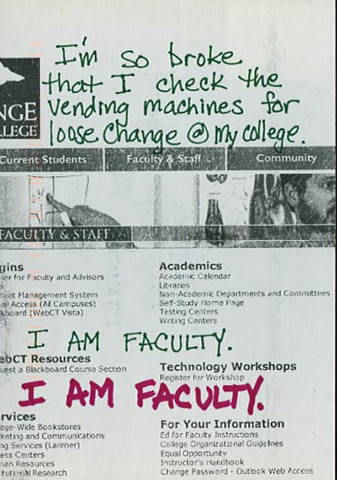
  • Adjunct Profs, Academic Poverty & the Quixotic Quest for a Tenure-Track position

    Three articles about the steady decline of tenure. A lot of stories about adjunct teachers.

    Also worth mentioning that for these kinds of columns warning about the job market, it’s just as important to read the comments by disaffected academics as it is to read the actual article. In fact, because most of the time the articles are being written by well-intentioned tenured academics, they could possibly be – by definition – the ones least likely to see the problems at ground level. 

    After reading the replies, I felt inclined to write my own response. I had some nuggets of wisdom to impart. But after typing two paragraphs, I realized that my contribution to this debate was trivial; I did not actually have to live the life that commenters despaired about; there was no way I really understood what it felt like (except the personal testimony who followed market signals and avoided college teaching).  image


    image Under the fold  are several dozen commenters on the subject. They will tell you what life in academia is really about.  People in the humanities seem to be particularly hard-hit; it’s amazing how different the perspective of people in professional and science programs can be from people who stuck it out in the humanities. These people ought to be respected, not vilified. Ok, now the comments: 

    (more…)

  • July Linkdump Social/Political 1

    Why is it standard operating procedure  for beauty pageant contestants to favor world peace & world leaders to favor war? — Constant Weader

    I’ve become a real fan of Constant Weader whose  realitychex blog covers a lot of the usual liberal haunts for commentary and analysis in a succinct & entertaining way. I found out about this woman by seeing the URL on all the great comments she made on NYT articles (which she generally reposts on her blog).

    Where  should one  go to read about current events? Reading the NYT headline page is a safe choice. For a while I would go to ThinkProgress/Matt Yglesias site, but I like the idea of checking an offbeat blog for a summary of the good stuff in NYT.

    By 2015 75% of American adults will be overweight or obese, and 41% will be obese.

    According to recent studies, as many as one in five girls between 10 and 18 years of age are now cutting themselves with razor blades or burning themselves with matches (according to Leonard Sax).

    In other words, the girls who are most successful at meeting gender-specific societal expectations appear to be just as likely as other females to be cutting themselves.  Not so for boys.  How come?  That’s one of the questions I try to answer in my book Girls on the Edge.  My bottom line is that these pretty girls are searching for a sense of self that’s not about how they look, but about who they are.  We reward them for how they look but we — i.e. American society — are much less interested in what’s going on inside.  Self-cutting fills that need for some of these girls — just as anorexia does for others, and obsessive perfectionism does in others.

    According to a Chronicle report, white children make up less than 8 percent of the Houston ISD enrollment… None of the 181 Texas state lawmakers are Hispanic Republicans.

    According to this NPR Article:

    "Children of parents who reported having a rule about bedtime scored about 6 percentage points higher on an assessment of their vocabulary compared with children whose parents did not report a rule about bedtime. They scored 7 percent higher on assessments of early math skills."

    Health care information site. Good and easy to find things.

    Melvin Goodman on how much of the defense department is privatized and lacking in accountability:

    Nearly a quarter of the federal budget is devoted to contracts to the private sector, with the new Department of Homeland Security and Office of National Intelligence serving as conduits for this money.

    Private contracts are now responsible for 70 percent of the intelligence budget, and private contractors represent more than half of the employees of the new National Counterterrorism Center. The trumpeting of "cyber war" marks the next cash cow for the defense industry.

    See 2 other articles by Melvin Goodman here and here.

    Steve Benen and commenters debate the soul of the Washington Post. I think the downfall began when Bob Woodward started writing Tell-All books about the Bush Administration.

    Realclimate asks whether we can provide different levels of reporting for differing proficiency levels.

    Joe Keohane reports on how brain science is finding that people cling to certain political beliefs, regardless if proven wrong.

    People ignorant of the facts could simply choose not to vote. But instead, it appears that misinformed people often have some of the strongest political opinions. A striking recent example was a study done in the year 2000, led by James Kuklinski of the University of Illinois at Urbana-Champaign. He led an influential experiment in which more than 1,000 Illinois residents were asked questions about welfare — the percentage of the federal budget spent on welfare, the number of people enrolled in the program, the percentage of enrollees who are black, and the average payout. More than half indicated that they were confident that their answers were correct — but in fact only 3 percent of the people got more than half of the questions right. Perhaps more disturbingly, the ones who were the most confident they were right were by and large the ones who knew the least about the topic. (Most of these participants expressed views that suggested a strong antiwelfare bias.)

    Studies by other researchers have observed similar phenomena when addressing education, health care reform, immigration, affirmative action, gun control, and other issues that tend to attract strong partisan opinion. Kuklinski calls this sort of response the “I know I’m right” syndrome, and considers it a “potentially formidable problem” in a democratic system. “It implies not only that most people will resist correcting their factual beliefs,” he wrote, “but also that the very people who most need to correct them will be least likely to do so.”

    Other insights: people with wrong ideas are more likely to change when presented with direct contradictory evidence; just showing them an article doesn’t do any good. Self-esteem has something to do with it:

    Nyhan worked on one study in which he showed that people who were given a self-affirmation exercise were more likely to consider new information than people who had not. In other words, if you feel good about yourself, you’ll listen — and if you feel insecure or threatened, you won’t. This would also explain why demagogues benefit from keeping people agitated. The more threatened people feel, the less likely they are to listen to dissenting opinions, and the more easily controlled they are.

    Alan Bellows talks about how the 1985 New Coke marketing campaign overlooked the tendency of people to develop irrational reactions based on groupthink. The concept is informational conformity, defined as “the human tendency to unconsciously adjust one’s opinions to correlate with the outspoken views of the social group.”

    Informational conformity was first formally documented by Dr Muzafer Sherif in 1935, when he placed a group of subjects in a dark room with a single point of light in the distance. He asked them to estimate how much the light moved around, and although each person perceived a different amount of movement, most of them relinquished their own estimates to conform to the predominant guesses within the group. In reality, the light had not been moving at all; it only appeared to move because of the autokinetic effect, a quirk in visual perception where a bright point of light in complete darkness will appear to wander. It is thought that this imagined movement occurs due to the lack of a fixed visual reference point, and it may be the cause of many nighttime UFO sightings.

    (Michael Tobis relates this groupthink tendency to climate change).

    (I remember that era well, and New Coke was on everybody’s minds, even to the point where during a homily, my parish priest held up a can of New Coke and asked rhetorically whether there were more important things to worry about).

    David Corn explains why Politifact sometimes gets things only half-right:

    Yet PolitiFact didn’t evaluate Cheney’s remark. So here’s the real problem: Huffington made a charge that was rooted in reality. Cheney responded with a statement that had no basis in reality. Yet PolitiFact zeroed in only on the former and let the real lie escape. True, Huffington had dared PolitiFact to review her remark. But Adair and his intrepid band were free to expand the mission. The greater public service would have been to compare Huffington’s and Cheney’s comments and determine who was closer to the truth. This is where PolitiFact truly fell short.

    Matt Thompson talks about how news media drowns you with episodic content when  we yearn for  system content: 

    Chances are that most of the information you’ve encountered about this subject has been what I’d call episodic. Over time, you may have heard a lot about budget reconciliation, insurance premium hikes, the public option, the excise tax, the Wyden-Bennett bill, the Stupak amendment, and on and on and on. You know that Democrats are trying to do something to the health care system, but it’s either a government takeover or an insurance industry giveaway. Hard to tell.

    This constant torrent of episodic information is how many of us encounter information about current events. This has been true for as long as any of us has been alive, but in the wake of the real-time Web, it’s become ever more constant and ever more torrential.

    Hundreds of headlines wash over us every day. And part of why many of us engage in this flow is because we have faith that over time, this torrent of episodic knowledge is going to cohere into something more significant: a framework for genuinely understanding an issue. And we live with it ’cause it sort of works. Eventually you hear enough buzzwords like “single-payer” and “public option” and you start to feel like you can play along.

    See also:  Matt Thompson on 3 key parts of news stories you don’t usually get. Later Thompson describes 5 ways journalists can improve the news:

    You might have heard about Politico’s notorious goal of “winning the morning,” i.e. finding a scoop that’ll lead each day’s news cycle. That’s great, if you’re content with your stories having about as much impact as a popular tweet. Too many of us follow Politico’s lead.

    Instead, try to win the story. Aim to produce a work of journalism so excellent it’ll get passed around for weeks. Put your best storytelling chops to work on this. Try to supplant Wikipedia as the top Google result for your topic. This might not be a single article; it might be a nicely-packaged collection, a wiki, or something else you devise. The key is that it should be long-lasting and distinctive.

    Essay on the same topic by  Tristan Harris and Jay Rosen. Also Thompson has 10 questions journalists should ask themselves.  Also, there is a modest amount of discussion on the Future of Context website even though it doesn’t seem to be actively maintained.

    10 Mistakes JFK Jr. on the day his plan crashed. Interesting insights into the minds of nonprofessional pilots.

    Beijing and Mexico City have the worst traffic congestion. Houston has one of the best.

    Robert Sullivan on new ways to use buses in mass transit to improve efficiency:

    Flexibility remains the bus’s chief advantage—unrailed, they can go wherever we want them to go—and they’re a relative bargain. But over the last decade, in a few transit-enlightened cities around the world, the bus has received a dramatic makeover. It has been reengineered to load passengers more quickly. It has become much more energy-efficient. And, most important, the bus system—the network of bus lines and its relationship to the city street—has been rethought. Buses that used to share the street with cars and trucks are now driving in lanes reserved exclusively for buses and are speeding through cities like trains in the street. They are becoming more like subways.

    For me, this leaves out another obvious issue: decentralized mass transit system protects  against terrorist attacks.

    Great list of reasons why using cameras to give traffic tickets is a bad idea. (PDF Alert). I would add:

    • Before these red light cameras, were we facing an outbreak of people running red lights? In my experience, I haven’t seen much redlight running….
    • There are reasons to run red lights on occasion. But the ticketing process makes it impossible for the ticket recipient to have a specific memory about the incident in question (which would be necessary to defend himself). If there were a way for the ticket recipient to be receive immediate feedback about the violation, my opposition would be greatly reduced. But if I receive a ticket and a photo in the mail two weeks later, chances are I will have no memory of this specific incident (and be powerless to oppose it).

    Here’s one reason that I could find persuasive: saving police manpower! If police don’t have to handle routine stops, that could free up their time to do more pressing things. But the benefits of that would have to be proven. For example, traffic tickets may be a good excuse to stop cars exhibiting suspicious behavior.

    My personal problem with camera tickets is that I don’t know the threshold for ticketing. If i follow a car across when the light is yellow, I don’t know if that would be considered a violation. Are the firms looking for egregious cases? Somehow I feel that if there is revenue involved, the tendency will be to fine all people who meet some minimum threshold.

  • Pushback on Social Media

    Mike Phillips on Digg being dead:

    The biggest problem with Digg in the past was that unless you devoted serious time to it and knew how to work the system, you had little hope of ever making the front page. The only stories that made the front page were typically those voted up by voting blocs; networks of like-minded individuals attempting to send streams of traffic to each others’ sites no matter the content of the story. And if you didn’t make the front page, the benefits were very little, if any. Now, you still will need to dedicate serious time to the site — only this time you won’t receive near the level of exposure. That is, unless your "friends" vote up your stories at a breakneck pace. Which, for all intents and purposes, puts us right back where we started with Digg. In other words, there’s no innovation here and the real value proposition of Digg hasn’t changed, it’s just become more labor intensive.

    In the soon-to-be end, Digg will become known as the first network to die from social fatigue. Facebook and Twitter are booming, LinkedIn is holding steady and even MySpace seems to have settled into a niche. But Digg is in a deadly, unrecoverable tail spin. The fact is, people — real people — are beginning to tire. Submit this, upload that, vote on this, "like" that, be my "friend", check in here, suggest this, retweet that … there’s already so much to do. The only thing left to "Digg" is a grave.

    Charles Arthur writes a longer article examining why Digg’s web traffic has been going down. Apparently, the axing of the Diggbar and changes in Google’s algorithm had more to do with it than any social filtering trend.

    By the way, I had already predicted Digg’s downfall in 2006 and even expressed the opinion that Digg and Gawker Media  was evil. By now of course, Facebook and Twitter are out-meta-ing everybody.

    Joanne McNeil says that Facebook is the new AOL:

    when I heard about the “poke” feature that did it for me. It indicated the creators just weren’t serious about making something that could be more than a place for goofing around in a perplexingly formal way. “Poke” is the dumbest and worst feature ever invented for a social network. Even worse than that “suggest a match” thing on Friendster back in the dark ages (I still turn bright red and wince thinking of the time a less than socially savvy pal suggested a match for me with the person I had a crush on at the time.) I don’t really like when people lay out “best practices” for social networking like, “oh, she doesn’t @ reply enough people on Twitter.” And “netiquette” very often neglects the fact that introvert/extrovert classifications also exist in the digital world. But no, there’s never a good time for a poke. (Why stop with the poke? Why not call me and hang up before answering? Why not send me a blank email with no subject? Why not blank @ me?)

    …Facebook epitomizes filter failure for me. Yes, there are ways to segment information and keep groups, but there aren’t very good ways to keep worlds from overlapping. Facebook isn’t a more neutral LinkedIn and Myspace. It is the collapse of LinkedIn, Myspace, and a bunch of other networks, while many people want these worlds compartmentalized. I mostly avoid Facebook the same way that I’ll get drinks on a Monday night with colleagues, but not on a Friday or Saturday night. This generation blurs the line between work and play, but there is still a line or else you’re not getting the best out of either.

    Now, this is my experience with Facebook. I don’t doubt there’s value to it for lots of people. I like it as a visual rolodex, and if I were a heavy user, I can see the advantage of adding just about everyone you meet at a conference or class as a “friend.” But mainly my use of Facebook is transitionary. I import my contacts to newer, hopefully better social networks as they come along like Foursquare or Quora.

    McNeil also talks about how social media collides  with her tendency towards introversion.

    I spend a lot of  time on Facebook, mainly as a microblogging platform. That’s right. I’m cheating on this blog by posting a lot of things first on FB. (I eventually catch up though, so you never miss anything on my blog; things just arrive late).

    One reason I like Facebook is that acquaintances will actually read the things I post. That is gratifying.  With bloggers you never know if you are being read by anyone (except by other bloggers, and even that audience has been diffusing over time). One reason I started blogging was so I wouldn’t have to clog people’s emails with missives and shareable articles. I wanted the Robert Nagle Show to be a purely optional experience. But with blogging you go to the other extreme.  Friends almost never read my posts except in special cases. Perhaps it’s a generational thing. (People in my age bracket don’t use news aggregators). Or it may be that every blogger overestimates the value of his own postings (and  friends don’t have the heart to break the news to him).  Another  reason has to do with frequency of postings. Nonbloggers don’t have an easy time following infrequent bloggers. I post 2 or 3 times a week normally (if not more). But that is not often enough to make it worthwhile to check here regularly.  It is common for me to completely lose track of certain bloggers for long stretches of time simply because I forget to catch up on their posts in my news reader. . 

    With Facebook I get the sense that people actually read my microposts.  About 40% of my microposts are political, but actually, I do it only if I find an unusual news source that nobody is likely to stumble upon. Moreover, I limit myself to maybe one or two microposts on Facebook per day. I’ve been tempted to micropost more often, but I know that  more than that will simply clutter up people’s   friendstreams. The world can take Robert Nagle only in small doses.

    Some of my microposts are advocacy-oriented (“Pass a climate change bill”, etc), but I’ve drifted away from those  over time. The main reason is that on facebook you are dealing with acquaintances who don’t share your values. Conflicts occur.  There is nothing more futile or awkward or cumbersome  than trying to have an intelligible discussion on a Facebook thread. An acquaintance of mine who friended me on Facebook posted lots of offensive political comments on my posts.  He did it purely for trollish reasons, but it’s hard to ignore trolls. 

    What I like most about Facebook is that you are exposed to people who don’t share your values or curiosities. What things interest them? Perhaps I spend more time online (and find more interesting things in general) than most people. But  having conservative or less-wired friends on my friendfeed give me a glimpse of what kinds of things these people find superficially important.  A few of my conservative friends probably never get a chance to hear about climate change articles. Sure, they probably dismiss everything I micropost about on Facebook (typical eco-liberal hogwash), but at least they are coming in contact with it occasionally. Mission accomplished.

    My main complaints with Facebook are not about commercialism or privacy, but the fact that walled gardens can’t be easily  archived. Indeed, that is the point. Facebook has intentionally made it difficult to see items  posted more than a week ago. There is no way you can search old posts, and if you want to view something you or a friend  microposted a few months ago, you have to manually click a lot of hyperlinks to expand your old posts. Facebook (like Twitter) is about conveying ephemera – certain in the knowledge that in a few weeks this ephemera will be gone.

    Although this affords a new kind of freedom, it is contrary to the writer’s main mission – to create enduring messages and stories.

    Last week I met a meatspace friend  who has been following my microposts pretty closely on FB.  He and I share a lot of interests. He expressed amazement that I had a blog and  2500 posts on it. Even though I micropost fairly often on Facebook, I generally do not link to  my blog (unless there is a special reason – maybe once or twice a month). Generally I am happy keeping those two identities separate. My blog is for writers/intellectuals/geeks. My facebook microposts are for people who are not always wired, who have a family, who just want to share dog photos and snarky remarks.  

    Facebook will lose its prominence eventually, but for now I am happy with what it is (and isn’t). It’s conceivable that I could resign from it as a microposter, but I probably would still follow people’s feeds on Facebook – because there is no other way to obtain this content otherwise. 

    One final thought. My mother has criticized me on more than one occasion for spending too much time on facebook. I had to laugh. I spend hardly any time on Facebook. Maybe 15 minutes on posting and a little longer clicking on links that interest me.  Perhaps in a later post I could talk about the online activities which eat up my time, but rest assured that Facebook is only a small part of it. 

    Postscript: Here’s how to specify that a certain FB friend cannot make a comment on your microposts.  Privacy Settings –> Custom –> Customize Settings. On Things Others Share, select Can Comment on Posts –> Choose the dropdown list –> Custom Edit –> Hide this From and type the name of the individual in the text box. It should prompt you for names. Choose Save Settings. Whew! I didn’t realize it was so complicated!

  • Linkdump: Takedowns, smokers and dying culture

    Tom Slee has a good takedown of the anecdote-based arguments of Clay Shirky.

    But stories and analogies should be a starting point for thought, and not its terminus. They should be the spark that prompts more analytical, more rigorous investigation and introspection, testing out your idea to see where it fits reality and where it fails. In this essay, and in some of his others (see below) anecdotes are all there is, and that’s just not good enough.

    Slee alludes to Shirky’s statement that Charlie Bit My Finger youtube video was the number 1 video and that it suggested the paradigm-shifting nature of user-generated content away from complex production models. Except it isn’t. In fact, Slee says:

    the most watched video made in the last five years shows Lady Gaga and a group of hired models dancing on an elaborate set in a video that embodies complex production methods, that is part of the Vevo channel (a joint venture between Google and major record labels) and that features product placements by Nemiroff Vodka, Parrot by Starck, Carerra sunglasses, and HP Envy  [link]. Now there is a complex business model.

    That’s the thing about anecdote-related pieces. People can refute your larger point simply by mentioning extra details about the anecdote that show it’s not typical or valid any more. Actually,  you have to give credit to popularizers like Shirky, Friedman and Gladwell.  Making your prose interesting and readable is the hard part; fixing the logical errors is not as much of a challenge.

    Daniel Seidemann counters the logic of pro-Israelis about Jerusalem settlements

    93 percent of Israel – including most of West Jerusalem and the 35 percent of privately-owned land in East Jerusalem expropriated by Israel since 1967 – is categorized by Israel as "State Land." Only Israeli citizens and those entitled to immigrate under the Law of Return may acquire properties on this land. Palestinians of East Jerusalem, with rare exception, are in neither of these categories. So while Wiesel may purchase a home in anywhere in East or West Jerusalem, a Palestinian cannot.

    Since 1967, Israel has built more than 50,000 dwellings for Israelis in East Jerusalem, but has built fewer than 600 for Palestinians (the last was built 35 years ago). And from 1967 until today, as East Jerusalem’s Palestinian population increased from 70,000 to 280,000, Israel has issued only 4,000 permits for private Palestinian construction in East Jerusalem. Barred from building legally, the Palestinians built without permits – leaving them subject to Israeli demolition of their "illegal" homes.

    Today extreme settler groups have launched a campaign to evict Palestinian families – refugees of Israel’s War of Independence – from densely-populated Palestinian neighborhoods in the heart of East Jerusalem. They are doing so based on the "right" of Jews to recover properties lost in the 1948 war. But under Israeli law Palestinians have no such right. So while Israel insists that Palestinians renounce any "right of return" – something understood as necessary for the two-state solution – it is implementing a Jewish right of return to Palestinian neighborhoods in East Jerusalem, and turning 1948 refugees into 2010 refugees.

    Karl Levin has a testy exchange with Goldman Sachs CEO about shitty deals.

    Paul Krugman criticizes Mitch McConnell’s false logic for opposing new banking regulations:

    "And basically, the (Republican) argument boils down to saying that what we really need to do to deal with fires is abolish the fire department. Because then people will know that they can’t let their buildings burn in the first place, right? It’s incredible. So anyone who says bipartisan, should say, bipartisan doesn’t include the Senate minority leader."

    Jane Brody reports that teenagers engage in risky behavior not because they are oblivious to the risk but because they perceive the benefits of them as being greater or more important. Fascinating!

    Jonathan Schwarz lets us know about a South American mining tragedy that resulted in 8 million miners being worked to death.

    Wow, a great insight in an article about a terminally-ill blogger by Madison Park:

    "What we’re seeing over the last decade, we are gradually moving from a culture that had become during the 20th century, very closed about death," said Dr. Chris Feudtner, research director of Palliative Care Services at the Children’s Hospital of Philadelphia in Pennsylvania.

    A cultural shift has occurred, he said, referring to columnists and Randy Pausch, a computer science professor at Carnegie Mellon University, who discussed their impending deaths with frankness. Pausch’s last lecture, urging students to fearlessly pursue their dreams, went viral on YouTube in 2007, getting more than 11 million views.

    Their line of thinking may be, "I’m still alive. I don’t want to be closed. I want connection. I want to be able to share what I’m learning on this journey," Feudtner said.

    Bloggers like Miles Levin, an 18-year-old who had a rare soft-tissue cancer and died in 2007, and Michelle Lynn Mayer, a 39-year-old mother who had scleroderma and died in 2008, shared their thoughts on living and dying, too.

    "We all tend to be open via video, blog or Facebook about what we do every day. It’s hardly surprising that openness extends to people’s last days or weeks," said Dr. David Cassarett, author of the book "Last Acts," about end-of-life decisions.

    These bloggers, Cassarett said, are helping the rest of us through largely uncharted territory. He used a sports analogy to explain.

    "Hardcore bicycle riders ride in packs, and there’s a tradition," he said. "The one in the front points out hazards in the road to those who come behind. It’s both an opportunity to be helpful, if you’re in front. You spot sewer grates, so others can avoid accidents."

    Blogs like Markvoort’s could be acting similarly, he said. They don’t shy away from the ugliness and brutality of the dying process.

    "They’re not just about hope but also about despair. That is, they’re telling us not just what we want to hear but also what we need to hear," Cassarett wrote.

    This is a great insight. The sick and the elderly are easy to overlook especially because they don’t get out of doors as often. But information travels quickly over the Net, and unless one is a hermit, one is active on Facebook or blogging or some web-community. This network becomes a way for people to keep up with you. This happened to a friend of mine who has breast cancer.  It is convenient to have people check her blog for the latest anecdote. Web communities and blogging tools allow for more introspection than we used to have. Before that  we had poetry and prayer and churches and hospital socializing.

    1/4 of boys in Indonesia between 13 and 15, Margie Mason reports:

    As smoking has declined in many Western countries, it has risen in Indonesia — about 63 percent of all men light up and one-third of the overall population smokes, an increase of 26 percent since 1995. Smoking-related illnesses kill at least 200,000 annually in a nation of 235 million

    "If Kelly Clarkson goes ahead with the concert, she is by choice being a spokesman for the tobacco industry and helping them to market to children," said Matt Myers, president of the U.S.-based Campaign for Tobacco-Free Kids, which has urged Clarkson to drop the sponsorship.

    "She has the power now to turn this situation around and to send a clear message to Indonesian young people and, frankly, to the young people of the world."

  • What percent of Americans have health coverage from their employer?

    Here are some statistics which I found in an October 2009 report from the Economic Policy Institute (available only in PDF).  A cautionary note: a lot of the percentages depend on knowing exactly what category is being spoken abo0ut. All of the statistics are about working-age Americans under 65 unless otherwise specified.

    In 2008, 62% of Americans (working & not working)  had health insurance with employer-sponsored insurance (ESI).  The percent decreased from 2000 where it was 68%.

    But in 2008,  70% of all employed   Americans  between 18-64  had ESI.

    Source of insurance coverage for people under 65 in 2008 :

    • employer insurance 62%
    • individually-purchased insurance 6.5%
    • public insurance   20%
    • No insurance  17%

    In Texas, working-age Texans with ESI was 59% in 2000 and 52% in 2008

    In 2008, 74% of full time workers had ESI; 51% of part-time workers do.

    Characteristics of uninsured workers in 2008 by income:

    • 39% were in the bottom 20% of income
    • 27% were in 20-40% range of income
    • 16% were in the 40-60% range of income
    • 9.5 were in 60-80% range of income
    • 7.4% were in  the top 20% range of income

    In 2008, out of the uninsured, 75% are working full time; 25% are part-timers or unemployed.

    In 2008, 55% of full time workers with only a high school education had ESI (a drop of 10% since 2000)
    In 2008, 79% of full timers with college degrees had ESI (a drop of 3% since 2000)

    Economic Policy Institute summarizes:

    One of the clearest indicators of the deepening recession is the unemployment rate. In 2007, the most recent peak year, the unemployment rate was 4.6%. Average unemployment rose modestly to 5.8% in 2008. The unemployment rate this year is expected to average 9.3% and reach 10.2% in 2010 (CBO 2009). This dramatic increase in unemployment over this recession is one of the worst on record (Shierholz 2009).

    While employer-sponsored health insurance remains the predominant form of health coverage for the under-65 population, when people lose their jobs, they often lose access to their health insurance. Therefore, the modest declines in ESI from 2007 to 2008 are likely to be exacerbated in the future by the sharp rise in unemployment from 2008 to 2009 and 2010. Research has shown that a 1.0 percentage-point increase in the unemployment rate is associated with a 0.9 to 1.0 percentage-point decline in the share of the under-65 population with ESI (Holahan and Garrett 2009; Cawley and Simon 2003).

    The under-65 rate of employment-based coverage was 61.9% in 2008, down 1.0 percentage points from 2007. It can be expected that the ESI coverage will drop another 3.2 to 3.5 percentage points in 2009 and nearly another point in 2010. These projections suggest that by 2010, another 10 million fewer people under 65 will have their employer-sponsored health insurance.

    While not one-for-one, a drop in ESI coverage is strongly associated with a rise in the number of uninsured Americans, only lessened by increases in public coverage (particularly among children). Using an association found between unemployment and the uninsured detailed in Gruber and Levitt (2002), it is predicted that the current number of nonelderly uninsured will be at least 50 million by years end and may rise another million in 2010.

  • Just the facts, Ma’am (Facts to enlighten our political discourse)

    Bruce Bartlett on the actual IRS rates vs. perceived rates:

    According to the CBO, the highest figure for all federal taxes since 1970 came in the year 2000, when they reached 20.6% of GDP. As we know, after that George W. Bush and Republicans in Congress cut federal taxes; they fell to 18.5% of GDP in 2007, before the recession hit, and 17.5% in 2008.

    Tuesday’s Tea Party crowd, however, thought that federal taxes were almost three times as high as they actually are. The average response was 42% of GDP and the median 40%. The highest figure recorded in all of American history was half those figures: 20.9% at the peak of World War II in 1944.

    To follow up, Tea Partyers were asked how much they think a typical family making $50,000 per year pays in federal income taxes. The average response was $12,710, the median $10,000. In percentage terms this means a tax burden of between 20% and 25% of income.

    Of course, it’s hard to know what any particular individual or family pays in taxes, but according to IRS tax tables, a single person with $50,000 in taxable income last year would owe $8,694 in federal income taxes, and a married couple filing jointly would owe $6,669.

    But these numbers are high because to have a taxable income of $50,000, one’s gross income would be higher by at least the personal exemption, which is $3,650, and the standard deduction, which is $5,700 for single people and $11,400 for married couples. Owning a home or having children would reduce one’s tax burden further.

    According to calculations by the Joint Committee on Taxation, a congressional committee, tax filers with adjusted gross incomes between $40,000 and $50,000 have an average federal income tax burden of just 1.7%. Those with adjusted gross incomes between $50,000 and $75,000 have an average burden of 4.2%.

    Even though the Tea Partyers were specifically asked about federal income taxes, it’s possible that they were thinking about other federal taxes as well, such as payroll and excise taxes. According to the JCT, when all federal taxes are included, those earning between $40,000 and $50,000 have an average tax rate of 12.3%, and those earning between $50,000 and $75,000 pay a rate of 14.5%.

    To be fair to the Tea Party dimwits, these taxes are paid to the same source (IRS); it’s not easy distinguishing Social Security from IRS taxes if both come out of your paycheck. Adding to this perception are state-based taxes, which take the form of sales-taxes and property taxes. In Texas, the sales tax in my district is 8.25%. Contract workers are used to paying 16% off their income (which combines Social Secure/Medicare/IRS), so if you throw the rest of the taxes in, it’s not unreasonable to guess it being over 25%.  Also, I’d be curious about how much higher the rates are if your household income is closer to 100,000.

    After Obama’s announcement that the East Coast would be potentially open for offshore drilling, here are estimates about how it will affect the oil supply from EIA:

    … access to the Pacific, Atlantic, and eastern Gulf regions would not have a significant impact on domestic crude oil and natural gas production or prices before 2030. Leasing would begin no sooner than 2012, and production would not be expected to start before 2017. Total domestic production of crude oil from 2012 through 2030 in the OCS access case is projected to be 1.6 percent higher than in the reference case, and 3 percent higher in 2030 alone, at 5.6 million barrels per day. For the lower 48 OCS, annual crude oil production in 2030 is projected to be 7 percent higher—2.4 million barrels per day in the OCS access case compared with 2.2 million barrels per day in the reference case (Figure 20). Because oil prices are determined on the international market, however, any impact on average wellhead prices is expected to be insignificant.

    Similarly, lower 48 natural gas production is not projected to increase substantially by 2030 as a result of increased access to the OCS. Cumulatively, lower 48 natural gas production from 2012 through 2030 is projected to be 1.8 percent higher in the OCS access case than in the reference case. Production levels in the OCS access case are projected at 19.0 trillion cubic feet in 2030, a 3-percent increase over the reference case projection of 18.4 trillion cubic feet. However, natural gas production from the lower 48 offshore in 2030 is projected to be 18 percent (590 billion cubic feet) higher in the OCS access case (Figure 21). In 2030, the OCS access case projects a decrease of $0.13 in the average wellhead price of natural gas (2005 dollars per thousand cubic feet), a decrease of 250 billion cubic feet in imports of liquefied natural gas, and an increase of 360 billion cubic feet in natural gas consumption relative to the reference case projections. In addition, despite the increase in production from previously restricted areas after 2012, total natural gas production from the lower 48 OCS is projected generally to decline after 2020.

    After a family member forwarded a bogus rant about the unconstitutionality of health care reform, I found that the Wyden amendment specifically allows states to opt-out and devise their own solution. It states:

    b) Granting of Waivers-
    (1) IN GENERAL- The Secretary may grant a request for a waiver under subsection (a)(1) only if the Secretary determines that the State plan—
    (A) will provide coverage that is at least as comprehensive as the coverage defined in section 1302(b) and offered through Exchanges established under this title as certified by Office of the Actuary of the Centers for Medicare & Medicaid Services based on sufficient data from the State and from comparable States about their experience with programs created by this Act and the provisions of this Act that would be waived;
    (B) will provide coverage and cost sharing protections against excessive out-of-pocket spending that are at least as affordable as the provisions of this title would provide;
    (C) will provide coverage to at least a comparable number of its residents as the provisions of this title would provide; and
    (D) will not increase the Federal deficit.

    Supreme Court reporter Linda Greenhouse piles on. Igor Volsky speculates that Scalia has already made up his mind about the constitutionality issue.

    In other news, the House of Commons exonerates Alex Jones of any ethical or professional wrongdoing with the CRU hacked emails. IPCC’s Pachauri is cleared of financial wrongdoing and (a while back) Michael Mann is vindicated (and so is his hockey stick data). Funny, these spurious charges all made the front page of the NYT website; where are the retractions?  I expect the same lame hockey stick criticism to keep getting recycled for the next century.

  • Shallowness of Sunday talk shows

    I noticed that mediamatters is now  factchecking the statements made on  the Sunday talk shows. I don’t know how hard this is, but it’s extremely convenient to have this as a reference.  Up until recently, TV commentary was provided only on Sunday talk shows. Now with 24 hour cable, we have news commentary shows that appear in Prime Time.  The fact that political shows seem to be successful at prime time or late night on weeknights indicates how politicized a country we have become. 

    Steve Benen comments on the shallowness of Sunday Talk shows:

    ABC’s "This Week" held its usual roundtable discussion this morning, with Elizabeth Vargas hosting a panel of Cokie Roberts, Sam Donaldson, George Will, and Paul Krugman.

    The last topic of conversation was introduced by Vargas this way:

    "[O]f course, this weekend, we have a brand-new White House social secretary appointed to replace Desiree Rogers, a close friend of the Obamas who is exiting after a bumpy tenure, I would say. Cokie, you spoke with her. She — she was highly criticized after the Obamas’ first state dinner in which she arrived, looking absolutely gorgeous, but in what some people later said was far too fancy a dress, but most importantly, that was the state dinner that was crashed by the Salahis, who walked in without an invitation when the social secretary’s office didn’t have people manning the security sites."

    This led to a surprisingly long chat about Desiree Rogers.

    Krugman sat silently while the discussion went on (and on), before eventually interjecting:

    "Can I say that 20 million Americans unemployed, the fact that we’re worrying about the status of the White House social secretary….

    Donaldson responded, "Paul, welcome to Washington."

    Steve Benen comments:

    But this panel discussion covered exactly four subjects this morning: health care reform, Charlie Rangel’s ethics problem, David Paterson’s latest troubles, and the fate of the former White House social secretary (and where she’s from, what her clothes looked like, what her next job is likely to be, etc.), which hardly seems relevant to anyone who doesn’t actually attend social events at the White House.

    In this same discussion, there was nothing about the jobs bill that passed the Senate this week, nothing about the incredibly important Zazi guilty plea this week (and the fact that it makes Republican talking points look ridiculous), nothing about Jim Bunning single-handedly delaying unemployment insurance for those who need it.


    (Wow, am I the only one who missed the fact that Zazi plead guilty!?

    The people at Washington Monthly have funny observations about this exchange:

    Donaldson responded, "Paul, welcome to Washington."

    Longer Sam Donaldson: "Washington is a fundamentally unserious place, completely removed from and uncaring about the problems afflicting ordinary Americans. Deal with it."

    ***

    The Sunday morning talk show is the Washington Beltway Establishment on parade. In no other place can you expect to see a party now controlled by its radical fringes, where elected Republican lawmakers are no longer in charge of their party must instead take orders from their far right factions, cable news broadcasters and talk radio demagogues. And yet they are still treated as royalty on these shows, fully the equal with Democrats who have won the past two elections.

    There is an unspoken code on these shows, and one of them is not to notice that Republicans have completely lost their minds. Watching insiders like David Gregory and George Stephanopolous preside over these farces you really start to believe that Washington has become another Court of Versailles.

    ***

    "Hey Krugman! Here’s a Nobel Prize in Shut Yer Mouth!"

    ***

    This is just standard high school stuff. The popular kids let one of the brainy nerds (Krugman, Maddow) sit at their table, but the eggheads always wanna talk about boring ol’ policy instead of wailing on the unpopular girl’s clothes and hair. "Welcome to Washington" = Like, what-ever.

    ***

    "Paul, welcome to Washington."

    Google Translate:

    "Paul, most of us can’t even get our kids into Princeton, much less teach there. We rise through sycophancy and ingratiation, and we assume that, being trivial ourselves, that the rest of the world is not. We don’t consciously try to create a tableau vivant from the pages of Laclos–or unconsciously either; for people like us, "Dangerous Liaisons" is that movie where Uma Thurman takes her top off. So go back to New Jersey and worry about the little people, while we go off to Sally’s brunch."

    ***

    "I wonder, who was the target audience for the discussion of Desiree Rogers…"

    The same as the audience for the Rangel and Paterson stories–namely, people who enjoy hearing about black people screwing up.

    I no longer watch the Sunday talk shows. (Wolf Blitzer does a good job – if you can stand the commercials). Fareed Zakaria’s GPS is by far the most cerebral shows out there. I just love how occasionally CNN will give a prime spot to someone who actually knows what they’re talking about.

    Let me see. What is my multimedia news diet these days?

    • PBS Newshour (occasionally, but especially Friday with Shields & Brooks)
    • Washington Week in Review (smart reporters give the inside scoop on everything)
    • Bill Moyers (still the best; see also NOW on PBS).
    • Best of the Left podcast… Takes snippets from the political satire and commentary shows.
    • Fareed Zakaria’s GPS
    • McLaughlin Report. This retro program features blowhards from all political sides. What I like about it is 1)it lets me hear the loony rightwing talking point of the week (which I would otherwise miss). I sometimes learn a lot of things about political culture – for example that lots of conservatives still deny global warming as a reality. 2)Jim McLaughlin is good at identifying the next big hot issues. I always learn a few new things each time I watch, and it’s not only the extent of right-wing foolishness.
    • Paul Solman Economic Reports on PBS News hour. He’s the best, and frankly, he is good at bridging the gap between academic discussion and concerns of the common man.
    • Red, White & Blue, a Texas political talk show.
    • From Our Own Correspondent, a BBC behind-the-scenes 1st person narrative about the major and not-so-major news stories.
  • Dear Mr. Cornyn and Ms. Hutchinson (RE: Health care)

    (Here is a short complaint letter I sent to my US Senators. I have basically given up on writing these people because they seem to have ideological blinders on (especially Mr. Cornyn).

    Dear Mr. Cornyn and Ms. Hutchinson:

    I wanted to point out one fact: my Aetna individual health insurance rates skyrocketed 40% in 4 months. I am a perfectly healthy person and haven’t visited the doctor in 4 years. (The rates of other companies have gone up considerably).

    That is capitalism. I accept that. What I don’t accept is your failure to participate in any kind of meaningful discussion about health care reform (except in an obstructionist and  jeering way). Solving my particular problem isn’t rocket science: individual mandates coupled with some kind of subsidies for indigent people. Most observers say this is a fair and necessary policy change.

    When I see this 40% increase, I blame YOU  specifically for failing to endorse any comprehensive solution.

    Here are 4 articles I wrote about the subject of health reform.

    http://www.imaginaryplanet.net/weblogs/idiotprogrammer/2010/02/health-insurance-rate-hikes/
    My recent thinking about death spirals and health insurance.

    http://www.imaginaryplanet.net/weblogs/idiotprogrammer/2009/09/health-care-reform-and-medical-bankruptcy-answering-the-libertarian-argument/
    (I know your position papers and mass mailouts are full of the usual libertarian claptrap; I address these concerns in a general way)

    http://www.imaginaryplanet.net/weblogs/idiotprogrammer/2010/02/the-free-market-can-be-a-time-sink/
    How the notion of a free market in health insurance assumes an infinite amount of time and knowledge to make decisions. Some people have this luxury; most do not.

    http://www.imaginaryplanet.net/weblogs/idiotprogrammer/2008/12/how-to-buy-an-individual-health-insurance-policy-in-texas/
    In 2008 I wrote an article for Texans about how to buy individual health insurance.Suffice to say I have looked into  Texas consumer issues in depth.

    I have been tempted to write detailed responses to any one of your misguided missives, but frankly, your arguments are replete with misinformation and industry talking points; why bother? But I’ll throw out random remarks.

    http://cornyn.senate.gov/public/index.cfm?p=NewsReleases&ContentRecord_id=8b8955bf-ac40-4bf8-b54b-edd2ca6197e3
    (RESPONSE: Entitlements is a problem, but not THE problem, which is adverse selection and  death spirals. You are diverting attention away from the REAL problem).

    http://cornyn.enews.senate.gov/common/mailings/?id=314
    I reject the premise of your  article. The Mass Senate victory was fueled by Massachusetts people’s antipathy towards helping states with stingy Medicaid coverage.

    http://cornyn.enews.senate.gov/common/mailings/?id=303
    this article is frankly nonsense. Earmarks are not THE problem here (but they are A problem). This horse-trading is being done because of Republican obstructionism. If you supported  a comprehensive solution, this kind of horsetrading would not need to be done.

    http://cornyn.enews.senate.gov/common/mailings/?id=301
    I’ve seen different numbers than the ones you quote. Also, you haven’t really distinguished your bugaboo from the status quo (which is already swallowing us in health care increases). Also, your complaints would seem to be an argument for single payer.

    http://hutchison.senate.gov/cc010810HealthCare.html
    (I just wanted to say this is one of the vaguest articles I have seen. Transparency is important and a debatable issue with respect to health care reform. but it is a minor side issue).

    http://hutchison.senate.gov/pr122109a.html
    You say the bill was rammed in the middle of the night. This is grandstanding and you know it. You guys had an entire year to debate many provisions of this bill (and I watched hours of it on CSPAN). You can’t on the one hand be obstructionist and at the same time blame Democrats for having to do last minute negotiations as a result of your intransigence.   You can’t pretend ignorance about what was in the bill. Legislation is always a moving target, but to claim that the Democrats are hiding their activity from public scrutiny is dishonest and unfair. (By the way, I sure wish I could have been able to witness the discussions of  Aetna execs when they decided to raise my rates. Oh well, I  guess I won’t be hearing you express any pseudo-outrage about that!)

    http://hutchison.senate.gov/cc121809Healthcare.html
    (At least this gets into specifics! ) My basic response is: so what! You shouldn’t accuse Obama of saying falsehoods without stating the context of each remark (which is that Republican intransigence forced the bill to be reshaped several times).  You talk about more taxes. So what! From my perspective it’s either paying  increased costs to insurance companies or the government. You talk about tax credits. (which I’m semi-neutral about). But so what! You are focusing on the viability of insurance markets when you should be focusing on  health outcomes. Is it a matter of indifference to you that insurance coverage in Texas is one of the nation’s highest and that our Medicaid is one of the stingiest?

    Finally Ms. Hutchinson  you have failed to take responsibility for the increased mortality rates as a result of noninsurance. I would think that in Texas this would be the number one issue. For you, that seems to be hardly worth mentioning. You seem more concerned with preserving a market free of regulation even if it means worse outcomes and  rapidly increasing individual rates.

    That is sad.

    Robert nagle

    Update: This screencapture about summarizes the kind of games Cornyn plays.

    image

  • Health Insurance Rate Hikes

    Ironic Postscript: Hours after I wrote this, I received a note from Aetna informing me of another price increase for health insurance.  Until January 2010 my total price for a $5000 deductible health insurance + dental plan  was $148. Starting January 2010, it bumped up to $184. Starting April 2010, the price is $207.  This seems certainly to be a death spiral.

    What happens if you delay passing individual mandates on health insurance?

    The prices go up, up up! In a Noam N. Levey piece on health care, he notes:

    1. Profits for health insurance co. went up 56% in 2008.
    2. The major insurers covered 2.7 million FEWER people than the previous year.
    3. Health spending as % of GDP went up to 19.3% (it was 13.7%) in 1993.

    The individual health insurance market has gone haywire. My own individual health insurance went up 25%, and in California Anthem’s individual policies had increases up to 39% increases.  When I posted an article about it on Facebook, two people chimed in rate increases of 23% and 50%. Robert Reich notes:

    WellPoint’s profits rose to $2.7 billion last quarter. Even if you subtract one-time-only financial maneuvers, WellPoint is still fat and happy, which makes Anthem fat and happy. Everyone is fat and happy except Anthem’s policy holders, who are being skewered.

    Anthem’s argument is even more questionable when you consider that Anthem has been among the most aggressive opponents of the health-care bills passed by the House and Senate. If Anthem were sincere about why it’s raising its rates, it would be embracing the legislation. The Senate and House bills would add tens of millions of Americans to insurance pools – thereby spreading the costs over more people and avoiding the very problem Anthem says is now forcing it to raise its rates so much.

    Even more troubling is the fact that Anthem obviously believes it can raise its rates by as much as 39 percent without losing every one of its remaining customers with average or even somewhat above-average medical needs. The only way it could possibly raise its rates so high and expect to keep its customers would be if Anthem’s customers have no other choice. In other words, Anthem’s strategy makes sense only if Anthem faces little or no competition from other health insurers.

    I wouldn’t be surprised if this were the case. Insurers, remember, are exempt from the federal antitrust laws. And WellPoint, Anthem’s parent, is the largest insurer in America.

    Caveats are in order. A health insurance spokesman says that the comparisons with when companies were in the middle of recession are not quite fair. Also, average profit margins for the insurance industry are historically low (3% on average).  Rick Newman provides more numbers.

    The problem I have with health insurers is not that they make money, but they that they claim the right to refuse customers while at the same time benefitting from tax subsidies for employer plans. A private insurer can reject a person without answering to the public. Health insurers don’t need 100% coverage; their goal is simply to maximize profits (even if their business plan to cover only athletic 22 year old billionaires). What happens when there’s too much cherry picking and the public has to pay the tab? "Privatize the profits, socialize the losses" seems to be the strategy for the health care industry. And it gets worse:

    Insurance companies last year continued to try to purge their most costly customers, which are often small businesses with older workers, said Richard Kirsch, national campaign manager for Health Care for America Now.

    Another reason for the robust profits, Mr. Kirsch said, is that the companies reduced the percentage of their premiums that they spent on actual medical care and devoted more to administrative costs and profits.

    A third factor, he said, is that the insurers continued to attract more customers to public programs like Medicare Advantage, in which the federal government pays private insurers 14 percent more than it pays Medicare to cover the same people.

    The report said that the insurance industry’s long-term strategy was to shift responsibility for the care of millions of older, sicker and lower-income customers to taxpayer-supported programs, like Medicaid and the state Children’s Health Insurance Program. Those programs in turn are increasingly hiring the big insurance companies — and paying them — to manage the coverage.

    (The full PDF report is worth reading; full of good analysis of facts).

    In addition there is a power imbalance here. Multibillion dollar companies can refuse coverage secure in the knowledge they have a huge legal department and generally sympathetic regulators to prevent the individual from complaining or suing them.

    The justification for the privatized system was that private insurers will step in and provide private insurance for the public. Over the years, this coverage has been declining and becoming massively more expensive. Therefore, the justification for relying on the private system to fulfill a public concern is becoming more suspect.

    My preferred solution (if you take the privatized system as a fait accompli) is individual mandates. Generally people on both political sides agree with that, but disagreed with implementation details (subsidies, tax breaks, etc). Also, libertarian obstructionists have used the failures of the private system as a reason to justify even further use of it. (I’ve written about that here).

    That private strategy is also costing taxpayers a lot of money. We as taxpayers have a right to demand oversight for an industry that is increasing costs 5-10% per year (or 25% increases in the individual market). It’s easy to say, let the market offer better services. I’m sorry, but that hasn’t been happening; not only are costs increasing, but the number of companies offering services is decreasing.

    Update: Kevin Sack reports on the outrage in California.

    Medical costs have typically risen by 5 percent to 10 percent during each of the last five years. Mr. Poizner said he was starting to see significant increases for individual policies sold by some of Anthem’s competitors, and double-digit increases have been reported in other states.

    Several insurance analysts said it was possible, but not necessarily likely, that such increases would become common, at least while the economic downturn persists. Insurance brokers in Los Angeles said they had never seen jumps of such magnitude.

    “It’s more astonishment than irritation,” a Pasadena broker, John W. Barrett, said of the reaction from his customers. “Irritation was last year and the year before. Now they’re astonished.”

  • Health insurance and mortality

    A few months ago I brought up the question of amenable mortality as it relates to health care and insurance.  While the topic seemed interesting to me, I had to admit that the evidence looked questionable. When talking about public policy, it’s nice and convenient to have a way to quantify the number of corpses on the table,  but ultimately that kind of analysis fails to address the big questions for the sake of chasing after the “merely measurable.”

    Matt Yglesias summarizes some of the latest data.

    Ezra Klein covers the subject in more depth after first responding to a point by Megan McArdle:

    What we’re left with is three classes of evidence. The first are the major observational studies attempting to model something difficult to model, which is the causal effect of insurance on mortality. They do their best to control for the confounding factors and find an effect anywhere from 18,000 and 45,000 unnecessary deaths a year. The second are the natural experiment studies. The only one that measures people who are actually facing death in the near-term — and these studies are only really useful in the near-term — finds a 20 percent reduction in death rates. Then there are the many, many studies assessing the effect of insurance on conditions that kill you, like high blood pressure and cancer. And they show a large protective effect from insurance.

    “Policy can’t wait for perfect evidence,” (Harvard health care economist Katherine) Baicker says. “The evidence we have is strong enough that insurance is important for people’s health that one oughtn’t use the excuse of the absence of perfect information for not doing something about it.”

    There are 2 other effects to consider.

    First, delaying medical exams. I have a 5000$ deductible for my individual policy. I have coverage for a physical (up to maximum of $200 including lab work). Practically speaking though, a physical would be expensive. (The last time I went, the doctor ordered a routine test — an EEG — which cost me $700). This is money which comes straight from my pocket, and a strong disincentive for me to get a physical. Do  mortality estimates take into account the reduced number of office visits by people who have insurance policies but delay or avoid visits out of fear of the costs (and yet my individual premiums increased 25% from last year).

    Second, medical bankruptcies. Even if amenable mortality figures are later found to be fishy, we still have the economic toll of cost overruns. The sick individual (who is least able to earn income) is expected to pay maximum out-of-pocket costs which can run to $10,000 or $20,000 (if insured) or unlimited if uninsured.

    To the future anthropologists reading this blog entry: yes, these are the crazy things 21st century Americans used to worry about!

    Update: J. Michael McWilliams provides more documentary evidence.

  • Various things smart people should know

    image

    Business reporters Alex Nussbaum and Meg Tirrell estimate the impact of no health care reform on the US.

    One in five working-age Americans lacked health coverage during the first half of 2009, the highest in six years, the U.S. Centers for Disease Control and Prevention said in a Dec. 16 report. Health-care spending last year reached an estimated $2.5 trillion, rising 6 percent from 2008, analysts with the U.S. Centers for Medicare and Medicaid Services said in another paper, released Feb. 4 in the journal “Health Affairs.”

    I was shocked to learn that my super-high deductible Aetna plan went up 25% in one year – and I haven’t visited a doctor in three years!

    Here is an incredibly informative 90 minute lecture about the science of climate change.  I found that I watched the whole thing. (I recommend the slides on the same page too). Joe Romm interviewed each of the two scientists afterwards as well.

    Here’s an outstanding video by Peter Sinclair about plugin hybrids.  Apparently, having cars recharge their batteries is very compatible with our current power grid. Why? It’s done offpeak at night, and this electric reserve from the car could theoretically be shifted to the household during peak times (when the local power company usually needs to resort to their dirtiest power generator). Fascinating stuff!

    Garry Kasparov on chess.  Apparently the new thing is team matches (each consisting of 1 person and 1 computer).

    A while back I blogged about the hilarious Charles Brooker media criticism TV show.  I didn’t realize that this came from a longer TV series on BBC (See here and here and here).

  • You do not have the right to waste my time: Ignorance Removal Service

    (If a person has redirected you to this page, that is because the person sending you here thinks that you have used one or more tactics described below and should seriously consider either reexamining your argument or   purchasing the Robert Nagle Ignorance Removal Services. My prices are very reasonable: $300 per hour with a required minimum of 1 hour).

    image

    A few years ago a family member forwarded an email about the spurious claim that underarm deodorant causes breast cancer. That email infuriated me for various reasons. First, the email exhibited many of the classic characteristics of a bogus email.  Second, the truth of the email could easily be fact checked. Typing “breast cancer” and “underarm deodorant” in a search engine easily disproved this idea in less than one minute. When I mentioned this fact to the person who sent the email, he/she replied, “I was wondering if it were true.”

    You were wondering about it!?!? You didn’t know whether a fishy story was true; therefore, you forward it to two dozen of your closest friends to circulate the half-truth more widely! How is that an example of commitment to truth? But this person did not preface the email by saying, “I’m guessing this is false; can anyone confirm this?” He/she simply passed it along unthinkingly.

    When you do that, you are in fact using your reputation to promote this alleged  “truth.” You are tying people’s opinion of you to this piece of crap. So you better take the time to make sure you are  willing to stand behind it.

    More importantly, you are wasting my time. And if you forwarded it to 100 people, you are wasting 100 people’s time.  I’ve noticed that people have different opinions about what constitutes a worthwhile email. Some  think an email of 100 jokes is justified by entertainment value. I don’t share that opinion, but at least I understand the motivation behind this impulse. (That is why good labeling in the subject line is important).

    I have noticed (not only in email but on comment sections as well) that climate denialists will respond to solid science with URLs that purport to disprove some point or point to some counter-hypothesis, but in fact rely on some old tired argument long since discredited. When a person recently commented on a global warming thread by linking to a discredited petition, I immediately dug up the links about this petition. Then I realized, this commenter has already beaten me up  by wasting my time. Rescuing people from ignorance is a thankless and time-consuming job, but a blogger should not have to spend more than 3% of his time doing it. In a way, this person is like a troll because he/she is aware that dropping a URL into a comment requires less than 10 seconds  while responding to it is hard.  I try to be tolerant of political differences, but a blogger has a responsibility to prevent ignorance; he can’t just allow misinformation like that to stand on a blog without a response.  A few months ago, somebody I would describe as a crank left an incoherent economic rant on my blog in response to a short link I gave about TARP funding. The person left a long comment. It was not spam, but it was complete poppycock, dredging up some wacko conspiracy theory about currencies and gold and I don’t know what. After googling around, I found that the person did indeed have a blog, and was a ranter, so this rant was not exactly out of character.

    Here was the problem with this ranter. I was not prepared to argue this point with him. To be more precise:  Just because this person wrote nonsense doesn’t imply that I needed to spend the time showing why he was  wrong. Maybe I should also be compelled to write a scientific explanation defending  the “theory” that  the earth is round!?  I am not an economist and although I could probably do some research to defend myself, it would be hard to win this argument without spending a lot of time.  I had not intended to make an argument, just to provide a well-chosen link to an insightful article.

    Here were my options for responding:

    1. I could choose not to approve the article (that would be very easy).
    2. I could approve the article but would attempt a brief retort (with the knowledge that the commenter might try to engage me more)
    3. I could approve it, ignore it and hope another reader takes the time to write a counterreponse.

    I ended up approving the response conditionally and emailing the person to ask him to post URLs to his post rather than write long comments on my blog. As it happens, yet another person responded to the crazy person’s response with an even crazier  response  (This second person was a well-known troller).

    Regular readers will know that I have been blogging a lot about climate change over the past year. I certainly do not understand the issues as deeply as a scientist would, but I am familiar with most of the common counterarguments and tactics used by  denialists. Also, I have a pretty good sense of which kind of evidence is more authoritative, so  I think I would be capable of having a productive debate on the subject … for a while at least.  But why should I want to  – especially when the same denialist counterarguments are offered over and over?

    When a debate is as big and important as climate change, you can expect a lot of “debunking articles”  and a lot of “Scientist X doesn’t know what he is talking about” articles to pop up everywhere. Many are by paid industrial scientists which though reputable may have an inability to see the big picture.   So here are my blog  rules about having a civilized discourse or dropping a link:

    1. Does it pass the smell test? is the person who wrote the article a qualified scientist or just an opinionator?  Does the headline actually reflect the actual evidence presented?
    2. Has the argument been addressed before? Skepticalscience answers most of the common counterarguments, and you need to check there first to see if has been answered already.  I also recommend searching at realclimate.org and climateprogress to see if the actual article has already been discussed.
    3. Is the article or research breaking news or is it simply old news repackaged as new? I have been emailed a link to an article or video by John Coleman several times about the so-called global warming scam.  On Realclimate or climateprogress they rarely take seriously critics like Ian Plimer or John Coleman or Lord Monckton. Yet they are commonly found on many denialist blogs as though it were new research.
    4. Has the source cited shown a tendency over time not to provide useful or accurate information? First check here, then check here. Let me explain myself. All science sites will have inaccuracies or opinion pieces with controversial statements. That is normal. It does not  not bother me unless the site  seems to prefer  scare pieces to reasoned analysis. Wattsupwiththat is one of the most notorious sites like that. So is climateaudit or climatedepot.  But in fact, it is rare that either site presents original research or analysis. More likely than not, they are citing arguments presented more exhaustively elsewhere. Similarly Marc Morano is not considered a reliable source, and even Fox News is not reliable in my book.   I will almost never take seriously anything from these sources.  In truth, these sites are perfectly capable of digging up and promoting legitimate skeptical arguments, so it would be folly to say that everything on these sites is wrong. The Internet makes it possible to bypass these sites and link to the original analysis. If the argument has intellectual heft, chances are that it has been discussed on a more legitimate site.
    5. Does the article you cite show an obsession with certain themes? Such as Al Gore, hockey stick, Climategate, weather stations, the IPCC conspiracies, water vapor, sunspots  or “people are just trying to make a buck off cap and trade”? (See more in this Global Warming Skeptic Bingo).   These are sure signals that the arguer is not engaging seriously with the issues – and is probably not even knowledgeable. Ad hominem attacks on Gore are not only wrong, they are irrelevant. The hockey stick was hotly debated but is now widely accepted after some data issues were resolved. Now the National Academy of Science vindicated it.  Climategate was a red herring and even if you accept all the accusations at face value, all you’ve accomplished is undermine one kind of proxy evidence; scientists have several other kinds of proxy evidence to prove their same points. IPCC may not be infallible,but it’s as close as you’re going to get in science (especially if you limit yourself only to the well-vetted scientific recommendations in the Working Group 1 portion, not the less reliable Working Group 2).  Water vapor and sunspots has been posited  multiple times as alternative causes, but the research hasn’t borne it out. Water vapor amplifies warming rather than forcing it.  The influence of sunspots is a well-known phenomena that scientists have learned to factor out when assessing trends.  This is basic climatology 101.
    6. Does the article accuse a prominent figure or group from reaping  personal or financial benefit from climate change research or green investments? Most of these types of articles exaggerate the importance of self-interest when making intellectual arguments. Does anyone seriously think that Al Gore is going to get rich from issue advocacy? (In fact, he gives a healthy amount to charity and his job as communicator involves highlighting ideas which he thinks are most workable – that is precisely what he is good at and what people want him to do). Do scientists get tenured jobs for promoting climate change? Of course. But they have to do it well;  if a skeptic also did it well, he would ultimately be able to find acceptance in academia provided his scientific papers are sound.  In fact 5 of the 10 companies listed at the top of the Fortune 500 list are fossil fuel industries (7 if you include 2 car companies – who arguably are vested in fossil fuels as well).  The amount of money that fossil-fuel industries have to throw around to cast “commercial doubt” on climate change science dwarfs the paltry sums available to academics and government researchers. Yes, researchers benefit from an academic career, but they are often dedicated people who make enormous sacrifices to conduct their research. I would never castigate an academic (skeptic or otherwise) simply for being an academic.  Cap and trade has its flaws – though they are often exaggerated. But the best counterargument to the self-interest argument is: how is an  accusation that  greens are motivated by self-interest any more pernicious than the fact that fossil fuel people are already motivated by self-interest today?
    7. Is the article tossing out too many arguments at once without trying to defend any one  of them? (That is known as the Gish gallop or —  in the words of my high school debate coach — the “shitspread”).  Lord Monckton is the prototypical person to do this.

    Please ask yourself these questions when dropping a URL on my blog or sending me a random URL. You do not have the right to waste my time – especially if you have not bothered to do your homework. Believe it or not, I enjoy genuine skepticism – but only if you have taken the minimal  time necessary to make sure that the article you cited  is not  making some easily debunked claim.  I’ll be the first to admit that some articles can sound  incredibly persuasive — and turn out to be inadequate at closer inspection. Naturally I don’t claim to be an expert on everything; heavens, I would hate to be held accountable for articles I blogged about 4 years ago  (even though I probably did think it was insightful and reliable at the time I blogged about it).

    Lots of controversial topics remain  in climate change science. Now is not the time to be distracted by well-worn and shallow arguments from the past.

    I don’t enjoy trying to suppress arguments I disagree with. But if I feel you haven’t taken the time to vet your argument, then instead of responding, I will simply recommend a new  professional service I am offering:

    The Robert Nagle Ignorance Removal Service

    At the reasonable rate of $300 per hour, I will be more than happy to compile a dossier explaining in detail what I feel to be a reasonable evidence-based position on the issue and the essential fallacies in your  argument.

    Keep in mind that I am not a trained scientist, but I will try to cite only sources from reputable journals or scientific bodies. I do not have subscription access to the most prestigious science journals, but I can use the city library or general science magazines or moderated websites like Realclimate to gather good information.

    In order to request service, you will need to pay a $300 advance before I will even look at your issue. Otherwise,  stop wasting my time.

    Jan 30 Update: A commenter correctly points out that I should not have used the phrase “obviously false” when describing the breast cancer-deodorant claim. I agree. Instead I should have said,  “probably untrue.”

    March 10 2010 Update. See this incredible 70 minute analysis of the rhetorical problem of countering  climate denier  logic by science historian Naomi Oreskes. It is positively brilliant! See also Juan Cole’s piece about how to respond to irrational climate change arguments

    August 28, 2010. For people who can’t afford my service, let me recommend these books:

    (I’m sure there are countless others worth recommending, but these 3 stand out among the pack for me). Finally,  I’ll extend an offer which I make to all my denier friends. I would be willing to bet you up to $1000 that the 10 year average global mean surface temperatures between the decade 2000-9 will be less than the average of the global mean temperatures between the decade 2010-9. (Using NASA GISS Surface Temperature Data, with the important stipulation that the bet doesn’t apply if 2010-9 has 1 or more  VEI 6 volcano or  more than 2 VEI 5 volcano  during that time period. I’ll give you 2 to 1 odds on it. If you agree, we will have to talk about signing a promissory note that is legally binding in the state you are in.

  • Maximum family income to be eligible for Medicaid in Texas is $5750

    Here’s some amazing analysis by Alec McGillis that Brown’s victory in Massachusetts may have been triggered by a revolt by people who are sick of helping out states which are stingy about Medicaid (like Texas):

    Brown’s message underscores a little-noticed political dynamic in a country where rates of the uninsured vary widely, from Massachusetts to Texas, where 25 percent are uninsured. Seeking national universal coverage means sending money from states that have tried hard to expand coverage, mostly in the Northeast and Midwest, to states that have not, mostly in the South and West.

    Supporters of the national legislation say this transfer is an unfortunate but unavoidable aspect of expanding coverage. But, they argue, the nation is misinterpreting expressions of self-interest in Massachusetts as grand opposition to universal health insurance.

    “Massachusetts’s reforms continue to be popular in Massachusetts — sufficiently popular that Brown did not repudiate them,” said Paul Starr, a Princeton public affairs professor. “Here is a state that has enacted a similar reform and it is popular. That should encourage people that if it’s done at the national level, that it would work as policy, and that it would be popular.”

    Conservative analysts disagree, saying the Massachusetts law has been less successful than advertised and that this helped motivate residents to cast a vote they knew would set back national reform. In a new report from the libertarian Cato Institute, Michael Cannon argues that the law has covered fewer people than state data suggest and that it has cost residents and businesses more than supporters say. “Things are not as hunky-dory as people have been saying,” he said.

    Divining voters’ motivation is difficult. In a Boston Globe poll taken in October, 59 percent of state voters said they supported the state law, a drop of 10 percentage points from the prior year, and only 11 percent said they wanted the law repealed. There were no exit polls Tuesday to gauge voters’ views on health-care reform.

    Federal programs often divert money from richer states to poorer ones, but the regional dynamic is more stark in health-care reform. As it stands, the federal government shares the cost of Medicaid coverage based on states’ income, ranging from a 50-50 split in the richest states to 80 percent in the poorest.

    But under the legislation, that disparity could grow in a way that does not necessarily accord with state wealth. Many states, and not necessarily the poorest, set stringent terms for Medicaid eligibility, while others have eased entry. In Texas, parents qualify for Medicaid only if their family income is below $5,720, while in Virginia, the limit is $6,380. In Wisconsin, New Jersey, Maine, Minnesota, Illinois, Connecticut and the District of Columbia, the cutoff is $40,000 or higher. In Maryland, it is $25,500.

    The legislation would set a single standard for Medicaid eligibility, about $28,000 or $33,000 for a family, and the federal government would pay almost the entire cost of newly eligible people. That means that states with looser standards would continue to pay as much as half the cost for a broad swath of people that in other states would be paid for almost entirely by the federal government. This disparity, which would largely benefit Republican-leaning states, would be exacerbated if Congress decided to extend to other states a deal that the Senate gave Nebraska to fund the entire cost of covering newly eligible people.

    Both the House and Senate bills attempt to address this disparity: The Senate bill includes extra money for Massachusetts and Vermont; the House bill helps additional states, including New York. But John Holahan of the Urban Institute said Congress could have done more to even out the state-by-state impact.

    “It’s really striking,” he said. “The real beneficiaries of this are the states in the South and the West who are opposing health-care reform.”