Category: Instructional

  • HOW TO: Submit Author Photos to Wikimedia Commons (for Wikipedia)

    Recently I was editing a wikipedia page about an author when I realized I needed an author photo.

    You may not realize that graphics for wikipedia come from a separate website called Wikimedia Commons. Wikimedia Commons has a separate mission from Wikipedia. Unlike Wikipedia (which requires that pages for living people meet a “notability” test), it’s pretty easy to upload art or photographs to Wikimedia Commons. The main challenge is making sure that the person uploading it has the rights to do so and that they are willing to use a license that allows others the unlimited right to use the image commercially. After a person’s photo has been uploaded onto Wikimedia Commons, it can be used anywhere on Wikipedia (or other third party sites even). For authors and publishers, it generally makes sense that publicity photos have no special restrictions on use.

    Uploading Book covers (which are copyrighted and not-free) is allowed by Wikipedia under fair use, but there are special rules about that. I discuss this more at the bottom of this blogpost.

    Unfortunately, this information is not widely known. That’s why the wikipedia page for many authors, musicians and public figures lack a photograph of the subject.

    For this reason, I have prepared this page which explains how to get an author photo onto wikicommons (and possibly at some point Wikipedia). Because I work in publishing, the main use case I’m thinking of is author photos, but most of these rules are generally applicable to other living persons on Wikipedia (musicians, politicians, etc).

    Important Pre-Conditions

    To be able to use this upload wizard, you must either be the original photographer or the copyright holder with full copyright control. If you do not own the copyright, then you must be able to verify that the image has one of these creative commons licenses. That means you must 1)know the name of the copyright holder and specify where the digital file comes from. It could be a URL, a book or a publication.

    Personality Rights (and Model Releases). Generally the Wikicommons Upload Wizard does not require a model release. But the copyright owner who is doing the uploading must choose an image which respects the publicity rights (i.e., personality rights) of people inside the photo for that country (or US State). Wikimedia Commons has a process for considering removal requests if an individual feels that a photo violates someone’s personality rights. More information about publicity rights and personality rights and Wikimedia Commons can be found at the bottom of this blogpost.

    How to Upload the Image

    There are basically two ways to upload a graphic or photo to Wikimedia Commons.    Assuming you meet the pre-condition, you must take one of these two steps:

    1.    use wikimedia commons upload form wizard OR
    2.    email wikimedia commons, attach the photo and include a release of the rights to the image in the body of the email message. 

    The first option is easy to do (takes less than 5 minutes), even if the wizard is somewhat complicated. Importantly, it goes live within minutes of uploading.  Below are explicit directions  about how to use the form. 

    The second option is for less tech-savvy people. It takes several weeks for wikimedia volunteers to process.  But it works. 

    Below is a technical guide I wrote about how to perform either step.   Fasten your seat belts! 

    FIRST OPTION: The photographer uses the upload form wizard

    THE EASIEST WAY to get everything done is for the person taking the photograph to do the uploading. It often asks you to include a lot of metadata, but a lot of it is optional. You can always add/edit these things later.

    Before you do anything, you must create an account for yourself on Wikicommmons.

    After you do that, go to the upload form wizard.  

    Below the explanatory graphic, there is a blue NEXT button, which you should press. 

    Some remarks about the process of using the upload form.

    1. First tab allows you to upload the photo.

    2. Second tab allows you to specify if it’s your own work or not (i.e., Release Rights). If you choose THE FILE IS NOT MY OWN WORK, you then have to fill out some rights information. I would avoid selecting this option if at all possible.

    3. Next tag asks you to provide a description — pretty self-explanatory. However, the bottom category is somewhat important. You should add categories by typing AUTHORS FROM THE UNITED STATES and WRITERS FROM TEXAS. Filling out the category part is optional. Anyone can add  it later. Depending on the kind of person in the photo, you may need to choose different categories.

    4. The Add Data tab asks for you to fill out more data (like a description of the picture). Totally optional.

    5. Publish and then you’re done.

    I tried uploading a random selfie of myself to see how to do it. You can use this as a model. 

    Here is another photograph of myself on Wikimedia Commons. In this case, a professional photographer took it and he uploaded it to Wikimedia Commons himself. (I actually sat next to him and watched him do it!) He had to license it with a creative commons license.

    It’s really easy to do if you own the copyright to the image. It’s almost as easy if you have proof that you have full copyright control over the photo (like a signed agreement or posting on a website by the organization which owns the photo). After you finish the wizard and press submit, the image will immediately be available.

    SECOND OPTION: Send Wikimedia Commons an Email 

    The person who holds the copyright to the image (presumably the photographer) should send this email to photosubmission@wikimedia.org . The email should come from an email address that we can recognise as associated with the content being released. For instance, if you are releasing images shown on a website, your email address should be associated with the website or listed on the contact page of the website; if you are releasing images on behalf of an organisation, your email address should be an official email address of the organization.

    I used this wikicommons form to auto-generate this letter .

    EMAIL SUBJECT LINE: release of content attached to this email

    SAMPLE LETTER 

    I hereby affirm that I represent [University of Texas at Dallas], the creator and/or sole owner of the exclusive copyright of the following media work:

    (list content attached to this email)

    I agree to publish the above-mentioned work under the Creative Commons Attribution-ShareAlike 4.0 International.

    I acknowledge that by doing so I grant anyone the right to use the work, even in a commercial product or otherwise, and to modify it according to their needs, provided that they abide by the terms of the license and any other applicable laws.

    I am aware that this agreement is not limited to Wikipedia or related sites.

    I am aware that the copyright holder always retains ownership of the copyright as well as the right to be attributed in accordance with the license chosen. Modifications others make to the work will not be claimed to have been made by the copyright holder.

    I acknowledge that I cannot withdraw this agreement, and that the content may or may not be kept permanently on a Wikimedia project.

    JOHN DOE 

    OFFICE OF MEDIA RELATIONS — UNIVERSITY OF TEXAS AT DALLAS

    2022-01-14

    [generated using relgen.js]

    Publicity Rights (Personality Rights) for Author Photos

    Publicity rights (or personality rights) vary according to the country and US state you reside in. The copyright owner (usually the photographer) will generally have to respect these rights when choosing what kinds of photos to upload to WikiCommons (although it is not always required to obtain consent to take or publish it). This can be accomplished simply by getting a model release (even though in many cases it is not necessary). Generally though it is permissible to upload photographs of people taking part in a public event at a privately-owned venue; Some of the questions which the uploader should keep in mind when trying to decide:

    1. Generally is the photo reasonably flattering (i.e., in focus, not sweating, etc)?
    2. Was the author (subject) aware that he or she is being photographed? Does the context suggest that the author is performing a role as writer at a certain event (like after a reading or at a book sale)?
    3. Has this photo already been used by an individual or organization in order to promote some event or product or the author himself? (like publicity for a book, etc). If yes, this implies consent for the image being used for other promotional purposes.
    4. Does the upload include other people in the background? Are the individuals identifiable? Is it possible to crop the photo so that unnecessary figures are removed without damaging the overall photo?

    Generally my impression is that the Wikicommons upload wizard does not have any specific requirements about personality rights, except that the photo must follow the rules in one’s own country and state.

    Uploading Book Covers (non-free, Fair Use) to Wikicommons

    Book covers are a special case; Wikicommons/Wikipedia allows the uploading of certain non-free content still in copyright. On the upload page for non-free content, you should click This is a copyrighted, non-free work, but I believe it is Fair Use. and then check this box: This is the cover or dustjacket of a book, the cover of a CD or video, the official release poster of a movie, or a comparable item. It will be included as that work’s primary means of visual identification, at the top of the article about the book, movie, etc. in question.

    Here are wiki guidelines about what is a low-res images, summary of fair use cases (up to 2019),

    One other thing. If you are uploading non-free content, it must be low-resolution and it must be used on at least one wikipedia article. So if you are uploading a non-free book cover without actually including it inside a Wikipedia article, I’m guessing that it will be subject to deletion.

  • Making Sense of Algebra (Book Review)

    making-sense-algebraTitle:  Making Sense of Algebra: Developing Students’ Mathematical Habits of Mind

    Author:  E. Paul Goldenberg, EDC, Inc., June Mark, EDC, Inc., Jane M. Kang, EDC, Inc., Mary Fries, EDC, Inc., Cynthia J. Carter, The Rashi School, Tracy Cordner, EDC, Inc.

    Publisher: Heinemann,  (Download Sample Chapter)

    ISBN:  978-0325053011

    Publishing Date: April 2015

    Where to Buy: Publisher’s Web Site. Amazon.com, BN

    Price: $22.50 for print book (no ebook is available)

    Summary: Excellent CC-oriented guide for getting students to adopt the “algebraic” habit of mind with a particularly strong chapter on using puzzles in the classroom.

    I’m a first year middle school math teacher  trying to broaden my pedagogical understanding of the subject. I have come across many impressive math  education books by  Jo Boaler, Cathy Seeley, Marilyn Burns and  John A. Van de Walle. I’ve also picked a few recent titles which are “Common Core” aware (such as Cathy Humphreys’ Making Number Talks Matter, Building Powerful Numeracy for Middle and High School Students by Pamela Weber Harris and finally Making Sense of Algebra by  E. Paul Goldenberg and others). All are excellent in their own way. “Making Sense of Algebra” selects a small number of topics and covers them in depth; the problems and puzzles it presents  would fit perfectly well in high school algebra as well as a class for advanced middle school students. At the same time, the book covers some fundamental topics which properly should be taught at the middle school level (or  earlier).

    Making Sense of Algebra  does not contain lesson plans or activity worksheets. While the book alludes frequently to CC math standards, it doesn’t try to review these standards or at least provide a reference to them (that might have helped). Although the book has multiple names in the byline,  it has a good logical flow and certainly doesn’t read like an education textbook (it’s much better!)  With an important  exception noted below, the book doesn’t really cover geometry, nor does it refer to trigonometry or calculus in any in-depth way. Still, the general principles of solving math problems elucidated here do apply to all kinds of higher math.

    Rather than trying to plan a class or curriculum, the book covers the development of mathematical habits of mind.

    The first chapter introduces the concept of “algebraic habits of mind” and how it relates to the Common Core’s Standards for mathematical practice. Chapter 2 discusses problems in contemporary math education and the special challenges facing certain kinds of struggling learners. Chapter 3 covers how puzzles can be used in class to promote algebraic habits of mind. Chapter 4 talks about how  teachers can help students to  investigate problems and formulate solutions. Chapter 5 talks about the importance of revising certain mental models commonly used in lower grades to illustrate multiplication and negative numbers. It shows why  using number lines to illustrate addition and subtraction obviate the need to teach certain rote rules (like “multiplying two negatives cancels each other out”) and that using the metaphor of area  to illustrate multiplication lays the groundwork for explaining how to multiply polynomials.The last chapter covers how a teacher can monitor and tighten  language used in the classroom to best facilitate learning. It also provides insights into how a teacher can overcome a student’s reluctance to  talk in math class.

    I found the chapter on puzzles to be the most remarkable and helpful to me as a teacher. It can be a challenge though to use them in class. Some  puzzles that are too hard (or too dependent on non-mathematical skills) can end up segregating the class into those willing to try hard puzzles and those who don’t even bother. For example, I — like many other math teachers — introduced the infamous Cheryl’s birthday math problem to  my middle school students. My top students found it challenging but  perplexing while a good  chunk of my students didn’t even try (despite some pre-teaching about how to systematically record guesses, etc).  The puzzle chapter makes a case about the pedagogical value of having students experience frustration and  try a variety of approaches to solve something. It covers lots of different puzzle types which are more specifically about math (unlike the Cheryl’s birthday problem),  more inviting to students and apt to lead  students down algebraic paths. The book discusses the  learning opportunities of various puzzle types and the advantage of using puzzle types which are easy for a teacher (or student) to  create on their own. The idea of students creating math puzzles was  intriguing  to me, but it makes perfect sense; it helps students with  “posing interesting problems” which is another  habit of mind which  the book believes to be important.

    The book suggests that puzzles be used as  “stand-alone investigations” rather than introducing them during units when a specific topic is studied. The book defends this practice by saying: “Life’s real problems arrive at any time, not just when you are conveniently studying how to solve them. We investigate when we don’t know how to solve a problem. We must not start out by thinking, ‘Oh, I’m supposed to factor because that’s what we’re studying now.’”  The book argues that cultivation of  “stamina” is important when when trying to solve math problems and that  “problems which are too short or too scaffolded don’t increase students’ investigation skills or stamina.” For this reason, it’s helpful to give students problems with a “low threshold, high ceiling” (translation: problems which are easy to play with, but might involve concepts beyond their zone of proximal development).

    The book offers several strategies for helping to cultivate student’s investigative skills. First, it emphasizes the importance of gaining experience about the problem itself before trying to formalize a solution. This can involve plugging in a few haphazard numbers or  using experimental aids.   Second, the teacher can give “tail-less” or “headless” problems whereby students are given a set of facts without an actual question being asked and must  write a list of assumptions implied by this set of facts (or conversely,  the student is given a problem and asked to speculate about what data is needed to solve it). What a good idea! Often  failing to recognize the implications of a mathematical statement can prevent the student from reaching a solution. Third, presenting students with redundant quantitative  information  in a problem can make it easier for  struggling students to make connections. Fourth, providing additional questions (i.e., “have you found ALL  the solutions?”) can  be a challenging and interesting way to extend the assignment for advanced students.

    While the first half of the book did a great job of explaining how students think mathematically and how to make them think more productively, I was beginning to think that the book offered little real insight about how to run a math class and organize students effectively. Some questions spring to mind: 1)how do you do assessments of puzzle solving or habits of mind? 2)what kinds of topics lend themselves better to small group activities and what kinds require more teacher-prodding? 3)How do you  integrate the need to teach habits of mind with the need to teach mandated objectives?

    The second half of the book  tackles these kinds of questions. The investigations chapter ends with a fairly good discussion of how to structure whole class discussions of investigations after students have collaborated on clarifying examples. The subject of the last chapter “Thinking Out Loud” is about the best ways how  to teach students  to discuss mathematical ideas in the classroom. The book stresses the importance of encouraging students to “think first, then talk,” but argues that discussions are a way to “vary the texture of the class.” I recently finished Cathy Humphreys Making Number Talks Matter and feel that this book provides a exhaustive treatment of the value of a more communicative approach to math and how to implement it. The  chapter in Thinking Algebraically covers some of the same ground (without as many examples), but it makes several important new points. First, the teacher should encourage and model precision in speech. For example, when discussing a cube, using the word “side” invites misunderstanding; if you use “vertices,” “edges”, “faces”, that reduces the possibility of confusion. (Of course, it is impossible for students to avoid using “sloppy” language, but it is possible to make students aware of the need for precision). It’s important to choose topics which are actually discussable and to give the student enough time to formulate an answer (the book says “counting to 20 in your head….is not unreasonable”).

    The book analyzes in great detail the various reasons why students prefer not to talk in a math class. Perhaps the question seems too trivial, or the student may lack confidence in their own math skills to express their ideas. It offers ways that teachers can encourage productive discussions. For example, instead of saying “close” or “you are getting warmer,” the teacher can respond to a wrong answer with supportive    statements like “the answer needs to be even” or “were you thinking that 7×7= 49?” The book offers ways for the teacher to make the student feel empowered in the classroom and links the ability to solve puzzles appropriate to their level as a confidence-builder. One  recommended technique  is to present written fictional  “math dialogues” about a math situation, and have students read along and critique the approaches of the fictional students. Although these dialogues may sound corny, “the student reading it can imagine — even without knowing this is fiction — how characters who are never told what to do or how to do it can believe and demonstrate that they can figure out mathematical ideas for themselves using what they already know. This invests mathematical authority in these characters, repeatedly giving the message that mathematical knowledge can be built logically rather than from some external source.”

    This is a brilliant insight and a great way to model student conversations  and habits of mind. The book provides one extended example of a fictional dialogue and references to other books which contain additional dialogues.  (I would have liked the book to have a second example, but this is fine).

    My only complaint is that I wish the book had covered how technology and videogames can be incorporated in class. In Texas, all middle schoolers are expected to follow self-guided online lessons and videogames called Think Through Math. I have recently been wowwed by the Dragonbox Algebra 12+ mobile app/game (described in detail in Greg Toppo’s book The Game Believes in You). For various organizational and budgetary reasons, math departments are having to use these kinds of courses and modules, and  teachers could benefit from guidance about whether these methods can be academically rigorous and easily integrated into the classroom. I suspect that the book’s authors would  be skeptical of algebra via videogames. At the same time, students have lots of access to math resources via the web; are these “cheats” pedagogically useful? Or should the teacher make some attempt to discourage students from finding the answer online so they may arrive at their own insights?

    OVERALL this compact book is a pretty dense read, but full of insights  and really fun to read. (I enjoyed trying out many of the puzzles myself).   This book  showed an awareness of existing scholarship and provided an ample bibliography, making it invaluable for the novice teacher (though the experienced math teacher will find useful insights here as well). I fear that the book will be known mainly for exploring the use of puzzles in the classroom. But the book covers a lot more ground than that.

  • Education Book Reviews

    Over the past few months I have been pursuing  a teacher’s public school certification for Texas. One important step in that endeavor has been reading the latest books on education policy, curriculum and classroom management. I have been collecting lots of books and learning new things. I haven’t begun to finish these books, but I have skimmed a lot and learned a lot of important things.

    Reign of Error: The Hoax of the Privatization Movement and the Danger to America’s Public Schools. By Diane Ravitch . Eye-opening analysis of education reform by one of America’s education experts. Ravitch makes the case that a test-centered approach to teaching and learning has done significant harm to students. Significantly Ravitch pins much of the blame on charter schools and the push by foundations (like Gates and others) to privatize learning. One of the most eye-opening facts was how performance of US students on NAEP (a fairly reliable test used for comparing education progress)has been steadily rising, belying the idea that public schools are “failing” the kids. At heart Ravitch believes that public schools are doing as good a job as they can under the circumstances and don’t need private entrepreneurship to upend the system. Highly recommended.
    Teach Like a Champion. Doug Lemov . This is a very impressive set of practices and guidelines for ensuring that learning actually takes place inside the classroom and that the classroom is managed properly. This is a very clever book and probably most new and experienced teachers could learn a thing or two from it. This helpful book also includes video excerpts on the enclosed DVD to illustrate the principles when put in practice. To my delight, I later learned that Lemov did some teacher training at HISD, and so this book is influencing schools already.
    Lies My Teacher Told Me. James W. Loewen . This very famous and respected critique of high school history classes shows the danger of an approach to social studies which skims the surface of historical events. Lowen highlights some howlers which are nonetheless taught in class (and most of which I remember learning about). Although I applaud the aim of this book, in fact I think the process of producing and approving textbooks is what ensures its bland inoffensiveness. I’m guessing that a lot of these misperceptions are quickly dispelled in college history classes, so I have to wonder what Loewen wants here. Does he want history teachers to focus on less material in more depth. Or more class time in general? Also, I’m sure it would be ideal to have high school teachers who know some of these historical old wives’ tales. I guess the book’s reputation (and catchy title) ensures that all history teachers will have to read it and tailor their lessons accordingly.
    Brain Gain. By Marc Prensky .
    Power of Mindful Learning. By Ellen Langer .
    Essential 55. By Ron Clark.
    Case Against Homework by Sara Bennett and Nancy Kalish. (Website ).This book argues that schools harm children and family life by assigning too much homework. Most of the book consists of anecdotal evidence, quotes by psychology professors and harried parents. I’m sure there is a grain of truth here, but I felt that the case wasn’t made fairly. For example, are some kinds of homework worse than others? What about long term project work rather than daily assignments? The book successfully conveys the fact that huge amounts of homework interferes with family life and participation in extracurriculars. That is certainly important. One Amazon commenter (and school administrator) mentioned that teachers often assign too much homework because they didn’t have time to finish their lesson in class (or students didn’t have the interest to do their work in class). Having too much homework might be a symptom of a dysfunctional classroom than a teacher with unreasonable expectations. Interesting to read, but I wish it went into more detail about what kinds of homework actually are worthwhile (other than throwaway advice for students to avoid doing more than 5 math problems a night).

    Below are books I have been accumulating and haven’t read enough of to formulate an opinion about:

    • Teach like your hair is on fire. by Rafe Esquith.
    • Power of Poems by Margriet Ruurs.
    • Five Minds for the Future by Howard Gardner.
    • Activating the Desire to Learn. By Bob Sullo.
    • Art of Thinking by Vincent Ryan Ruggiero.
    • Strategies that work. By Stephanie Harvey and Anne Goudvis.
    • Myth of Laziness. By Mel Levine, MD
    • Dramatic Literacy: Using Drama and Literature to Teach Middle-Level Content.  By J. Lea Smith & J Daniel Herring.
    • Engaging Minds: Motivating & Learning in America’s Schools by David A. Goslin.
    • Anti-Education Era by James Paul Gee.
    • Unschooled Mind: How Children Learn and how schools should teach.  by Howard Gardener.
    • Live Wires: Neuro-Parenting to Ignite your teen’s brain. By Judith Widener Muir MD
    • Dramatic Literacy: Using Drama and Literature to Teach Middle-Level Content by J. Lea Smith & J. Daniel Herring.
  • Things to Learn, Things to Teach

    I have reached a  critical juncture in my life: it’s now time to pass some teacher certifications.

    I have always loved teaching and had been meaning to drift back to it midcareer. In my twenties I held out  hope that there was a path to teaching at universities.  My thinking at the time was that  fiction writers became professors by publishing a few recognized books and parlaying that into a full time teaching job. What caught me offguard in the early 90s was that 1)getting published was a lot harder than I expected it to be (and boy, I had already expected to be hard!) and 2)even the lower rungs of academia seemed too high to grab onto.  With the wisdom of hindsight, I can see both phenomenon pointed to unstoppable  long term trends.  There were way too many candidates with PhDs competing for fewer jobs, and writing was becoming so commercialized that it was quickly becoming standard wisdom that you’d have to publish a few books before you were noticed even by the literary/academic crowd. I could deal with that somewhat, but the bigger barrier seemed to be the glacial pace of the acceptance process. It took months just to have a small literary magazine send you a rejection slip, and I envisioned that it could take at least 10 years just to find a willing publisher.   That seemed way too long to wait.

    At 30 I joined Peace Corps and taught for 3 years at universities in Albania and Ukraine (which I loved). When I returned stateside, I discovered that higher education offered no easy prospects — often adjuncts would work for years at low pay  without ever advancing up the career ladder. It seemed like insanity to continue down the  higher education path.  At the same time, I found my interests shifting to IT and technology. I did that for about ten years, but  realized in 2013 that the labor market had changed pretty drastically. First, there were fewer overall jobs for technical writers, and second the few remaining jobs  seemed to last for only a month or two.  Often they ended prematurely and unexpectedly or would involve horrendous commutes.  In Houston, I discovered that the lion’s share of technical writing jobs were in oil and gas, a field which is very hard for a ecologically-minded person to feel comfortable working for. I tried to stay consistent to my principles, but I kept returning to the same question: why should I give my labor to a company whose very business model depends on destabilizing the world’s climate for future generations?

    Perhaps if I lived in another city, it might be possible to stay in technical writing, but in Houston the career opportunities are very limited to those wishing to avoid fossil fuel companies.

    So teaching seems to be the best  career path for me, and one I have dearly missed.  I will still  pursue my ebook publishing opportunities fairly vigorously (and indeed, I am almost embarrassed at having delayed publishing my own writing as ebooks).  But suddenly I face a new set of challenges and professional realities. Suddenly I want to read certain books and focus on certain social issues.

    I am now enrolled in an alternative certification program with TexasTeachers. For the record,  with my master’s degree in English, I am already “highly qualified” to teach high school English. For the next month, I will be studying for two content exams: Social Studies 7-12 (232) and Special Education EC-12 (161). If all goes well, I should be ready to interview for teaching jobs by the end of May.

    The Social Studies test is a broad composite test which allows you to teach high school geography, world history, US history, government and economics. I would greatly enjoy teaching any of those subjects. As someone who is well-read and interested in politics,  I have a good background for this — although I should certainly read up on Texas history and world history and geography. Observations:

    • Testprep guides for these tests are ridiculously expensive and not particularly good. At the same time, there’s a lot of testprep material for student  AP placement exams which are cheap and easy to find.  Essentially the AP test prep guides cover the same material as the teaching guides — indeed, because you’ll be teaching these same  subjects, you might as well start with  the student learning guides!  (Alas, when a teacher teaches, he needs to know enough background about a subject to make it compelling for students,  but my immediate goal  is simply passing the exam).  So I’ll be relying on these study guides to pass the content tests. Indeed, one unusual purchase I’ll be making is for flashcards for US History and World History. To buy the flashcards specifically  for the teacher certifications costs about $50. To buy essentially the same flashcards for the student AP exams costs about $10.  (For the no-budget alternative, there are  online flashcard sites for free which have questions specific to the certification exams).
    • Looking over the ETS practice exams for the certifications, I am reminded of how much I dislike standardized tests in general.  At the same time I know how to prepare for them and take them.  Generally I scorn high on these exams,   but I remember how much pointless  hair-splitting is involved in many of the reading  questions. Sometimes this hair-splitting reveals interesting distinctions, but more often the hair-splitting involves using  intentionally vague or broad statements and asking the test-taker to figure out which generalization is the  least wrong. (Often the best strategy is simply to pick the answer which is the most cautious and least assertive even if it happens to sound vapid and devoid of any meaning).
    • Strangely, there is not yet a StackExchange on teaching subjects — although they already have an Academic exchange for college teachers (which is overly fixated on career issues like Why are salaries for adjuncts so low?  )This  is kind of bizarre because the pedagogical aspects of higher education is fairly straight forward whiles the ones for public school are broader, more diverse and more interesting.  The best forum at the moment seems to be A to Z Teacher Stuff. Also the TexasTeachers online study community seems to have lots of great information about studying for exams.

    Although I certainly intend to devote a lot of time and energy to passing these exams, I recognize that there are certain deficiencies I wish to plug.  While teaching English as a foreign language  overseas and later taking two graduate classes in Instructional System Design,  I was really on top of teacher methodologies and learning theories. 10+ plus years later, I recognize that his knowledge might be a little stale and no longer relevant to the kinds of subjects I will be teaching.  (Plus I forget things easily!)  Also, I really need to revisit the basics of teaching — the why’s, the social aspects, the implications of being a teacher.

    I fully expect that I’ll learn a lot of things by doing after being hired, but for the next few months at least, I’ll use this blog to record some interesting discoveries in the field of teaching (articles, books, videos, etc). I actually used to post a lot on educational topics in the early 200s on my blog,  so in a way, I’ll be returning to my roots.

    Off the top of my head, here’s a list of  books on teaching  I have already  found memorable or interesting:

    • I’m the Teacher, You’re the Student by Patrick Alitt. Great book by a distinguished professor of history about his interactions with his students over a single semester for a single class.
    • What the Best College Teachers Do by Ken Bain. A concise summary of best practices for higher education.
    • Digital Game-Based Learning. By Mark Prensky. Ground-breaking book about using games for teaching. (I wrote a lengthy and well-received book review about it  for Slashdot.org).  (P.S. I see that he has written a sequel called Brain Gain: Technology and the Quest for Digital Wisdom).
    • Visual Thinking by Rudulph Arnheim.  A philosophical discussion about the relationship between language and imagery.  I guess, I ought to include in the same breath Ed Tufte’s books on effectively using visual aids as well as Dan Roam’s books on doodling (Back of the Napkin, etc).
    • Multiple Intelligences by Howard Gardner.  (I see that Gardner has published quite a number of other books which I probably should pick up, with the latest being the App Generation).
    • What Video Games Have to Teach Us About Learning and Literacy by James  Paul Gee. (Actually I may need to reread this as well as his later volumes like Anti-Education Era: Creating Smarter Students through Digital Learning ).
    • Hoop Dreams (Movie!)  A controversial and complex documentary about basketball which provides  food for thought for educators and parents.
    • Bureaucracy by James Q. Wilson. A great tome which analyzes how the incentive structure and organizations for public agencies differ from comparable ones in the private sector.
    • Hackers and Painters. by Paul Graham. Ground-breaking book about DIY education.
    • Convergence Culture by Henry Jenkins. (also other books on the same topic — funny how tenured professors tend to do this)

    Books on my long-term reading list (feel free to suggest titles!). These are more about the fundamentals of educational and the broader social ramifications. Actually I would be happy to include some “bag of tricks” books if only I know of some!

    • Teachers as Intellectuals by Henry Giroux. (Actually Giroux has written a lot of stuff about critical pedagogy which I should get to).
    • Different Kind of Teacher by John Taylor Gatto. (also, the later Weapons of mass instruction : a school teacher’s journey through the dark world of compulsory schooling)
    • Pedagogy of the Oppressed by Paulo Friere. This was the inspiration for Giroux, so I probably should read this one as well.
    • Surfaces and Essences: Analogy as the Fuel and Fire of Thinking by Douglas Hofstadter. How metaphors and analogies  are used to convey ideas and aid in cognitive development.  I picked this very heavy book at a book sale. I ended up selling it online  for $20 because I needed the money, but read enough that I knew it was worth revisiting.
    • Probably something by Richard Hofstader. (I read the American Political Tradition already, probably should read Anti-Intellectualism in Public Life or Paranoid Style in American Politics).
    • People’s History of the US  by Howard Zinn. (On my reading list forever).
    • Some mainstream academic book about governance or political science.
    • A book on classroom flipping. Yes, I realize that this approach to teaching can be summarized in a single sentence, but maybe one book might cover implementation details better than I can figure out on my own.
    • Maybe some book about the new literacy/media literacy, etc.  (I’m trying to avoid reading the fashionable net authors — the Clay Shirkys and Jared Laniers — , but I’m sure there’s some practical book rattling out there by one of the  techno-utopians which is actually useful for teachers).
    • It’s Complicated: The Social Lives of Networked Teens by Danah Boyd. I’ve generally found that Boyd is pretty good at explaining things which are already obvious, but I remain hopeful (seriously!)   that her latest book has some research relevant to digital immigrant teachers.
    • Reality Is Broken: Why Games Make Us Better and How They Can Change the World by Jane McGonigal. I’ll try to look into at least one general  book about ludology at some point.

    I’ve been rearranging some of my online classes to coincide with my teaching goals. Here are classes I have taken and will be taking (found mainly  from the Open Culture blog):

    Finally, I wish to pose an unsettling question: Given that  students now have unprecedented access to video classes and documentaries  by some of the world’s leading minds, what role does the public school teacher still have to play?

    Obviously, the teacher has to teach to state-mandated tests and give feedback and grades, but I think it goes even deeper than that. The teacher ought to help the student to learn that learning book stuff is still interesting and relevant. The teacher also ought to give the student confidence (through scaffolding and other methods) that understanding our shared  culture is not beyond a single  student’s comprehension. The teacher can  provide  hints for embarking on a self-directed exploration into learning. Finally the teacher needs to know how to moderate a group of young people in a way that focuses them on a single task in a social setting.

    Finally, to reiterate what I said before, I’ll be blogging more regularly about educational topics for the next few months. Stay tuned!

    Fun Update:  Turns out the World History class (video above) by Richard Bullitt is by the man who directed the writing of the nation’s leading world history textbook. The Earth and Its Peoples (in 2 volumes) In the first class, he deconstructs the very notion of World History, calling it purely a construct of the ETS AP World History exam…. Colleges almost never taught it, and the only reason he was doing so was to explain the politics behind the writing of the textbook! (The first 30 minutes of Class 1 is pretty wild!) To show off my book-buying prowess,  even though the list price for the 2 volume book is about $150, I obtained a low-cost edition of the 5th edition for a total cost of $5 (and that includes shipping!) Apparently this cheaper edition  has fewer graphics and colors, but it contains the full text for both volumes.

    Two other reference books which I found for a song and a dance were:  Disunion : Modern Historians Revisit and Reconsider the Civil War from Lincoln’s Election to the Emancipation Proclamation (a collection of columns from a history blog hosted on NYT)  and Lone Star : A History of Texas and the Texans by T. R. Fehrenbach (which is apparently the only decent Texas history survey around).

    Fun Update 2: I have been reading a ton of books about teaching and education — way beyond what is listed here. I have decided to review many of these books on a separate page. Stay tuned!

    Fun Update 3. I have shifted gears, focused on teaching at the middle schools and therefore more on classroom management and teenage psychology.  So my reading priorities have changed somewhat…

  • How to find and view RSS feeds in various browsers

    Strangely, it is getting difficult to view RSS feed information  from a web browser . A few years ago, you used to see syndication icons everywhere, but it never really caught on. As a blogger and regular reader of RSS feeds on feedly/Mr. Reader, the crucial detail I want to know is whether a website is syndicating the partial feed or the full feed. From the standpoint of a person checking feeds on my Feedreader in a place without wifi access, it is crucial that I only add full feeds to feedly instead of partial feeds. Partial feeds may serve a purpose, but for the most part they are useless to me. The methods described below don’t always tell you directly whether the feed is full or partial, but once you know how to view the feed in “raw” mode, it’s pretty easy to figure out.

    As far as I know, only Safari and  the Chrome extension lets you view the raw feed.

    Firefox

    Firefox has 2 methods for detecting RSS methods. Either one works. The second method puts a shortcut on your toolbar for easy permanent access.

    • Right click anywhere on the web page and choose Page Info and then the Feeds tab. It will show all available RSS feeds (and sometimes more than one!)
    • View –> Toolbars –> Customize and then choose the icon for Subscribe/Feeds and drag it to your Firefox toolbar. (This assumes that the menu toolbar is already visible. If not, right- click on the top of the browser and make sure that Menu Bar is checked.)

    Internet Explorer (IE)

    Tools –> Feed Discovery –>(see if a feed exists). If it does, IE will display it and give you some queries and options for subscribing and filtering. (If you don’t see the Tools toolbar, right-click on the top toolbar and make sure Menu Bar is checked).

    Chrome.

    At the time of this writing, the best way to discover RSS feeds in Chrome is to install an extension called RSS Subscription Extension. After installing it, you will see an orange feed icon on the URL bar. Pressing it will reveal more information about the RSS feeds on that particular URL.  In Chrome  after you go to the “pretty” view of the RSS feed, you will see a link on the right side of the browser labeled simply “Feed.” If you press this, Chrome will show you the complete feed as XML source code. (i.e., the raw view).

    Safari.

    The URL toolbar at the top will display a small blue rectangle with the letters RSS whenever a RSS is detected at a URL. When you click on this button, the full feed will display within the browser, along with some tools for filtering.

  • Learning Games, Apps & Ebooks for Kids on the Ipad

    When I visited the kids’ library at  Houston Public Library last week, I learned 2 amazing things from children’s librarian Sandy Farmer: wii games were available for in-library checkout, and the library   would soon be lending out ipads   stocked with apps and games especially for kids. What a grand idea. I can vouch that kids under 10 find the  ipad absolutely engaging.   Not only has it become a permanent babysitter, it has caused endless number of fights about whose turn it is to play and which game to play and why can’t X play the 2 player version of the game.  Out of the first few words to come from their mouths when they see me, I can say with certainty that one of them will be “ipad”  followed with a question mark. I’m almost embarrassed to admit that I use the device mainly for catching up on RSS feeds.

    Over time I have downloaded a number of kids’ games – some cost money, but most of them were free. I haven’t really looked at the games themselves, but I  have paid  attention to which games are capturing their attention.   I have  two nieces ages 3 and 4 and two nephews aged 5 and 10. So I really have a good sense of what games are more likely to excite them. I have a bit of an educational background and have written about educational games here and here. Curiously though, I haven’t spent much time playing games (except for Wii Dance 2 – which I love). Mainly I like to see what games are engaging today’s youth and what kinds of narratives they are concocting with their games. For example, I have noticed that my nephew really gets into Will Wright’s Spore (and even though it isn’t educational per se, it does a good job of conveying the basic sequence of evolution and how societies progress and regress.  On the Playstation, not only will my nephew learn about longer narratives like Harry Potter and Star Wars by playing the games, he will gleefully recount his adventures to anyone willing to listen. So these  games can have a verbal component… plus they can drive kids to the original source material…always a good thing.

    Ipad games are much less ambitious, but more intuitive. 3 out of the 4 children I deal with don’t even know how to read, and yet they managed to get through the menus and figure out the rules – something which amazes me to no end. I think there is value in letting kids play game just for the fun of it, but it would help if the games stressed some learning domain or made use of some cognitive skill. About 2/3 of the titles are free or Lite versions, and 1/3 are commercial apps. I’ll indicate if I remember whether they are free or cost money. 

    The best way to get a feel for the game is to Youtube and search for the game. For example: “Ipad World of Go.” Don’t forget to include ipad as a search term. Some of these games are available on several different platforms, and the ipad version might be substantially different.

    Recommended Ipad Games by Sandy Farmer, Children’s Library for the Houston Public Library

     Sandy Farmer’s blog about ipad games gives capsule reviews. I suspect Ms. Farmer has had to play and test a lot of games for the library, so she probably keeps tabs on the latest and greatest.  (Her remarks are in italics).  Incidentally Farmer also blogged recently about playing Xbox Kinect in the Houston Public Library, so that may indicate another gaming platform due to hit HPL soon.

    • Jungle Fractions (2.99). Sandy writes, Jungle Fractions is a great learning tool for learning all about fractions from simple identification, to conversions, adding, and comparisons. A great tool for learning a difficult concept like fractions. Animals roar when you get the answer right and it makes great jungle noises.
    • Jungle Time (2.99). Sandy writes, Does your child need to learn how to tell time? This is the app for you. You can match the hands on the clock to a digital time, learn to tell how much time has passed, or learn to tell time. The app rewards you with an animal growl. You can also change animals at any time. Clock styles can be changed as well as the level being played in the settings of the game. Level 2 covers 30 minute intervals, Level 3 is 15 minute intervals, etc. The jungle sounds add to the atmosphere as you play.
    • Alphabet Freeze Tag. Sandy writes, Letters wander the screen as you try to touch them in alphabetical order in this winter wonderland. Great app for a child needing to learn the order of the Alphabet in a way that is entertaining. The final level is timed and children can compete with themselves and others for the fastest time.
    • World of Goo. (4.99).  Although she hasn’t written about it yet, Sandy Farmer recommended this game as a puzzle game that used physics. you chain together balls of goo to form objects (bridges, etc). I haven’t played it yet, but it looks fascinating.

    My recommendations (based on watching my nieces and nephews).

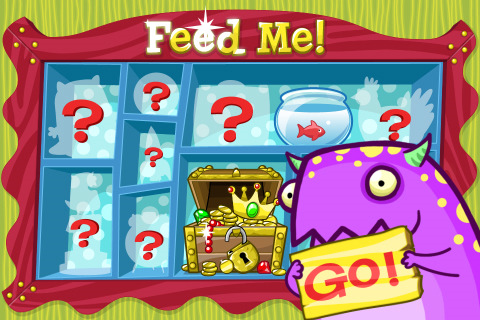
    • Feed Me. Great learning game appropriate for 2-4 year olds. Started out with identifying numbers or letters, but now focused on identifying patterns and images. image
    • NobyNobyboy. Surreal drawing game, with lots of movements and sounds. Frankly, I didn’t get it, but the kids under 5 loved doodling with it. I like this one and jellycar because they are  very constructivist and open-ended. image
    • Jellycar2 (disney)  Another action-oriented build your own car game for 4-6 year olds.
    • GearedHD. A good game about mechanical things and shapes. Probably appropriate for 5 to 9 year olds.
    • Soosiz HD. This game has minimal educational value, but it’s extremely engaging; my nieces and nephews seemed to love this game more than anything. Great music, funny effects, lots of adventures and scenery. Cost $3 i think. image
    • Cut the rope. Excellent mechanical and cause-and-effect game. For kids ages 4-10. All of them love it.
    • Memory Cards. Free memory game….like concentration with several variations. Can play with up to 3 more players. The best thing about this game is that even though the game is challenging (it’s about memory), my 3 year old can play it very well (often better than the other kids).
    • Fruit Ninjas HD. movement-oriented game that’s more about colors, how to combine them. They love the movement and excitement of this game.
    • Alphabet Car HD Lite. Sort of mindless letter-chasing game which the kids 3-5 like.
    • Pedlar Lady. Multimedia children’s book with some mild interactive effects. $5. Whenever I show adults this book/app, they flip out, but kids don’t seem to be as impressed. Probably for ages 8-10. image
    • World Factbook. Geography encyclopedia whose target audience is probably adults, but it’s easy for older kids (8 to 12 year olds) to use it to explore the world. Cost money.
    • Star Walk.. If you don’t know it already. Real time constellation guide.
    • TanZen (and Tanzen Lite). Geometry, match the pattern puzzle game. Good for 8 years and up.
    • Catcha Hd. Good strategy game where you have to enclose a mouse with mousetraps, thus  preventing  him from escaping down a  hole.

    Out of these games, here are the ones which grabbed me as an adult: Catcha HD (very tricky!) and Cut the Rope (lots of variations, and involves lots of mechanical thinking).

  • Google Groups out, Stack Exchange In

    Recently I had a technical problem I was dreading having to find the answer to. It involved installing and configuring Java; that’s one of those topics where answers and resources seemed to be plentiful on google groups. But recently, google groups has been spammed to death, and my best bet was to find a forum or a mailing list.

    This may sound as though I’m whining, but signing up for forums and mailing lists can be tedious and time-consuming. Then, there’s the problem of finding the right forum and/or mailing list. My question is too idiotic to ask on a java programmer’s mailing list, and forums tend to be for hardware/software/OS.

    That is why it is with great relief that I have discovered several communities which let you post questions and search older answers.  On all of them you can browse by tags. They use the digg frontend to let you find interesting/important questions.

    • Stack Overflow lets you ask programming questions and hard setup questions.
    • Server Fault lets you ask system administration questions.
    • SuperUser lets you ask questions specific to an OS or piece of software. 
    • Doctype lets you ask web design and programming questions.

    I really like the interface, and it seems that geeks have already gravitated to these forums. Also, there is practically no spam and my question got a reply fairly quickly.

    Another thing. I confess that I enjoy browsing through the question lists. You can read a tutorial or article to learn something, but that’s only as good as how it was originally written. But when you read through questions dealing with everyday configuration and programming issues, you leave with a better sense of what is hard and easy to get done and which methods are the most powerful.

  • Adjunct Profs, Academic Poverty & the Quixotic Quest for a Tenure-Track position

    Three articles about the steady decline of tenure. A lot of stories about adjunct teachers.

    Also worth mentioning that for these kinds of columns warning about the job market, it’s just as important to read the comments by disaffected academics as it is to read the actual article. In fact, because most of the time the articles are being written by well-intentioned tenured academics, they could possibly be – by definition – the ones least likely to see the problems at ground level. 

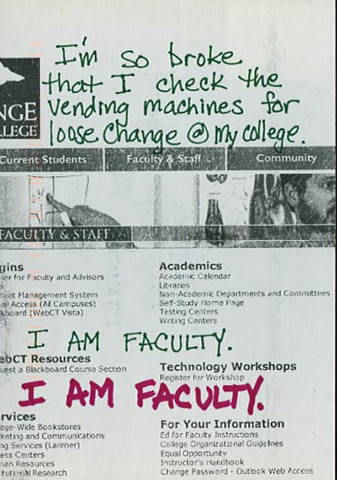
    After reading the replies, I felt inclined to write my own response. I had some nuggets of wisdom to impart. But after typing two paragraphs, I realized that my contribution to this debate was trivial; I did not actually have to live the life that commenters despaired about; there was no way I really understood what it felt like (except the personal testimony who followed market signals and avoided college teaching).  image


    image Under the fold  are several dozen commenters on the subject. They will tell you what life in academia is really about.  People in the humanities seem to be particularly hard-hit; it’s amazing how different the perspective of people in professional and science programs can be from people who stuck it out in the humanities. These people ought to be respected, not vilified. Ok, now the comments: 

    (more…)

  • Which subjects demand the best teachers?

    A fascinating discussion at Marginal Revolution: for  which subjects does the quality of a teacher make a huge difference?

    One interesting commenter:

    This reminds me of something my dad (a CS prof at a flagship state university) told me when I was leaving for college. He suggested that there were some fields that lent themselves to self-study, and that I should avoid taking classes in those departments, because I would do so at the expense of taking courses where I would benefit from a live instructor. I think history was one of his examples.

    Looking back, I’d probably think about my dad’s dichotomy somewhat differently. Rather than believing that some fields are easier for auto-didacts, I’d say that there are some subjects that I knew were intrinsically interesting, and the marginal value of live instruction was probably lower, to me, in those fields. By the age of 21 I had voluntarily read many books about history but zero about non-linear optimization. Perhaps for that reason my OR class on optimization was mind-blowing– the prof might only have been average on an absolute scale, but he was good enough to interest me in material that I would not have pursued on my own, so his value to me was much higher than perhaps the best history teacher might have been.

    There are several ways to answer this question:

    1. did the teacher sustain your interest in a subject where it is often difficult to stay interested?
    2. did the teacher inspire your curiosity and enthusiasm after class was over?
    3. would you have been able to learn this subject on your own without the teacher’s help?
    4. Did the teacher make the class fun?
    5. Did the teacher make you accomplish a lot without it feeling too much like work?
    6. Did the teacher’s organization of the class maximize  class time?
    7. Was the choice of class material wisely chosen?

    I really need to weigh in here with my favorite teachers. First, I stopped taking a lot of hard math and sciences in college, so I rarely had tough or specialized classes. However, once I left college I took several challenging classes at community colleges. One problem with technical subjects is that if you fall behind at the beginning, that makes it harder for you to understand later lessons. A good class (in my opinion) would not be so cumulative.

    Another thing is that I am more likely to enjoy classes in which I am moderately good at. I am less likely to appreciate classes I suck at. Yet, those classes may be important and it may be therefore critical to have a highly qualified teacher for.

    Here are some of my favorite teachers over time. The individuals here are crucial to the class, but I am describing the class because the class is more important than the teacher. A great teacher can still teach an awful class (and vice versa).

    • Comparative Politics. In high school, I had a great  teacher who cobbled together a class and assigned a lot of fascinating outside readings. He was also hard, but he had so many fun anecdotes that you were always learning a lot about different cultures.
    • Asian Religions. A professor taught a class using 20 years of class notes and lots of tricks. Perhaps he had each lesson down too pat; perhaps any class can be compelling if you teach it long enough. But I learned a lot in that class, and even though it was hard, it didn’t seem hard or overwhelming.
    • Theology. I took a great class on theology at a Catholic school. It was taught by a colorful man with lots of interest in morality, psychology and relationships. Plus, this man had a marvelous background in teaching creative thinking. Every class was a delight. I always remember how the xeroxes were always different colors. Almost every class begin with a KYZU (short for Keep Your Zipper Up), which was a short humorous lesson about sexual abstinence.  Seriously, we all had a good time.
    • Conversational German. I had a fantastic German professor at Trinity who was warm and fun and knowledgeable about German literature. The problem was, my German sucked and I kept falling behind.  Also, he was a very formal instructor…and this was college. But I felt such affinities for the man that I kept with it for a while. Actually though I am not talking about this man but a woman who taught a 12 week class at the local Goethe Institute. She was young and pretty but very fun. She made me realize how much fun a foreign language could be. I always remember how music was always playing when we entered the room (it reduced the stress level, she said).
    • Continental Fiction. I took a great literature student with the Dean of Students at Trinity …who was a laugh riot. Besides being eloquent, she knew how to organize group discussions effective without the class going awry.
    • Introduction to Philosophy. I loved philosophy, but I ended up taking an intro class which I thought was going to be better than it was. The teacher wasn’t bad, but he went through all the material effortlessly. He managed to lead (half-hearted) class discussions. After I finished, I realized just how much material we had gone through – and none of it felt hard! I had assumed that the teacher was dumbing the subject down. Later, after I took classes with other philosophy teachers – most of which were abtruse and dull. This Intro teacher had a light touch and never got me bogged down. (To be fair, an Intro class must be easier to teach than an upperclassman one).

    Oddly, I’ve taken a lot of computer training classes, but haven’t found any of them particularly remarkable (I took an Ubuntu training class – sort of, and that was great, but the class was unusual for various reasons).  One reason computer classes are not usually worth noting is  that you are usually being taught straight from a book, and the quality of the class depends on the classroom material. The teacher’s role is essentially to be interesting enough so that students don’t fall asleep. No, I’m being unfair. I’ve taken programming and system administration classes where the teacher did a good job solving problems and keeping students ontrack.

    Perhaps I subscribe to the philosophy that classes shouldn’t seem hard; that’s nice for a liberal arts student say, but it’s not so easy for a science major. But I would love to go back to school and take the hard science courses I used to be so afraid – and see if they were really so hard.

    Oddly, I am not including any  graduate classes here. Each class was special and remarkable in its own way, but I think the high caliber of students contributed to the experience. Also, I have taken several technical workshops which have overall been great. But they’re not classes; instead it’s one expert trying to share his knowledge and expertise (in film, web design etc). It’s hard to compare these to normal classes.

    See also two highly recommended books: I’m the Teacher and You are the Student by Patrick Ailitt and Ken Bain’s What the Best College Teachers Do.

  • Vocabulary Resources for Kids

    Ever since I wrote my article about the importance of a good vocabulary, I’ve been looking for ways to help my 8 year old nephew and 10 year old niece learn new words. Here are some things I’ve found.

    By far, the most interesting thing I’ve found for children is the interactive vocabulary game from Big IQ for Kids. Kids choose a level, and then the website will talk to him about the word and ask them to follow a series of steps about the word. Each level has 10 words, and after a kid finishes, they win a credit to play a game.  BigIQ has free and paid memberships for their various learning activities, but the free membership is adequate.  Almost as good as the vocabulary game is a list of all the words kids learn in the game. It is divided into these levels: 2nd/3rd level words, 3rd/4th level words, 5th/6th level words, PSAT words and SAT words. In other words, enough for just about any student.

  • Flattery and Validation: Professors who Seduce

    William Deresiewicz notices that mass media tends to stereotype  professors as lechers (especially those in the humanities) Why is that?

    In the popular imagination, humanities professors don’t have anything to be ambitious about. No one really knows what they do, and to the extent that people do know, they don’t think it’s worth doing — which is why, when the subject of humanistic study is exposed to public view, it is often ridiculed as trivial, arcane, or pointless. Other received ideas come into play here: “those who can’t do, teach”; the critic as eunuch or parasite; the ineffective intellectual; tenure as a system for enshrining mediocrity. It may be simply because academics don’t pursue wealth, power, or, to any real extent, fame that they are vulnerable to such accusations. In our culture, the willingness to settle for something less than these Luciferian goals is itself seen as emasculating. Academics are ambitious, but in a weak, pathetic way. This may also explain why they are uniquely open to the charge of passionlessness. No one expects a lawyer to be passionate about the law: he’s doing it for the money. No one expects a plumber to be passionate about pipes: he’s doing it to support his family. But a professor’s only excuse for doing something so trivial and accepting such paltry rewards for it is his love for the subject. If that’s gone, what remains? Nothing but baseless vanity and feeble ambition. Professors, in the popular imagination, are absurd little men puffing themselves up about nothing. It’s no wonder they need to be taught a lesson.

    Still none of this explains why the new academic stereotype has emerged just now. he first possibility is that today’s academics are portrayed as pompous, lecherous, alcoholic failures because that’s what they are. In terms of some of the longer-lasting elements of the professorial image, this is no doubt true. Pedantry and elitism are inherent temptations in the academic enterprise, and Max Weber remarked nearly a century ago that, for professors, vanity is a sort of occupational disease. Precisely because they don’t possess the kind of wealth that accrues to doctors and lawyers or the status wealth confers, academics are more apt to parade their intellectual superiority than members of other elite professions. But professors have neither a monopoly on nor a disproportionate share of quiet desperation or the self-destructive gestures that attend it. Male professors are not less-devoted or less-faithful husbands, on average, than other men — in fact, relative to wealthier ones, they are probably more so. (That there are now a substantial number of female academics is a circumstance the popular imagination has yet to discover.)

    Citing a response from a female student who says she wants to have “brain sex” with a professor, not actual sex,he comments:

    That is why, for the Greeks, the teacher’s relationship with the child was regarded as more valuable and more intimate than the parents’. Your parents bring you into nature, but your teacher brings you into culture. Natural transmission is easy; any animal can do it. Cultural transmission is hard; it takes a teacher. But Socrates also inaugurated a new idea about what teaching means. His students had already been educated into their culture by the time they got to him. He wanted to educate them out of it, teach them to question its values. His teaching wasn’t cultural, it was counter-cultural. The Athenians understood Socrates very well when they convicted him of corrupting their youth, and if today’s parents are worried about trusting their children to professors, this countercultural possibility is really what they should be worried about. Teaching, as Neil Postman says, is a subversive activity — all the more so today, when children are marinated in cultural messages from the moment they’re born. It no longer takes any training to learn to bow to your city’s gods (sex or children, money or nation). But it often takes a teacher to help you question those gods. The teacher’s job, in Keats’s terms, is to point you through the vale of soul-making. We’re born once, into nature and into the culture that quickly becomes a second nature. But then, if we’re granted such grace, we’re born again. For what does it profit a man if he gains the whole world and loses his mortal soul?

    What attracts professors to students, then, is not their bodies but their souls. Young people are still curious about ideas, still believe in them — in their importance, their redemptive power. Socrates says in the Symposium that the hardest thing about being ignorant is that you’re content with yourself, but for many kids when they get to college, this is not yet true. They recognize themselves as incomplete, and they recognize, if only intuitively, that completion comes through eros. So they seek out professors with whom to have relationships, and we seek them out in turn. Teaching, finally, is about relationships. It is mentorship, not instruction. Socrates also says that the bond between teacher and student lasts a lifetime, even when the two are no longer together. And so it is. Student succeeds student, and I know that even the ones I’m closest to now will soon become names in my address book and then just distant memories. But the feelings we have for the teachers or students who have meant the most to us, like those we have for long-lost friends, never go away. They are part of us, and the briefest thought revives them, and we know that in some heaven we will all meet again.

    This has been a subject of more than casual interest in me. I had always planned to go into academia at some point, and indeed I taught overseas for three years at universities. In the early 1990s I remember reading a fascinating debate in Harper’s magazine about seduction in academia. One male professor adopted the provocative point that no, we got the problem backwards. There wasn’t a sexual harassment problem in academia. The problem is that people tended to infantilize college females, saying they couldn’t be trusted to make their own decisions. For heaven’s sake, he argued, they were 18! They were old enough to vote and enlist in the military. Professors offered obvious appeal to college women. They were smart and successful in this academic world, plus they had the maturity of understanding and appreciation for what lies beneath the physical. And, the professor added, would college women really be better off having affairs with frat boys and college boys who were lousy lovers and had superficial views on romance?

    After  the professor tossed  that hand grenade into the debate, you could imagine the  protest and denunciation that ensued. That professor (I wish I knew his name) stuck to his guns though. All you are doing, he said,  is treating college-age women as chattel…as helpless virgins who needed to be protected…a throwback to more puritanical times. He wasn’t exactly advocating professor-student sex; all he was saying that it wouldn’t be a tragedy; it wasn’t inherently exploitative and we should be focusing on the decision-making skills of the college student (and yes, of the professor).

    I kept those sentiments in mind while teaching overseas. I taught many brilliant and beautiful women. Of course, during that time prurient thoughts did enter my brain…how could I avoid it?  Some  students probably had college infatuations towards me–not wanting romance obviously, but seeking my attention and approval.  Although I didn’t reject the possibility of a student-teacher romance while teaching overseas,circumstances never worked in my favor for one reason or other. In the first country, I had to teach the same student for two years, and then civic unrest forced a premature evacuation. In the second country, contract problems caused my contract to end after one year, leaving me in the lurch.   In Eastern Europe, there was far less disapproval at academic seductions, and yet even there it seemed needlessly complicated.  Many years later, a former student of mine mentioned that she had been propositioned by another professor; it had shaken her, and frankly, I knew both people fairly well and couldn’t imagine it. (He was older and  married, etc).  He was just acting stupid and he probably should have been disciplined for it. But what do you do if  the college student seems receptive?

    Part of the problem is that students are seeking validation of their own intellectual selves, and professors are easily able to give it.  In the business world, you don’t have such opportunities. (Of course, students wouldn’t know that yet). Outside of an academic setting,  I doubt students of mine would have found me interesting.

    When in college, it just doesn’t occur to you that interesting creative people live and work outside of academia.  Those working in academia know its pitfalls: the tenure train is too slow for most people, adjunct teachers have a hard time making ends meet and  engage in intellectually productive activities. Instead they spend their time cranking out papers, teaching massive classes  and trying to gain recognition.   This is not fun (especially if you are at the bottom of the academic totem pole); there are very few rewards except for approbation from students. The irony is that those with the most active libidos (graduate students)  are  lowest on the academic hierarchy.Graduate students have a precarious  future; in a way they are more sensitive to power imbalances than undergraduates (who at least know that screwing up in college won’t sabotage their professional careers).  Nobody should really be surprised if the academics with the least promising academic future are parlaying the slim benefits into something more substantial.

    The problem with these academic relationships is that they exist only in the context of academia. High status individuals in academia have low status almost everywhere else. I could be a distinguished literary critic, but when I’m working at an investment company, I’m just an ordinary blow with a few interesting hobbies.

    See also: Straight Talk about Graduate School

    August 18, 2009 Update: Gin and Tacos summarizes the attitude in academia.

    Grad school orientation: “OK, seriously people, don’t fuck the undergrads. Come on. Just don’t.”

    New faculty orientation: “Remember grad school orientation? When we told you not to fuck the undergrads? You probably didn’t listen. But now, seriously people, don’t fuck the undergrads.”

  • March OLPC Meeting Houston (Notes)

    Hi, I wanted to provide information about the recent meeting of the Houston OLPC meeting, which featured Samuel Klein, the director of community content.   I don’t know how much of these nuggets of information was off-the-cuff and how much is official; use your own judgment. After the meeting, we met at Beck’s Prime for Hamburgers. Here is some tidbits we learned over that day:

    • OLPC is due to have a major update in a week or two. (Translation: two to three weeks). Here are the release notes. This update is expected to fix lots of things (which may have already arrived in the minor updates).; Klein mentioned a few things I don’t remember. He mentioned faster startup time for Activities,  better mappings of the game buttons on the display (useful for reading in tablet mode), improved handling of video and other multimedia. However, you will need to download  Activities and  Collections again, and possibly other customizations you made to the machine (such as Flash) . For this update, they separated Activities from Updates, so after this Update, it will no longer be necessary to reinstall activities.
    • Klein confirmed that that for Update 1, drivers/libraries have been written to make use of the trackpad (which up until now was disabled). That means that developers of Activities will be able to integrate the trackpad (and handwriting detection)  fairly soon although no activity included with the update will be able to use it.
    • Klein showed off a 3-D game called Bounce which was the hit for the meeting. In addition to being like a 3-D pong, children are able to configure/edit the game to increase the physical dimensions of the play area and speed.
    • I learned quite by accident how to install content collections (i.e., .xol files)  in XO. The collections page has so far been poorly maintained and documented. All you have to do is download the .xol file. Afterwards, when you open up the Browse Activity (as if you plan to surf the web), the newly added collections will appear on the left hand side of the home page  underneath each categories (after you expand them). This is so non-obvious it’s hilarious.
    • So far not a lot of .xol content has been available. Most of the content are image galleries and little else.  But here are three .xol files you should download: Wikislice GeneralWikislice Animals, and Wikihow
    • Building a collection is not hard.  It basically is a bunch of files readable by XO which are bundled together and zipped, along with a configuration file. So far, a lot of the collections are PDF files, so they take a while to load, but I suspect it would be possible to build a collection out of HTML files and view it inside the same Browse activity. That would definitely avoid the slowness of PDF loads. 
    • I have plans to put together a storybook/picture book of well known children’s tales. I plan to have two volumes: Level 1 and level 2 (depending on age level).  I am definitely taking suggestions for content!
    • Klein confirmed that XO owners have had difficulties sharing activities with XO owners who have already updated to a more recent version.  (That is why for example sharing activities was relatively easy at our first meeting, but became more difficult after people updated their machines with each minor release). Hopefully, if everyone gets updated to the Major Update 1, these problems will disappear. (I’m assuming that WPA authentication problems will disappear as well).
    • Klein confirmed that XO will be available for sale to Americans at the end of 2008.
    • Klein mentioned something interesting; although olpcnews.com is popular with users inside North America, in fact,  developers mainly follow the official forums, so if you want to give feedback or hear from people who actually know what they’re talking about, you should check the official forums in addition to olpcnews.
    • Houstonian Aaron Poffenberger did a demo to show off Webkinz on the XO. Our main problem turned out not to be XO but the library’s wifi capabilities.

    This was a really fun meeting. The topic for April’s meeting will be Updating; if you haven’t had time to update your XOs, someone at the meeting will be happy to do so. I haven’t picked a meeting date yet but would entertain suggestions. (We’ll try to meet at Montrose library this time on a Saturday afternoon).

  • Random Lists

    Elearningpost has long been one of the more interesting weblogs out there. I’ve been reading it off and on for — gosh, 7 years! It’s run by Maish R Nichani (who is much much smarter than I) and has lots of useful information in the field of information design, instructional technology and even web design. Although I find gems from the site, I admit I haven’t looked at the site in months. Here’s some things I found just by looking at one month worth of archives:

    • 12 things Journalists need to know about the future (by James Cascio) My fave: 10. “Technology” is anything invented since you turned 13. What seems weird and confusing will become familiar and obvious, especially to people who grow up with it. This means that, very often, the real utility of a new technology won’t emerge for a few years after it’s introduced, once people get used to its existence, and it stops being thought of as a “new technology.” Those real uses will often surprise — and sometimes upset — the creators of the technology.
    • Best Web applications for Education 2007 by Larry Ferlazzo. Lots of blogging-audio-presentation web applications.
    • Immutable Laws of Project Development. By Brian Fling. So true it’s not even funny. My fave: The first 90% of the code accounts for the first 90% of the development time. The remaining 10% of the code accounts for the other 90% of the development time.
    • Jakob Nielson on Long Articles vs. Short Articles. He writes
    • So: should your website have concise or in-depth content?
      • If you want many readers, focus on short and scannable content. This is a good strategy for advertising-driven sites or sites that sell impulse buys.
      • If you want people who really need a solution, focus on comprehensive coverage. This is a good strategy if you sell highly targeted solutions to complicated problems.
    • another Jakob Nielson piece: Why Articles are better than blogposts:

    As the chart shows, the fatter the report became, the more it has sold. Of course, page count (the blue line) is only a rough indication of the amount of insight, which is what customers are really paying for. The new edition has a large number of eyetracking heatmaps, showing how users read various newsletters, and these many illustrations eat up pages ferociously. Still, there’s no doubt that each report edition contains significantly more information than previous editions.

    The report’s price has increased less than its page count: as we keep doing this research, we become more efficient. You could argue that customers are getting more for their money, and that’s why they’re buying more. But this argument works only if customers in fact assign extra value to more comprehensive reports. So either way, I conclude that in-depth content sells.

    Why are paying customers (the people who matter) attracted by detailed information? Because systematic and comprehensive coverage is more actionable. It also protects them against the risk of losses caused when something important is overlooked.

    (this is reminiscient of Yaro Starak’s concept of Pillar articles).

    • 12 things journalists need to know about Economics.  By Brad De Long. 4. No meaningless numbers. Do not report budget, trade, tax, or other numbers in billions or trillions or even millions. Use per capita or per worker or per household or per share terms to make them meaningful. It’s not a $70 billion tax cut–it’s $43,000 per recipient millionaire per year. It’s not a $300 billion deficit–it’s an extra $4,000 per family of four per year that the government has charged and is expecting you to pay through additional taxes sometime in the future.
  • Tips for Work Activity

    A work colleague gave a mini-presentation about time management skills. Here are my own guidelines:

    1. Be clear about what your role in the project is and ought to be.
    2. Resist the temptation to turn away from an activity if something more important comes up (It takes time and effort to switch gears and back again; you may lose the good karma you accumulated in the meantime).
    3. Deadlines are mutable. Every deadline has consequences which you need to understand and accept (and you need to make sure the customer understands).
    4. If the stakeholder/customer cuts off a feature/line of investigation/endeavor, stop it immediately! (you have no choice).
    5. Miscommunication is an inevitable part of human interaction. Accept that fact and concentrate on:
      • establishing trust with the stakeholder
      • setting expectations in more than context and method.
    6. If you get stuck on something:
      • do you need to be the one to solve the problem?
      • can you delay solving it while you solicit outside help?
      • can you get away temporarily from it to start over (a good night’s sleep can often help).
      • set a limit on how much wheel spinning you can do on one task. After that, reconsider your options.
    7. It’s often bad to promise a specific result or event (especially if it turns out that the result is not what you would have wanted).
    8. Paul Graham’s method for solving problems: Keep your options open. Choose the alternative that maximizes your options.
    9. Make the effort to explain your internal progress/goals to your bosses/managers.
    10. Too many status reports can lead to micromanagement.
    11. If it’s possible to outsource mental schedules to a piece of SW, it can pay off after a few weeks if adhered to.
    12. Most new work methods are eventually abandoned for one reason or another. Occasionally one will bring enormous benefits.
    13. Trying a new work method (on a personal level at least) involves little risk.
    14. Frequent deliverables increases the amount of negative feedback. This can be bad or good.
    15. Overpromising is a result of a person’s inability to appreciate the complexity of a task.
    16. Keeping long term objectives in the back of one’s mind can be helpful for later brainstorming.
    17. When prioritizing, the project with the most inflexible  deadlines can also be the least important.
  • Designing for Children: The Constructivist Approach

    In response to the announcement that SimCity will be ported to the One Laptop per Child platform, Alan Kay writes a long piece wondering whether Sim City is truly an example of constructivist learning. He talks about designing software environments for children and at the end concludes that Sim City might not be the best platform for that (he prefers something called etoys):

    If “children first!” is the rallying cry, then it makes sense to try to invent computer environments that use the very best ideas (and these are very hard to come up with). This is why the various groups that got interested in this romantic quest via early contact with Seymour have always been colleagues and never rivals. The hard to come by ideas for projects, representations, user interfaces, experiments, etc., have been freely traded back and forth. The notions of “thresholds below which is not worth going” have been jointly refined, etc. One of the parasitic difficulties is that computer environments, once made (with lots of effort and dedication) tend to form tribal bonds that are rather religious in nature. The amount of effort required plus the attendant religion makes it extremely difficult to take new insights and ideas and make brand new better environments for the children. The strong tendency is to use and reuse and incrementally expand the old environments.

    So, for young and youngish children (say from 4 to 12) we still have a whole world of design problems. For one thing, this is not an homogenous group. Cognitively and kinesthetically it is at least two groups (and three groupings is an even better fit). So, we really think of three specially designed and constructed environments here, where each should have graceful ramps into the next one.

    The current thresholds exclude many designs, but more than one kind of design could serve. If several designs could be found that serve, then we have a chance to see if the thresholds can be raised. This is why we encourage others to try their own comprehensive environments for children. Most of the historical progress in this area has come from a number of groups using each other’s ideas to make better attempts (this is a lot like the way any science is supposed to work). One of the difficulties today is that many of the attempts over the last 15 or so years have been done with too low a sense of threshold and thus start to clog and confuse the real issues.

    I think one of the trickiest issues in this kind of design is an analogy to the learning of science itself, and that is “how much should the learners/users have to do by themselves vs. how much should the curriculum/system do for them?” Most computer users have been mostly exposed to “productivity tools” in which as many things as possible have been done for them. The kinds of educational environments we are talking about here are at their best when the learner does the important parts by themselves, and any black or translucent boxes serve only on the side and not at the center of the learning. What is the center and what is the side will shift as the learning progresses, and this has to be accommodated.

    OTOH, the extreme build it from scratch approach is not the best way for most minds, especially young ones. The best way seems to be to pick the areas that need to be from scratch and do the best job possible to make all difficulties be important ones whose overcoming is the whole point of the educational process (this is in direct analogy to how sports and music are taught — the desire is to facilitate a real change for the better, and this can be honestly difficult for the learner).

    Specifically about Simcity he says:

    SimCity is similar but more pernicious. It is a black box of “soft somewhat arbitrary knowledge” that the children can’t look at, question or change. For example, SC gets the players to discover that the way to counter rising crime is to put in more police stations. Most anthropologists, sociologists, psychologists, and economists would disagree violently. Alternate assumptions can’t be tried, etc.

    Both of these packages have won many “educational awards” from the pop culture, but in many ways they are anti-real-education because they miss what modern knowledge and thinking and epistemology are all about. This is why being “above threshold” and really understanding what this means is the deep key to making modern curricula and computer environments that will really help children lift themselves.

    Two nuggests from the slashdot discussion about whether Simcity is a truly educational tool. First, a comic dialogue exchange:

    Is this to give the kids a virtual sense of what it’s like to live in a 1st world country? “look at all of the nice luxuries you will never experience!” how about the irony of building a nuclear powerplant on a computer you have to handcrank?

    Reply: This comment is funny, but it relies on a common misperception that the poor kids for whom the OLPC was created have no idea what modern urban life is like. Most of them live in or in the shadow of large modern cities, Johannisberg, Kolkata, Rio de Janeiro, Jakarta, Manila, and Mexico City, just to name a few. They have plenty of opportunities to see modern life, they just don’t have much opportunity to participate.

    Let me help you out with a simple analogy. You read slashdot, right? So, you have plenty of opportunities to see beautiful women, but all you get to do is watch, from a distance. That’s why you bought that stick of Axe Deoderant.

  • Yu Gi Oh for children? (A parents’ guide)

    A shout out to the blogosphere: does anyone have children who play Yu Gi Oh?

    If yes, do you have advice about how to get started? i have a 7 year old nephew who I’m thinking of buying some cards for. Here’s a parents’ guide. Here are rules about basic gameplay.

    James Paul Gee has written about this game before and spoken about it too.