Category: Instructional

  • Learning Games, Apps & Ebooks for Kids on the Ipad

    When I visited the kids’ library at  Houston Public Library last week, I learned 2 amazing things from children’s librarian Sandy Farmer: wii games were available for in-library checkout, and the library   would soon be lending out ipads   stocked with apps and games especially for kids. What a grand idea. I can vouch that kids under 10 find the  ipad absolutely engaging.   Not only has it become a permanent babysitter, it has caused endless number of fights about whose turn it is to play and which game to play and why can’t X play the 2 player version of the game.  Out of the first few words to come from their mouths when they see me, I can say with certainty that one of them will be “ipad”  followed with a question mark. I’m almost embarrassed to admit that I use the device mainly for catching up on RSS feeds.

    Over time I have downloaded a number of kids’ games – some cost money, but most of them were free. I haven’t really looked at the games themselves, but I  have paid  attention to which games are capturing their attention.   I have  two nieces ages 3 and 4 and two nephews aged 5 and 10. So I really have a good sense of what games are more likely to excite them. I have a bit of an educational background and have written about educational games here and here. Curiously though, I haven’t spent much time playing games (except for Wii Dance 2 – which I love). Mainly I like to see what games are engaging today’s youth and what kinds of narratives they are concocting with their games. For example, I have noticed that my nephew really gets into Will Wright’s Spore (and even though it isn’t educational per se, it does a good job of conveying the basic sequence of evolution and how societies progress and regress.  On the Playstation, not only will my nephew learn about longer narratives like Harry Potter and Star Wars by playing the games, he will gleefully recount his adventures to anyone willing to listen. So these  games can have a verbal component… plus they can drive kids to the original source material…always a good thing.

    Ipad games are much less ambitious, but more intuitive. 3 out of the 4 children I deal with don’t even know how to read, and yet they managed to get through the menus and figure out the rules – something which amazes me to no end. I think there is value in letting kids play game just for the fun of it, but it would help if the games stressed some learning domain or made use of some cognitive skill. About 2/3 of the titles are free or Lite versions, and 1/3 are commercial apps. I’ll indicate if I remember whether they are free or cost money. 

    The best way to get a feel for the game is to Youtube and search for the game. For example: “Ipad World of Go.” Don’t forget to include ipad as a search term. Some of these games are available on several different platforms, and the ipad version might be substantially different.

    Recommended Ipad Games by Sandy Farmer, Children’s Library for the Houston Public Library

     Sandy Farmer’s blog about ipad games gives capsule reviews. I suspect Ms. Farmer has had to play and test a lot of games for the library, so she probably keeps tabs on the latest and greatest.  (Her remarks are in italics).  Incidentally Farmer also blogged recently about playing Xbox Kinect in the Houston Public Library, so that may indicate another gaming platform due to hit HPL soon.

    • Jungle Fractions (2.99). Sandy writes, Jungle Fractions is a great learning tool for learning all about fractions from simple identification, to conversions, adding, and comparisons. A great tool for learning a difficult concept like fractions. Animals roar when you get the answer right and it makes great jungle noises.
    • Jungle Time (2.99). Sandy writes, Does your child need to learn how to tell time? This is the app for you. You can match the hands on the clock to a digital time, learn to tell how much time has passed, or learn to tell time. The app rewards you with an animal growl. You can also change animals at any time. Clock styles can be changed as well as the level being played in the settings of the game. Level 2 covers 30 minute intervals, Level 3 is 15 minute intervals, etc. The jungle sounds add to the atmosphere as you play.
    • Alphabet Freeze Tag. Sandy writes, Letters wander the screen as you try to touch them in alphabetical order in this winter wonderland. Great app for a child needing to learn the order of the Alphabet in a way that is entertaining. The final level is timed and children can compete with themselves and others for the fastest time.
    • World of Goo. (4.99).  Although she hasn’t written about it yet, Sandy Farmer recommended this game as a puzzle game that used physics. you chain together balls of goo to form objects (bridges, etc). I haven’t played it yet, but it looks fascinating.

    My recommendations (based on watching my nieces and nephews).

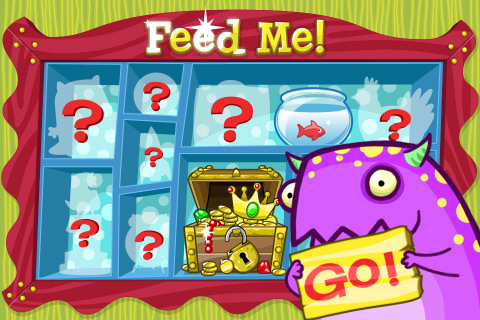
    • Feed Me. Great learning game appropriate for 2-4 year olds. Started out with identifying numbers or letters, but now focused on identifying patterns and images. image
    • NobyNobyboy. Surreal drawing game, with lots of movements and sounds. Frankly, I didn’t get it, but the kids under 5 loved doodling with it. I like this one and jellycar because they are  very constructivist and open-ended. image
    • Jellycar2 (disney)  Another action-oriented build your own car game for 4-6 year olds.
    • GearedHD. A good game about mechanical things and shapes. Probably appropriate for 5 to 9 year olds.
    • Soosiz HD. This game has minimal educational value, but it’s extremely engaging; my nieces and nephews seemed to love this game more than anything. Great music, funny effects, lots of adventures and scenery. Cost $3 i think. image
    • Cut the rope. Excellent mechanical and cause-and-effect game. For kids ages 4-10. All of them love it.
    • Memory Cards. Free memory game….like concentration with several variations. Can play with up to 3 more players. The best thing about this game is that even though the game is challenging (it’s about memory), my 3 year old can play it very well (often better than the other kids).
    • Fruit Ninjas HD. movement-oriented game that’s more about colors, how to combine them. They love the movement and excitement of this game.
    • Alphabet Car HD Lite. Sort of mindless letter-chasing game which the kids 3-5 like.
    • Pedlar Lady. Multimedia children’s book with some mild interactive effects. $5. Whenever I show adults this book/app, they flip out, but kids don’t seem to be as impressed. Probably for ages 8-10. image
    • World Factbook. Geography encyclopedia whose target audience is probably adults, but it’s easy for older kids (8 to 12 year olds) to use it to explore the world. Cost money.
    • Star Walk.. If you don’t know it already. Real time constellation guide.
    • TanZen (and Tanzen Lite). Geometry, match the pattern puzzle game. Good for 8 years and up.
    • Catcha Hd. Good strategy game where you have to enclose a mouse with mousetraps, thus  preventing  him from escaping down a  hole.
    Out of these games, here are the ones which grabbed me as an adult: Catcha HD (very tricky!) and Cut the Rope (lots of variations, and involves lots of mechanical thinking).
  • Google Groups out, Stack Exchange In

    Recently I had a technical problem I was dreading having to find the answer to. It involved installing and configuring Java; that’s one of those topics where answers and resources seemed to be plentiful on google groups. But recently, google groups has been spammed to death, and my best bet was to find a forum or a mailing list.

    This may sound as though I’m whining, but signing up for forums and mailing lists can be tedious and time-consuming. Then, there’s the problem of finding the right forum and/or mailing list. My question is too idiotic to ask on a java programmer’s mailing list, and forums tend to be for hardware/software/OS.

    That is why it is with great relief that I have discovered several communities which let you post questions and search older answers.  On all of them you can browse by tags. They use the digg frontend to let you find interesting/important questions.

    • Stack Overflow lets you ask programming questions and hard setup questions.
    • Server Fault lets you ask system administration questions.
    • SuperUser lets you ask questions specific to an OS or piece of software. 
    • Doctype lets you ask web design and programming questions.

    I really like the interface, and it seems that geeks have already gravitated to these forums. Also, there is practically no spam and my question got a reply fairly quickly.

    Another thing. I confess that I enjoy browsing through the question lists. You can read a tutorial or article to learn something, but that’s only as good as how it was originally written. But when you read through questions dealing with everyday configuration and programming issues, you leave with a better sense of what is hard and easy to get done and which methods are the most powerful.

  • Adjunct Profs, Academic Poverty & the Quixotic Quest for a Tenure-Track position

    Three articles about the steady decline of tenure. A lot of stories about adjunct teachers.

    Also worth mentioning that for these kinds of columns warning about the job market, it’s just as important to read the comments by disaffected academics as it is to read the actual article. In fact, because most of the time the articles are being written by well-intentioned tenured academics, they could possibly be – by definition – the ones least likely to see the problems at ground level. 

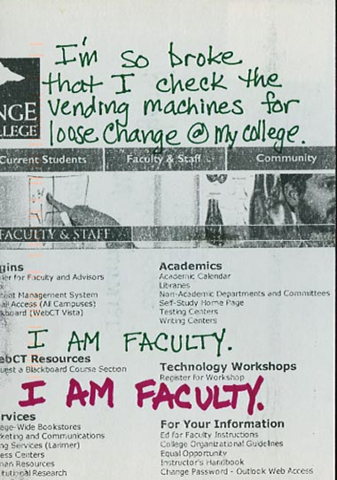
    After reading the replies, I felt inclined to write my own response. I had some nuggets of wisdom to impart. But after typing two paragraphs, I realized that my contribution to this debate was trivial; I did not actually have to live the life that commenters despaired about; there was no way I really understood what it felt like (except the personal testimony who followed market signals and avoided college teaching).  image


    image Under the fold  are several dozen commenters on the subject. They will tell you what life in academia is really about.  People in the humanities seem to be particularly hard-hit; it’s amazing how different the perspective of people in professional and science programs can be from people who stuck it out in the humanities. These people ought to be respected, not vilified. Ok, now the comments: 

    (more…)

  • Which subjects demand the best teachers?

    A fascinating discussion at Marginal Revolution: for  which subjects does the quality of a teacher make a huge difference?

    One interesting commenter:

    This reminds me of something my dad (a CS prof at a flagship state university) told me when I was leaving for college. He suggested that there were some fields that lent themselves to self-study, and that I should avoid taking classes in those departments, because I would do so at the expense of taking courses where I would benefit from a live instructor. I think history was one of his examples.

    Looking back, I’d probably think about my dad’s dichotomy somewhat differently. Rather than believing that some fields are easier for auto-didacts, I’d say that there are some subjects that I knew were intrinsically interesting, and the marginal value of live instruction was probably lower, to me, in those fields. By the age of 21 I had voluntarily read many books about history but zero about non-linear optimization. Perhaps for that reason my OR class on optimization was mind-blowing– the prof might only have been average on an absolute scale, but he was good enough to interest me in material that I would not have pursued on my own, so his value to me was much higher than perhaps the best history teacher might have been.

    There are several ways to answer this question:

    1. did the teacher sustain your interest in a subject where it is often difficult to stay interested?
    2. did the teacher inspire your curiosity and enthusiasm after class was over?
    3. would you have been able to learn this subject on your own without the teacher’s help?
    4. Did the teacher make the class fun?
    5. Did the teacher make you accomplish a lot without it feeling too much like work?
    6. Did the teacher’s organization of the class maximize  class time?
    7. Was the choice of class material wisely chosen?

    I really need to weigh in here with my favorite teachers. First, I stopped taking a lot of hard math and sciences in college, so I rarely had tough or specialized classes. However, once I left college I took several challenging classes at community colleges. One problem with technical subjects is that if you fall behind at the beginning, that makes it harder for you to understand later lessons. A good class (in my opinion) would not be so cumulative.

    Another thing is that I am more likely to enjoy classes in which I am moderately good at. I am less likely to appreciate classes I suck at. Yet, those classes may be important and it may be therefore critical to have a highly qualified teacher for.

    Here are some of my favorite teachers over time. The individuals here are crucial to the class, but I am describing the class because the class is more important than the teacher. A great teacher can still teach an awful class (and vice versa).

    • Comparative Politics. In high school, I had a great  teacher who cobbled together a class and assigned a lot of fascinating outside readings. He was also hard, but he had so many fun anecdotes that you were always learning a lot about different cultures.
    • Asian Religions. A professor taught a class using 20 years of class notes and lots of tricks. Perhaps he had each lesson down too pat; perhaps any class can be compelling if you teach it long enough. But I learned a lot in that class, and even though it was hard, it didn’t seem hard or overwhelming.
    • Theology. I took a great class on theology at a Catholic school. It was taught by a colorful man with lots of interest in morality, psychology and relationships. Plus, this man had a marvelous background in teaching creative thinking. Every class was a delight. I always remember how the xeroxes were always different colors. Almost every class begin with a KYZU (short for Keep Your Zipper Up), which was a short humorous lesson about sexual abstinence.  Seriously, we all had a good time.
    • Conversational German. I had a fantastic German professor at Trinity who was warm and fun and knowledgeable about German literature. The problem was, my German sucked and I kept falling behind.  Also, he was a very formal instructor…and this was college. But I felt such affinities for the man that I kept with it for a while. Actually though I am not talking about this man but a woman who taught a 12 week class at the local Goethe Institute. She was young and pretty but very fun. She made me realize how much fun a foreign language could be. I always remember how music was always playing when we entered the room (it reduced the stress level, she said).
    • Continental Fiction. I took a great literature student with the Dean of Students at Trinity …who was a laugh riot. Besides being eloquent, she knew how to organize group discussions effective without the class going awry.
    • Introduction to Philosophy. I loved philosophy, but I ended up taking an intro class which I thought was going to be better than it was. The teacher wasn’t bad, but he went through all the material effortlessly. He managed to lead (half-hearted) class discussions. After I finished, I realized just how much material we had gone through – and none of it felt hard! I had assumed that the teacher was dumbing the subject down. Later, after I took classes with other philosophy teachers – most of which were abtruse and dull. This Intro teacher had a light touch and never got me bogged down. (To be fair, an Intro class must be easier to teach than an upperclassman one).

    Oddly, I’ve taken a lot of computer training classes, but haven’t found any of them particularly remarkable (I took an Ubuntu training class – sort of, and that was great, but the class was unusual for various reasons).  One reason computer classes are not usually worth noting is  that you are usually being taught straight from a book, and the quality of the class depends on the classroom material. The teacher’s role is essentially to be interesting enough so that students don’t fall asleep. No, I’m being unfair. I’ve taken programming and system administration classes where the teacher did a good job solving problems and keeping students ontrack.

    Perhaps I subscribe to the philosophy that classes shouldn’t seem hard; that’s nice for a liberal arts student say, but it’s not so easy for a science major. But I would love to go back to school and take the hard science courses I used to be so afraid – and see if they were really so hard.

    Oddly, I am not including any  graduate classes here. Each class was special and remarkable in its own way, but I think the high caliber of students contributed to the experience. Also, I have taken several technical workshops which have overall been great. But they’re not classes; instead it’s one expert trying to share his knowledge and expertise (in film, web design etc). It’s hard to compare these to normal classes.

    See also two highly recommended books: I’m the Teacher and You are the Student by Patrick Ailitt and Ken Bain’s What the Best College Teachers Do.

  • Vocabulary Resources for Kids

    Ever since I wrote my article about the importance of a good vocabulary, I’ve been looking for ways to help my 8 year old nephew and 10 year old niece learn new words. Here are some things I’ve found.

    By far, the most interesting thing I’ve found for children is the interactive vocabulary game from Big IQ for Kids. Kids choose a level, and then the website will talk to him about the word and ask them to follow a series of steps about the word. Each level has 10 words, and after a kid finishes, they win a credit to play a game.  BigIQ has free and paid memberships for their various learning activities, but the free membership is adequate.  Almost as good as the vocabulary game is a list of all the words kids learn in the game. It is divided into these levels: 2nd/3rd level words, 3rd/4th level words, 5th/6th level words, PSAT words and SAT words. In other words, enough for just about any student.