Category: most popular

  • Who will NOT be president in 2021

    Exactly 4 years ago I wrote a tongue-in-cheek article about who would be president in 2017 by figuring out who could not possibly win. (I basically predicted it would be Jeb Bush vs.  Andrew Cuomo).

    I had fun writing this article and I tried to take the exercise seriously even though it was just an exercise. I was also catastrophically wrong.  I couldn’t anticipate that Trump would run for president or even have a shot. He was just too amoral and full of shit — even for Republicans.  At the same time, I immediately ruled out Bernie Sanders as too old and fringe. Since that time, I have seen that Americans are a lot more accepting of older candidates than they used to be, and that the Overton window of  Sanders’ unabashed  progressivism has been effectively shattered.   I also began to look at the race as a kind of perverse reality show where the object is not necessarily to win  but to be the last person standing. I now recognize that coastal liberalism may resonate differently in the heartland.

    For  the 2020 election these will be the important questions: 1)Do we want systemic or incremental change in health care?  2)Which candidate has led an exemplary life? (How important are family values, honesty and being a good role model? Disgust with Trump will cause Americans to focus on this a lot more than usual). 3)Who will restore our standing  in the world? (Trump has been ruining our global  standing;  even Republicans are saying that) and 4) What kind of industrial policy will win support of the business community AND help the underclass to improve their lot?

    Here are some secondary questions:  how willing will the donor class be to donate to this person’s campaign? Donors not only want beneficial policies, they also want steady and reliable administration. But the  2016  election repudiated this idea. Cruz and Bush received lots of donor support, but this didn’t translate to public support. Hilary received lots of donations, but Sanders received more grassroots support and wasn’t that penalized by lacking Clinton’s fundraising apparatus. Perhaps the more critical question is : how easily can the candidate rally supporters? Trump, Obama and Sanders did a great job on this. Hilary Clinton did a rather mediocre job.

    Among the Dems, it seems the choice is mainly between a female Senator and a male who is a business tycoon or former governor.  In the past, we have typically said that governors and business people make better executives, but I don’t know if that applies anymore. Maybe when two candidates go head to head the dynamics will seem different, but my default assumption is that women are the angry class for the election and come out overwhelmingly for the  female candidate.  Females come into this election believing that they were robbed in 2016.

    By 2019 I predict that any enthusiasm for Trump will have disintegrated, and Americans on both sides will be hungering for someone more  dignified and honest. (Mitt Romney — if he were 10 years younger — would have fit the bill perfectly).

    In 2016, I was more interested in figuring out who would win the Republican primary (Hilary Clinton seemed like a shoe in). For 2020, though it’s a wide open race for Democrats; Republicans has a smaller base of potential candidates, and they need to have demonstrated independence and judgment of Trump, but also not to alienate Trump/Breitbart voters too much.

    Republicans

    1. Rick Perry. Perry is adept at understanding the political equation of various situations. He could probably manage to convince voters that he’s independent from Trump and assuage Trump voters that he’s secretly one of them. Terrible policies and ideas, but great fund-raiser, great populist and a good party man. His Oops moment and media personality in Dancing with the Stars can only help him.
    2. Jeff Flake. Definitely the man to watch, especially if/when the American public and Republican voters sour on the Trump brand. He’s actually a conventional politician with many interesting ideas and a capable spokesman for them. Expect him to run against Trump if Trump runs for re-election.
    3. Ted Cruz. It’s still scary to think that Cruz would have been the Republican nominee if Trump hadn’t won. He probably has a more mature understanding of politics now and probably is mending fences with other GOP politicians, but I don’t think this race is Cruz’s turn to run for president.
    4. John Kasich. Because his state is of strategic importance and because Kasich has governing experience and lots of federal experience, he would also be a formidable opponent — especially since he’s claimed to be more anti-Trump as time goes by. He also has worked with Hickenlooper to support a plan to fix Obamacare.  Republicans might look to Kasich as someone who can forge  private health care reform with Dems. But Ohio is a small place, and the US is a gigantic country.
    5. Marco Rubio. See my comments about Ted Cruz above.  Unlike Ted Cruz (who is formidable rhetorically), Rubio seems to be a lightweight politician. In a decade people may perceive him differently, but not now.
    6. Rob Portman has been an incredibly successful politician who has stayed out of the media glare.  On paper, he looks impressive. But it’s hard to imagine Portman emerging if Kasich is a strong contender. Also the impressive things about Portman tend not to win Republican primaries.
    7. Mike Pence.  Under Trump’s best case scenario, Pence will carry on the Trump  legacy. But Pence alienates a lot of people, and he’s incredibly lightweight on substance.
    8. Nikki Haley — Frankly her only qualification is that she is a woman who is a capable politician. Other than that, there is no particular reason for her to run (much less be elected).

    Democrats

    1. Amy Klobuchar. On paper she looks like the Dem candidate most capable of winning in the Midwest. She has a great background in policymaking and is personable and friendly, but not a particularly good speechmaker (Nov 2018 Update. I’ve definitely changed my mind about that last thing). She has more national experience than Kamala Harris, making her the most likely female candidate. The most important thing is that she’s very centrist/bipartisan and understands the legislative process very well.  One notable problem is that Klobuchar does not support single payer. That is a deal breaker for many Democrats.   Politics aside, it would be fun to see a person with that strange a name to become president.
    2. Al Franken. Franken could be persuaded to run for president — especially if Trump runs for re-election, but I get the sense that Franken is not that ambitious — nor does he have a grand vision. UPDATE: I do not think the accusations of sexual harassment will make a difference one way or another.
    3. Julian Castro. He has enormous potential as a politician, but he needs to run for governor — plus he needs to be reasonably confident that he can win his own home state!
    4. Elizabeth Warren. I think she’s a great rallier of the troops, rhetorically very powerful and has a great vision. But she’s divisive and aside from banking and health care, she doesn’t have a lot of foreign policy experience.
    5. Kamala Harris. Sharp lawyer with good political instincts and good rhetoric. She’s new to the national scene, and I don’t see Americans as favoring Harris over Klobuchar (except if you want single payer).
    6. Sherrod Brown. He’s a reliable progressive, but if he did not live in Ohio, I doubt that Americans would rally behind him.
    7. Tom Steyer. He’s definitely running if Trump stays in for 2020. I probably support his climate advocacy, but I don’t want billionaires wanting for president — Dem or Republican.
    8. Deval Patrick. He’s very impressive. African-American, successful Massachusetts governor and businessman. (Even with Bain Capital!) He’s a great speaker, but he’s been involved in a lot of urban issues — which doesn’t really help with winning the heartland.
    9. Mark Cuban. He will jump in the race only if Trump runs for re-election. But I think Steyer is more of a politician/progressive. Cuban is too much of a celebrity, and I think by 2020 Americans will be yearning for non-celebrities.
    10. John Hickenlooper. He and Kasich had talked about a Unity ticket for president in 2020. He’s also very impressive, and he’ll be 68 in 2020. Not particularly progressive, but is ahead of the curve on social issues (like gun control, cannabis, etc). Not a particularly great speech giver.
    11. Michael Bloomberg — Sorry, he’s too old, although in retrospect he should have run in 2016.
    12. Gavin Newsom. handsome and dynamic businessman who is now in the upper echelon of California politics. Cares a lot about gay marriage, homelessness and education. But he’s too young and probably fits the caricature of the out-of-touch California liberal.
    13. Kirsten Gillibrand. Probably the most energetic of female politicians, and a good communicator besides (though lacking the gravitas of a Warren/Clinton or even Kamala Harris).  I think she benefits from Hilary-sympathy; I just wonder how well she plays with Middle America.
    14. Andrew Cuomo.  I thought he was a strong candidate for 2016, but he didn’t run and doesn’t seem especially popular in NY. Being associated with NY is not going to help in 2020.
    15. Cory Booker. Good affable politician and he pops up all the time on talk shows and news shows. He serves on the Foreign Relations committee, so he stays well-informed about global issues. I don’t see anything special about him , but he is a skillful media personality — that can only help him.
    16. Jay Inslee. (added July 2018).  Inslee is a successful Washington governor, ex-congressman and former HHS staffer under Clinton. He also has the best climate change credentials of the bunch — plus he has experience as a governor — something rare among Democrats. In late 60s, old but not too old. He’s a very polished individual, and if Tom Steyer and Bill Gates were to throw money at him, he would be unstoppable.

    Single Payer: As of today, Harris, Warren, Brown, Franken, Booker , Gillibrand support single payer. I assume that Gavin Newsom and Steyer also support it. Hickenlooper supports a bipartisan improvement on Obamacare with Kasich. Klobuchar does not support single payer, but might support it later.

    TO SUMMARIZE:

    REPUBLICANS. If we assume that Trump does not run for re-election, that leaves us with three Republican candidates: Rick Perry, Jeff Flake and John Kasich.  Flake has the best vision of the three, is most likely to appeal to undecideds and quickly established his independence from Trump. Then again, ever since Goldwater’s stinging defeat, Republicans have generally not chosen an intellectual/policymaker type (with Jack Kemp being the notable exception). Assuming that Trump is not in prison, Rick Perry has the ability to straddle the MAGA types and mainstream conservatives, plus it’s his turn.  Kasich is probably smarter and better at economics and industrial policy, but he  never really had national prominence. He also has endorsed the bipartisan Obamacare fix plan with Hickenlooper while maintaining his conservative credentials.  But Perry has more ability to rally the troops. My prediction: John Kasich 

    Among Democrats, I really don’t know. They have a lot of media savvy politicians (Cory Booker, Deval Patrick, Kristen Gillibrand) and two impressive governors (Patrick, Cuomo, Hickenlooper), several impressive women (Gillibrand, Harris, Klobuchar, Warren) and several midwest politicians (Klobuchar, Hickenlooper). Among these, I think Patrick, Gillibrand and Klobuchar stand out.

    Out of all the politicians,  the only ones who are climate hawks are Tom Steyer, Cuomo, Gillibrand.

    For health care, Klobuchar and Hickenlooper do NOT support single payer. That is not in the Democratic mainstream right now. At the same time in 2016 Colorado voted against single payer; it’s hard to predict how angry people will be in 2019 and 2020 about health care.

    2020 will be the year of the female Democratic candidate. Which women can win a 2020 election? Also: which women can push most successfully for single payer? Gillibrand is very partisan and a good speechmaker and has access to a lot of campaign donations. Harris and Gillibrand strongly support single payer.  Klobuchar is more middle-of-the-road and bipartisan, less of a firebrand.

    The question becomes: which Democrat is capable of  bringing us to a viable health care  solution? Really, the only people who could do this are the ones who are NOT endorsing Single Payer.  Maybe Bernard Sanders could do this. Maybe Hickenlooper  or Deval Patrick could. By 2019, the country could be in a completely different mood, paving the wave for  a hyperpartisan candidate like Gillibrand or Harris.

    For the Democratic candidate, I predict Amy Klobuchar . (If  the health care system implodes by 2019 and the race becomes very hot, maybe Gillibrand will seem more appealing). I don’t like Klobuchar’s  incremental approach to health care, but she knows the heartland, sees things from the point of view of small businesses,  and she has deep relationships with other lawmakers. She is not a lightning rod to controversy. She is open to compromise.

    In 2nd place, I’m predicting Deval Patrick.  Progressive politician and great speaker with business experience. He’s done a lot of work with cities. I’m less confident about his ability to reach the heartland.

    Jan 8 Update:  Since writing this, the sexual harassment bugaboo, a lot of things have happened. Franken is out, Gillebrand has gotten ahead of the curve on this, and Oprah gave a rousing speech at the Golden Globes. I don’t think Oprah will run in 2020 unless Trump stays in (and even at that, it’s a slim possibility). Mark Zuckerberg is being talked about, as is Nikki Haley. But Zuckerberg probably would have more financial entanglements than Trump ever would, and probably already enjoys his political influence now, and Haley is glued to the mouth to Trump. I stick with my prediction that 2020 will put a woman into the White House, and that it will be a Senator to do it.

    March 7 Update.  I actually am amazed that everyone is assuming that Trump would run for re-election. Frankly, that would be outstanding news for Dems, but I still think it doubtful.  I think the Medicare Extra for All is capable of ensnaring fence sitters like Klobuchar.

    August 5 2018 Update.  I listened to some keynote speeches at NetRoots Nation by Warren, Inslee, Booker, Harris and Julian Castro.  Warren’s speech was remarkable, moving and impassioned, precise and value-based. Jay Inslee didn’t give a speech, but he did a long panel;  he’s experienced and friendly and politically savvy; he definitely knows the levers of power.  He reminds me a lot of Bill Clinton (minus the pecadillos), plus he is a dedicated climate change warrior.  Harris’s speech was conversational, informal, empathetic  and yet very sharp. She knew how to make her points well. (Yet she was focused on a small number of issues, rather than on larger issues from Warren’s). Booker sounded like a humble  preacher willing to listen to everybody  and describe life lessons and — very appealing. The issue of the day for all 3 speeches was tax breaks for low-income renters (horray!) None of them really paid attention to Trump (Warren made a few  oblique references), but the main message seemed to be  returning to the party’s roots (and the implicit admission that Clinton’s campaign didn’t do that enough). Maybe support for Medicare for All was implied — so the candidates didn’t need to mention the issue, but I was struck by  its absence in all 3 speeches. Based on these speeches, I would say that Warren is head and shoulders above the rest in clarity of vision and passion.  She does not sound professional or condescending at all — she even can play up her midWestern roots. She is  definitely the best one to make the case against Trump.  Over time, I have grown to respect Klobuchar’s fair-mindededness and respectful tone; when you hear her talk about  election security  and immigration, she comes off as very bipartisan and no-nonsense.  In contrast, Warren (and Inslee and Gillibrand) sound very partisan.

    Inslee is very aware of climate change issues and technology issues; his state did a net neutrality law and he tried unsuccessfully to pass a carbon tax.  He understands climate change politics very well.

    On the Republican side, one has to add Paul Ryan to the list, if only because he is highly skilled, experienced and a good speechmaker. Leaving office now allows him to distance himself from the Trump trainwreck while establishing a record of being a reliable conservative. It’s unclear whether he even wants to run in 2020 (although 2024 or 2028 sounds more tempting). I honestly don’t think Ryan wants to clean up after Trump’s messes.

    The issues again boil down to whether Trump will run for re-election. My bet is still no (especially after the midterms, and when the Muller report starts to trickle into the public consciousness). One of the problems is that very few Republicans have distanced themselves from Trump (except Romney and all the people who ran against him in 2016), so Trump’s exit from national politics will leave a large vacuum on the conservative side.

    The other issue — and I can’t believe I’m saying this — is that if the US enters another war, that could redound to Trump’s benefit in the short term — long enough to rally support for reelection. If such a foreign policy crisis of a non-economic nature arose, Klobuchar  and maybe a manly man like Cory Booker or Adam Schiff might become more attractive as candidates.

    September 29 2018 Update. Steve Bannon predicts that lawyer Michael Avenatti will run for president in 2020 and will be a formidable candidate. What an idiot! (Bannon seems to overvalue belligerence as a political quality). Beto O’Rourke is a name tossed about as a candidate. Not a chance! He’s correct on issues and very telegenic, but he’s a relative lightweight.  Bloomberg hinted on Fahreed Zakaria’s GPS that he’s considering a run, but ultimately I think his age works against him.

    It’s debatable  whether experience in the Senate transfers to running for president, but it’s  interesting that the 5 of the leading contenders are currently in the US Senate. From where things stand now,  the midterms will be a Democratic blowout, and the Trump scandals have not really popped, so I guess we can assume that Trump will stay in the race — changing the dynamics somewhat.

    From a Wash Post article about Klobuchar:

    The scene at the hearing — in which Kavanaugh was defending himself against allegations of sexual assault — has at once thrust Klobuchar into the national spotlight and reinforced what could be her central shortcoming as a 2020 contender for the presidency. In a party that by most accounts is searching for liberals and powerful personalities to counteract President Trump, Klobuchar has crafted a brand almost diametrically opposed to that. In many ways, Klobuchar’s running and winning in 2020 would defy conventional wisdom, just as Trump did in 2016.

    Yet more and more, she is finding herself earning strong reviews from partisan crowds, often on the strength of understated moments such as Thursday’s and the idea that she is essentially the complete antithesis of Trump. Where he’s brash, extreme and exuding machismo, she’s subtle, bookish, bipartisan and a woman in a party that is increasingly nominating female candidates.

    (The article goes on to say that what works as a Minnesota senator doesn’t work when you run for president, but that is condescending. My main complaint is about her lukewarm position on Medicare for All puts her out of sync with progressive politics.

    November 12 2018 Update.  Somebody on Predictit mentioned an Amy/Beto pairing for the 2020 race. Who can know at this stage, but the likability quotient of both people is staggering.. (It’s still an open question whether having Beto on the ticket would win Texas, but it could possibly make the difference in Florida). Since getting on board the Klobuchar train, I’ve been watching media appearances. Almost all are authentic and delightful and hilarious (see this and this). Will Bunch wrote a column making the case for Klobuchar and unearthed a beautiful tribute she made on the Senate floor to the musician Prince after he died.

    November 16 2018 Update. It’s interesting that so many liberal columnists are pointing to Kamala Harris as a frontrunner. Of course, now it’s just a guessing game, but I just don’t see it. I don’t see any vision thing from her yet and no broad command of issues.  Every candidate has strengths and deficiencies (or less strong qualities). For example, I think Warren would be an outstanding candidate even though she is viewed as divisive (unjustly, in my opinion, but there it is). Klobuchar is extremely likable and wonky, but maybe too nice? Harris is smart and tough, but not much depth? Gillebrand is smart and tough and argumentative, but maybe too New Yorky?  These are all first impressions. Political campaigns are good at establishing to the public that  no politician can be  perfect and each has comparative  shortcomings. That partly explains the cognitive dissonance of Trump supporters. They  see his flaws, but have decided that  Trump is so unique and colorful that they can live with his coarseness. Do supporters ever fall out of love with presidential candidates they have voted for? Rarely. Surely, some fell out of love with Clinton after the scandal, but that was after they reelected him. IBID for Nixon.  Even people with high negatives (like George W. Bush and Reagan) seemed to get reelected easily.  Final Note: I really hope that America Ferrara eventually transitions from acting to politics. Ferrara for President in 2036?

    December 7 2018 Update. If you look at the  schedule of Dem primaries , you see that  New York is on Day 2 of the primary (1 day after Iowa) and Alabama/Massachusetts/California/North Carolina are on SuperTuesday (March 3). That means that New York is going to be a major player (and New York is an expensive media market). The early importance of traditionally liberal states means more emphasis on fundraising and coastal politics. Policy-wise, I think this is going to push climate change to the front of the agenda, and while health care is always important, it is somewhat less important in the big liberal states. It seems somewhat strange that some of the contentious states (Florida, Pennsylvania, Wisconsin) are later, so maybe Klobuchar’s Middle America liberalism will be somewhat disadvantaged. 

    June 10 2019 Update.  What a fun and interesting list of candidates. At the moment Biden’s stay-above-the-fray strategy is working. Sanders and Warren are both in the same lane politically (but Warren is winning). Beto still stays in the limelight (and keeps getting invited onto talk shows) despite his inexperience. Egad, it’s such a beauty contest. I remain shocked that Inslee has not gotten a lot of traction even though climate change has suddenly become a front burner issue. As capable as Buttigieg is, it’s not his turn though he makes the race a lot more interesting and injects a bit of religious sensibility. As women start to drop out (I’m looking at you, Williamson, Gabbard and Gillibrand), support for the other female candidates will solidify. Both Klobuchar and Harris will gain when the Biden bubble finally deflates and women start to make up their mind. Punditry so far has downplayed  the importance of gender in this primary. It has also ignored candidates with DEPTH; by that, I mean, having a motive more than professional vanity, not focusing too much on a single issue and capable of appealing to the nation rather than one region of the nation. Among those having this depth are Sanders, Warren, Klobuchar, Inslee and possibly Biden and Harris (though Klobuchar and Inslee are currently regional — especially Inslee).  Another factor is  that early voting on Super Tuesday will overlap considerably with primaries in  early states. That will help candidates from larger states like CA and TX.  A cursory look at candidate websites shows that the best websites (so far) are 1) Bernie Sanders, 2)Joe Biden, 3)Kamala Harris, 4)Amy Klobuchar. Special mention goes to Jay Inslee whose website contains 5 separate climate change proposals. Impressive.  

    August 9, 2019 Update. Boy this primary has been exciting, and it’s only started!

    First, it’s interesting how Trump’s actions has been shaping the primary. It has made immigration a central issue — and increased the focus on temperament.

    Second, I am shocked and disappointed to see that many seasoned candidates have barely made the third tier. Klobuchar, Inslee, Castro all have made their marks, but seem unlikely to make any significant headway in the race. That’s a shame because Inslee has an incredible record, and so does Klobuchar. Also, every time Klobuchar speaks publicly on foreign policy, I think, this woman is incredible! I wish we had different candidates in the first and second tier, but here we are.

    Third, it’s interesting how qualifying for debates has shaped the early campaign. These events are exercises in pugilism; it’s probably interesting as much as it reveals which policies and talking points are being relied upon most.

    Fourth, I look at polls and see indications that Trump still has a shot (is the electorate smoking crack or what?). Also, I see a roar against the big liberals. (Do they realize that 20% of Texans don’t have health insurance?) This status quo bias on health care seems destined to let that continue for quite a while. Thankfully, there seems to be acknowledgment that action on climate change needs to be accelerated.

    Fifth, as a result of Steyer’s late entrance to the race, I am seeing FB ads EVERY time I open FB — Steyer is spending a lot of money to attract small donors. He is an extremely impressive candidate — smart, articulate, informed — and runs an effective lobbying group, but I’m afraid USA doesn’t really need another smart billionaire (not him, not Bloomberg, etc) to run the country. The billionaire-as-savior was interesting as an idea when Perot emerged, but maybe the problem today is that certain privileged people have gigantic megaphones in our society.

    Fifth, I am watching Texas polls closely for hints that it might be in play. I guess Chuck Kuffner and Nate Silver have better insight than I do. But a recent Emerson poll shows both Biden and Sanders beating Trump in a head to head poll of Texas registered voters, (and a total of 6 Dem candidates at the margin of error). It’s quite possible that Beto or Castro might fill a VP slot to increase that probability.

    I’m beginning to see obvious picks for a Dem cabinet: Inslee for EPA, Harris for DOJ, Gabbard for VA, O’Rourke/Castro for INS. I think Klobuchar would also be great for Dept of State or DOJ. Bullock for Interior, Ryan for Labor, and certainly places can be found for Booker, Buttigieg, etc.

    December 10, 2019 Update. In Houston all I see on TV are ads for woman’s cologne and Michael Bloomberg. I think his strategy is capture Texas, New York, California and Florida, with Texas being an important part. At the last part of November, I felt 100% sure that Nikki Haley and John Kasich would enter the primary — in anticipation of the impeachment tarnishing the GOP brand. Significantly this did not happen.
  • Robert’s Ultimate Guide to all 24 hours of Pharrell Williams’ Happy Video

    About this Video || 12:00 AM – 3:59 AM || 4:00AM – 7:59AM || 8:00AM – 11:59AM || 12:00 PM – 3:59 PM || 4:00PM – 7:59PM || 8:00PM – 11:59 PM || List of Names & References

    Click any of the above links to browse through the dancers for various hours of 24 hours of Happy. I started this webpage in 2014, but stopped in 2017 in the face of life events and technical issues preventing me from doing so. July 16 2023 I figured out a solution to the technical issues. Instead of putting everything on a single page, I subdivided the 24 hours into 6 blocs of 4 hours each. That still leaves the hardest part — making screenshots that aren’t terrible — but I think I can populate the rest of the 4 minute blocks relatively quickly. This blog post has been shortened considerably and contains three things: 1)a long description about the music video project, 2)a long list of names of people involved in the project and 3)blog comments which have been very helpful. Also, thanks to Rob O.’s information about street addresses for the Happy project, I hope to trace the map of all 24 hours! ]

    Here’s a running list of the Happy Dancers in the Pharrell Williams official 24 Hours of Happy video. At the very bottom of this web page is a list of everybody’s names, and I’m beginning to cross-index their dance times.  I’m not going to try to rate these dance vids too harshly; the main purpose of this page is just to list the dances and identify the people. Asking people to do impromptu dances on a city street is hard enough. So everybody receives 1 star unless there’s something highly unusual about it (with 3 stars being the best).

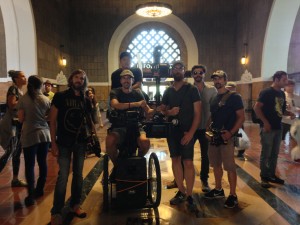
    The Fastcocreate article about the filming said that filming took 11 days and 2 separate days for Pharrell’s stuff.

    Those chosen by audition had the advantage of getting the song in advance, allowing them to rehearse their moves. But on the day itself, everyone got just one take, including Pharrell. “That’s what accounts for the charm,” says Valdes. “Everyone knew they had one shot–this was their moment to go all out, and we love that.” “The video’s imperfections, the funny bloopers and mess-ups, are what give it character,” says Pharell, whose own performances alternated between what he calls “semi-choreographed” (see the bowling alley at 11:00 p.m.) and improvisation. “I’m not interested in perfection. It’s boring. Some of my favorite moments are accidental. There’s one where I’m underground. I was turning a corner just as a train was coming in our direction, and it stopped right on cue! It was weird. The universe gave us great moments that day.”  … WAFLA chose to shoot in Los Angeles, … starting at sunrise in Downtown L.A., moving to LAX, Silver Lake, Echo Park and Hollywood, among other places, ultimately circling back to Downtown.

    Says a crew member:

    I was lucky enough to be a part of this as the location manager. It was a rough one. Not sure how Jon (Beattie)  did it. We did 12-15 hour days. There was a crew of 15-20 people with us at all times. Sometimes when we where shooting, we would have to make a u-turn to head back the other way. So all of a sudden, this mob of people would have to stand behind the camera, and do a 180 in sync. It was madness. There would also be times when we had to make a quick decision on which way to go. We would scout ahead and find out that the street was blocked, so at the last second, we changed the route. We also had fun with the talent. We would find someone walking down the street, and invite them to be a part of the video. It turned out amazing.

    Says another:

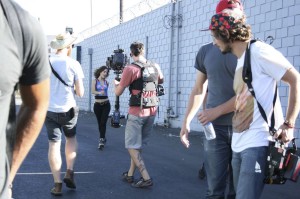
    The biggest obstacle was the fact that we were walking backwards through non-locked off streets and side walks. I ran into many a telephone pole and street sign, and on several occasions had to crawl under John to stay out of the picture. It was a lot of fun to work on, and I think the 4 minute edited version looks great.

    Background about the Video: 2 Minute Behind-the-Scenes Video and interview with the directors, Fastcocreate profile of the production process, A video production blog describes the lens, filming process, etc. I just learned that the steadicam guy who shot most of the vids was Jon Beattie.

    Other articles with lots of photos and snarkinessWe Watched Pharrell Williams 24 Hours Happy Video so you didn’t have to , Pitchfork’s 5 Best Things about the Happy Video, Christopher Grant Harris expanded account of dancers (with generous screenshots); Wikipedia page for the Pharrell Williams Happy song (it doesn’t yet have a separate page).

    My favorites so far are:  Happy Hair! 3:32AM,  Bollywood-style dancer Monica Moskatow  7:56AM, Elegant Blonde Girl in Street 9:56 AM (just magical!),  Jiggly guy with a fan 11:28AM,  Preteen Acrobatic Girl 12:28 PM, Asian Gene Kelley 1:28 PM,  2 Asian guys in tuxes in front of a Star Bucks 2:20pm,  Girl in Polka Dotted Dress 7:16PM (unbelievably good!) Man on Stilts at 7:36 PM,  Amazing & Speedy Guy at 10:44 PM (Amazing Choreography!), 2 Cute & Entertaining Girls at the Bowling Alley 11:08PM,  Hula Hoop Girl 11:40 PM  (but seriously I’m only getting started)

    How to Help:  If you know the name of any of the dancers, mention it in the comment section. (If you were one of the dancers who participated, drop me a line — I’d love to do a brief interview!). I’d also like to identify the buildings and neighborhoods if you know it. (I will probably look through Youtube comments for help, but give me time!) .  April 2 Update: I’m currently gathering information about places where everything was shot. I hope to have a nice map showing landmarks and dance paths fairly soon.  Stay tuned. I definitely appreciate everybody who identifies the dancer’s name. By the way, I’m behind on doing my screenshots and commentary, but the index of all the actors (at bottom) is updated every day.

    Tangential Aside #1: You may already have heard about the fatal car accident of Courtney Ann Sanford, caused by the Facebook update she posted while driving, “The Happy Song makes me fell so happy.”  What a tragedy! I do not condone texting while driving (and certainly don’t believe the song deserves any blame here), but this page needs to acknowledge that a song about being happy is just a song — ephemeral, distracting and even a bit escapist. All humans need a little bit of happy  in their lives, but we also need to recognize that happiness — like life itself — is a fragile commodity. Ultimately this dance video (and this page) is precisely a celebration of this ephemerality — while we still have time. Tangential Aside #2: You knew it was going to happen: some repressive regime was going to ban the song “Happy” or arrest the people who made the dance clip.  Seems like Iran couldn’t resist the opportunity to steal the thunder.  (Read more) This seems to come straight out of a Kundera novel.

    Dance Credits

    film-crew
    film-crew2

    List of  24 Hours of Happy Dancers

    (Taken from the Credits;  when I get time, I’ll try to add times to each dancer’s name)

    Special Guests

    • Buddy
    • Steve Carell 5:08 pm
    • Miranda Cosgrove 5:40 pm
    • Tyler, The Creator 6:16pm
    • Cyrcle
    • Gavin DeGraw
    • Urijah Faber & Michaella Tastad 8:36am
    • Luisa Fernanda Espinosa
    • Francesco
      • Jamie Foxx 5:28 pm
    • Ryan Heffington
    • Whit Hertford 1:04am
    • Magic Johnson 5:36am
    • JoJo 6:16pm
    • Jimmy Kimmel 11:48am
    • Leah LaBelle 12:00 PM
    • Alonso Mateo
    • Sérgio Mendes 10:32 am
    • Ana Ortiz 5:32pm
    • Kelly Osbourne 1:28am
    • Issa Rae
    • Fatima Robinson
    • Golden Sisters 11:36am
    • Bevy Smith
    • Earl Sweatshirt
    • Rob Zabrecky 10:12am
    • Odd Future 1:48 pm

    Dancers

    • Anna Abovyan
    • Kim Adams
    • Zaire Adams
    • Gianna Adams
    • Lisa Alcindor
    • Logan Alexander
    • Ben Allen
    • Lynette Almeron
    • Katrina Amato
    • Armond Anderson-Bell
    • Mecca Vazie Andrews
    • Rachel Angelini
    • Michael Angeloe
    • Kenny Apel
    • Judy Aquino
    • Freddie Araujo
    • CJ Archuceta
    • Ohmar De Arida
    • Leonard Baker
    • Belinda Bales
    • Natasha Zohra Banon
    • (uncredited?: Nathan J.  Barnatt? 11:16AM  His other dance videos are here and here )
    • Mary Bartnicki
    • Lauren Barzman
    • Megan Batoon 6:44pm
    • Dina Bedenko
    • Michael Beinuthy
    • Francis Raziel R. Belandres
    • Brianna Benford
    • Jude Berberian
    • Richard Berdecia
    • Lauren Bernard
    • Dave Birr
    • Nora Boghassian
    • Itsoso Bolivar
    • Amber Boone
    • Dena Bordelon
    • Brandee
    • Ray Brickerson 7:16am
    • Myesha Brown
    • Paula Bryisk
    • Al Burke
    • Delaney Burke
    • Alexander Burke
    • Kathryn Burns
    • Erin Burts
    • Bei Caldice
    • Kelly Campbell
    • Lucian Carter
    • Bryan Carter
    • Jacquan Carter
    • Shaquille Carter
    • Melissa Castillo
    • Erica Castillo
    • Ingel Catindrg
    • Josephine Cavalluzzi
    • Danielle Chambers
    • Seaonna Chanadet
    • Remey Chanadet
    • Cravon Charles
    • Joshua Christophe
    • Michael Churien
    • Germana Cifani
    • Tifani Ciotti
    • Stefani Ciotti
    • Joelle Claret
    • George Clarke
    • Alfonso “Enzo” Colichon
    • Brian Corona
    • Nicole Crepeau
    • Iman Crosson (aka Alphacat) 12:40pm
    • Omar Crossor
    • Joshua Curtis
    • Teresa Dablquest
    • Steven Dady
    • Brittany Daniel
    • Samuel David
    • Kelly W. Davis
    • Madison S. Deaver
    • Jean Delkhaste
    • Eric DeLoretta
    • Lauren deMauregne
    • Jessica DeShaw 3:08 PM
    • Rae Lynn Devine
    • Jennifer Deyaing
    • Jonathan Diaz
    • Gabe de Dios
    • Gina Dobson
    • Desarae A. Dotson
    • Bill Douglas
    • Abraham A. Duella
    • Emmet Duffy
    • Cindy DuLong
    • Jake DuPree
    • Joseph A. Bunaham Durant
    • Joe Van Dyke
    • Beach Eastwood
    • Lisa Eaton
    • Kota Eberhardt
    • Layne Eiler
    • Raymond Ejiofor
    • Frederick Emmerson
    • Brittany Falk
    • Chris Farah
    • Alyin Fernandez
    • Zamara Fernandez
    • Julia Fife
    • Heather Flores
    • Tibor Fober
    • David Charles Franklin
    • Sydney Freggiaro
    • Mariella Freyre
    • Jared Frieder
    • Galit Friedlander
    • Kathy Frye
    • Makayla Brooke Galindo
    • Callista Gallerani
    • Kimmy Gatenoor
    • Victoria Geil
    • Dianne Geivett
    • Arne Gelten
    • Karen Gevorkian
    • Brian Gibbs
    • Malik Gillins
    • Ronald L. Glass
    • Christopher Troy Gonzalez
    • Jamie González
    • Adisa Gooding-Henry
    • Alana Gospodnetich
    • Jasper Gough
    • Avery Gough
    • David Graf
    • Isaac Gray
    • Isaiah Gray
    • Alyssa Gray
    • Joy D. Green
    • Rodnesha Green
    • Andrew Grosso
    • Sarah Gul-Mohamed
    • Moniqu Guzman
    • Luke Haeger
    • Erik Hall
    • Tamara Ham
    • Erina Hamada
    • Juliet Hantig
    • Matt Harfield
    • Kelvin Harris, Jr.
    • Ryna Harrison
    • Aye Hasegawa
    • David Hawkins
    • Ivy Heeny
    • Josh Heller
    • Naomi Henderson
    • Nic Hernandez
    • Eduardo Hernandez
    • Bonnie Hernandez
    • Amy Hessler 6:12 AM
    • Aaron Hicks
    • John Hicti
    • Natsuko “Coco” Higashikawa
    • Marlee Hightower 6:48am
    • Marlon Hightower 6:48am
    • Olana Himmel
    • Amalia Holl
    • Anne-Marie “Diamondback Annie” Holman
    • Alyssa Hovey
    • Isaiah Howard
    • Corlina Hoyes
    • Steve Huang
    • Christy Huertas
    • Giulia Isacchini
    • Shawntae Jackson
    • Tami Dewell James
    • Ellie Jameson
    • Michelle Janine
    • Daniel Jaquez
    • Morgan Jenkins 11:44 PM.
    • Saudia Jenkins
    • Sarah Jenks
    • Trent Jeray 3:52 PM
    • Diamond Johnson
    • Jackie Johnson
    • Brittany Johnson
    • Dorothy Jean Joly
    • Grace L. Jones
    • Mao Kawakami
    • Sammy Kaye
    • Briana Kennedy
    • Jeremy Kesner
    • Torey Ketcham
    • Ara Keuroghun
    • Beckie Kiefer
    • Callie Kiefer
    • Ellen Kim 2:04 AM?
    • Essence King
    • Princess King
    • Jason Richard Kirby
    • NayNay Kirby
    • Kasi Kirkpatrick
    • Daniel Kwan 1:32am (more)
    • Bailey LaFlam
    • Quinn Lake
    • Scott Laurie
    • Jamie Lawrence
    • Julia-Thao V Lê
    • Georgina Leahy
    • David Leavitt
    • Harlem Lee
    • Brian Lee
    • Kendel LeGore
    • Francesca Leigh
    • Alexandra Lemelle
    • Will Leon
    • Cynthia Lester (IMDB) 4:48am
    • Siláwn Lewis
    • Tanita Ligons
    • David “Dash Riprock” Lipkin
    • Dava Liu
    • Everth López
    • Mandi Lowery 2:24 AM
    • Aerick Luckie
    • Anthony Andre Mack
    • Naiqui MaCobroad
    • Bill Manaqun
    • Alfredo Mancuso
    • Kathleen Mangan
    • Artur Manvelyan
    • Cerise Marchon
    • Teri Marlowe 4:36pm
    • Jamel Marshall
    • Isabel Martin-Horwth
    • Jose Martinez
    • Eddie Martinez
    • Jore Mana Amsel Martinez
    • Nikki Marvin
    • Tony Maseno
    • Hillary Matthews
    • Sean McBride
    • Ashleigh McGordan
    • Brian McGowan
    • Katherin McGowan
    • Jos McKain  (misspelled in credits as “Jes McKain”)
    • Erinilda Medeiros
    • Sergio Mendes 10:32 AM
    • Alberto David Mercado
    • Darwyn Metzger
    • Mikayla & Callie
    • Dustin Miller
    • Kevin Mimms
    • Albert Minero, Jr.
    • Ariana Moini
    • KC MoMillan
    • Nylah Mondesir
    • Chloe Mondesir
    • David Moore
    • Edgar Morgan
    • Tommy Morrison
    • Monica Moskatow 7:56AM (her youtube channel and her Happy Dance Audition!)
    •  
    • Omar Mosley
    • Aliyah Moulden
    • Terence Mufaland
    • Mike Munich
    • Jenny Muscatelli
    • Cameron Navam
    • Justin Nesbitt
    • Kevin Nguyen
    • Joseph Niemeier
    • Tyrell Noel
    • Warren Nomi
    • Deanna O’Bryan
    • Natalya Oliver 1:36PM
    • Jouré Omar
    • Annabell Osorio
    • Jon Overgaauw
    • Roxanne “Roxy Rene” Pacheco
    • Mitch Pearlstein
    • Marlon Pelayo
    • Rhoda Pell at 9:04AM.
    • Brianna Perez
    • Tuyla Peters
    • Trina Peterson
    • Trina Nicole Peterson
    • Timothy J. Petracca
    • Breanna Phillips
    • Avelavunee Phillips
    • Brian”BJ” Pierce, Jr.
    • Fatima Poenyoub
    • Frankie Ponce
    • Tara-Jean Popouich
    • George Powell
    • Ashton Powers
    • Ondreu Psenicka
    • Allison Quiller
    • Jon Raagas
    • Mattias Ramos at 5:56 AM Original audition video is here.
    • Charlie Ramos
    • Samuel Ramzy
    • Beau Ray
    • Rebecca Ray
    • Gavin Logan Raygoza
    • Jonathan Redavid 2:20pm
    • Vicki Reed
    • Amber Reed
    • Lupida Resh
    • Heather Reyes
    • Victor Reyes
    • Alfredo Reyna
    • Holly Richards
    • Hannah Richte
    • Veondra Roxxanne Riley
    • Luisa Rivera, Jr.
    • Billy D. Robertson
    • Estella Robinson
    • Jack Robinson
    • Alfonso Rodriguez
    • Nick Rodriques
    • Meredith Rogers
    • Sapna Rohra 9:16 PM
    • James Ross
    • Dylan Russcet
    • Faisal Salah
    • Azzle Salais
    • Olivia G. Salerno
    • Anastasia Salinger
    • Sasha Salinger
    • Elin Sandegard
    • J. Eric Sandoval
    • Anthony Sands
    • Reynaldo C. Santiago, Jr.
    • Sami Martin Sarmientov
    • Daniel Scheinert 1:32am ,(more)
    • Page Schorer
    • Page R. Sdn
    • Mahesh Seneviratue
    • Chaldea Sevilla 6:32 pm
    • Kristen Shapero
    • Loretta Shenosky 9:16AM.
    • Kiara Sieen
    • Melanie Siegel
    • Simmie “Boobly” Sims
    • Felicia Skrzypek
    • Jarrett Sleeper
    • Aaron Smith
    • Sterling Smith
    • Lauren Smith
    • Gwendolin Smith
    • Harpal Sodhi
    • Hannah Sotelo
    • Samie Soulogheh
    • Hope Spear
    • Anaya Sperlin
    • Neal Spinler
    • Carole Stanford
    • Melissa Staroszik
    • Ross Steeves
    • Athena Sterig
    • Alejandra Suayde
    • Yannnus Sufandi
    • Art Sughyan
    • Genevieve Svehiak
    • Theodore Szeto
    • Joanna Szeto
    • Etsgenet Tadesse
    • Arlene Tai, 4:20 PM
    • Ada Tai, 4:20 PM
    • Tsuyoshi Takayama
    • Mikaela Tallut
    • Louisa Tampi
    • Justine Tauriainen
    • Shaka Terry
    • Hondo Tey
    • Cleveland Third
    • Dayzjah Thomas
    • Whitmer Thomas
    • Jason Sensation Thomas
    • Ella Thomas
    • Nyah Monet Thompson
    • Cynthia Marie Thompson
    • Kumei Tneorio
    • Arleen Torgersen
    • David Torres
    • Gustavo Torres
    • Shenika Travis
    • Angela Trimbur (aka the “Dance Like Nobody’s Watching Girl”)  12: 24 AM
    • Marilou Troadec
    • Derrick T. Tuggle  12:20AM 
    • Alceem Turner
    • Nadia Vazquez
    • Tyler Vazquez
    • Clayton Velasquez
    • Liane Vitzk
    • Tonya Vivian
    • Minn Vo 2:20pm
    • Kara J. Wade
    • Bo Walker
    • Zoe Savannah Walker
    • John Ward
    • Jasmiru Shira Ware
    • Daisy Washington
    • Charity Watts
    • Ricky Webb
    • Brooke-Monaé Westbrook
    • Michelle Westbrook
    • Shawna Whitlock
    • Dallas Wiley
    • Deferra Williams
    • Ashley Williams
    • Xuly Williams
    • Josh Williams
    • Nicholas Williams
    • Rosalind Williams
    • Deshawnte “Smoothgalaxy” Williams
    • Phoebe Wilson
    • Michael Wilson
    • David Wincheu
    • Jenna Winn
    • Connie Wong
    • Alex Wong
    • John Wusab
    • Drew Wyman
    • Malcolm Xavier
    • Francesco Yates
    • Maritza Lerman Yoes
    • Gina Young
    • Katherina Zabe
    • Katrin Zales
    • Adisa Ziric
    • Isabella Zubor
    • Jill Zwarensteyn
  • A Slight Detour about Annoyingly Soapy Hair

    I often wonder if anything I say or think or write is original. Sometimes I will think of an allegedly great idea, but before I get too excited, I google a few keywords nervously — to see who beat me to it.  Google is  the ultimate humbler of humanity.

    Today, though, I think I will blog about a subject, and I sincerely believe I am the first to do. (Feel free to prove me wrong!)   And yet what I am about to write about is so familiar and prosaic to each of us that no one would bother to.

    This morning I was taking a quick shower — and not thinking about chocolate —  and when I stepped onto the bathroom floor, I dried myself thoroughly  and began to assemble the necessary tools for shaving. But I happened to brush my hand against my head — only for a millisecond, mind you — but long enough to surmise  that I hadn’t completely  rinsed the  shampoo suds from my hair. I immediately felt  the gooey mess and heard the wrinkly sound of lather. Yes, it was true, my hair was only half-rinsed; so now I would need to return to the shower to finish the job.

    It was only somewhat annoying, a slight detour in my day. It meant that drying myself would no longer be as satisfying as the first time, and the cool sensation of leaving a shower refreshed would be tempered by the paranoia that maybe my head of hair is not completely rinsed. (It has happened a few times; I return to the shower a second time and think that I rinsed everything out, and then to my horror discover that I had omitted one of the sides from this second cautionary rinse).

    As I started to shave, I began calculating. I probably commit this kind of washing miscalculation once every 10 or 15 days (that’s 25 times a year!) I would say I have a good 70 years of 1750 washing miscalculations for my lifetime (assuming 1 shower a day).  Out of the 7.1 billion people on this earth, let’s guess conservatively that they commit this same washing miscalculation 20 times a year. Let me see: that equals:

    140 billion times in a year that people are stepping out of the shower without realizing that they have forgotten to rinse their hair.

    That’s a really big number.  Think about it: despite the fact that everyone is doing it, there doesn’t appear to be any web pages by or about people who have made this mistake. Don’t believe me? Try here or here. (Actually here or here does produce something relevant though not particularly meaningful or lasting). The event is so mundane that it has never occurred to anyone to write a separate article about this phenomenon.

    One way to look at the thing is to say that this experience is something so vague that a search engine couldn’t possibly help you to find people’s descriptions of it. A friend and I were remarking at how useful search engines are for looking up and verifying facts. Sure. But that doesn’t imply that Google is actually useful. It’s like the paradox of not being able to verify the spelling of a word because you need to spell it correctly to look it up. Many of life’s questions are so  vague and imprecise that search algorithms are practically useless. Even our proper names are no longer unique enough  to find what we need. I’m sure AI and natural language processing will improve, but so will the amount of  random garbage on the Internet, and so will the challenge of sifting through things. Many are so alarmed by the NSA and the Echelon System that it might not occur to ask whether the NSA is actually equipped to sort through all the noise.

    Decline of the Search Paradigm

    In 2009 I attended  an education panel hosted by 4 undergraduates  attending elite institutions.  It was ironic, because the audience was packed with probably about 100 teachers or geeks. Most of the audience members  felt that we had a good grasp of reality and Internet reality, but we still were curious about how college students were learning in this Internet-addled age. The students on the panel  talked about collaboration, how they used social networking tools and how Internet changed the way they learned. It was fascinating; several talked about how it was changing the study of literature;  another talked about the awesomeness of getting help from someone thousands of miles away.

    During the talk one student mentioned how useful the Internet was in giving them suggestions about books to read and references to consult, I called out rather indecorously, “How do each of you find new authors to read?”

    The students, slightly annoyed at my interruption, but willing to answer, said, “I just google it.” The other three students chimed in with the same answer,  “Just google it” —  and then they continued their prepared remarks.

    10 minutes later was question time, and I jumped up to the front of the line to ask a follow up.  “You said that google helps you to find out about new authors or musicians or artists. Can you explain?”

    All four of them looked at me as though I were a crank. “Well, it’s not too hard really. Just go to the search box and type something. Then follow the links.”

    “Excuse me, but what exactly do you type in the search box?”

    “The name of the author.”

    “And how do you know what name to type?”

    The panelists shrugged. “Just follow any web page.””

    I understand that the Internet can help you locate more information about a topic, but only when you know what you want. But how do you know what you want?

    Being adept at devising a search term   (such as “best American author” or “recommend a 20th century novel” + American) will  get you only so far.  But lately I’ve noticed that even google’s sturdy algorithm is being weakened by dictionary sites, spam sites and commercial interests. When every company is trying to optimize for search results, then it is possible to programmatically manipulate the results. Some kinds of inquiries don’t yield anything meaningful; it’s not always easy to think of a unique combination of words and phrases to get the results you need. With facebook, stackexchange, quora  and other social media, you can receive lots of tips; but then again, people are responding to your questions; you are not finding these things out on your own, but relying on a certain number of people hanging out at these places who would be willing to provide some scaffolding for the edifice of your education.

    Perhaps it’s an obvious point, but the  topics which occupy most people’s attention are not necessarily the most helpful. Several of my conservative friends link to superficially optimistic articles about climate change, but who would seriously think that the URL most likely to appear on top of search results  (presumably from search-optimized CNN or NYT) would  also be the most authoritative  or accurate?  Even if we discount outright propaganda, the things displayed  by search engines may be neither relevant or important. Remember: there are probably more websites about the Gilligan’s Island TV  series  than the movies of  Ingmar Bergman.

    It’s ironic that the things pressing for our attention at any given moment can also be the most transitory.  Let’s see, current events today  talk about the LAX shooting, the final day of the Virginia governor’s race, the abortion lawsuits, the new Hyundai, refinancing with lending tree, What does the fox say?, the Obamacare website, the new Netflix titles. All screaming for your attention today, and then 10 years from now will disappear.  Perhaps this is a loss for  us all, but  the lesson to be learned here is that the things which appear to us so urgent today can easily disappear without a trace.

    It’s commonly assumed that search engines are good at looking up names and titles and dates. But suppose I wanted to find the name of a novel whose title and author escaped me.  One of my favorite novels was Nicholson Baker’s “The Mezzanine.” But what if I forgot the name of the author and title and tried to google it using some keywords? I remember the novel used a lot of footnotes, wasn’t particularly long, was clever, had a scene about drying one’s hands in the bathroom, had another scene about shoelaces and had a long series of digressions and ruminations about mundane things. If I typed “novella  literary hand dryer clever mundane  digress American  bathroom shoelace ruminate footnotes” into google and bing and wolfram alpha, one might feel confident that someone somewhere has used many of these words to describe  Nicholson Baker’s  novel.  My search query may be overlong, but it contains lots of distinctive words; even if a single web page is unlikely to contain ALL of these words, a good search engine should be able to compute the web page which is likely to be most relevant to these words.

    So here’s the search results for that query.

    search-google-mezannine
    bing-mezannine

    Bing results are similar;

    I don’t expect Google or Bing to get it exactly right, but we’re not even coming close. The search engines just provide awful and misleading results (and I’m not even including the ads).  Although shortening the list of keywords does  bring more interesting results, it is still nowhere close to the answer.

    I will admit that my search term isn’t exactly the best. To vary my approach a bit, I chose a more generic search term  Best American novel in the 1980s, and received decent relevance in results (although not THAT good).

    recommend-good-novella80s

    When I recited those  same keywords for the Nicholson Baker book over the phone  to a literary friend,  he  correctly guessed the author (though not the book itself). If you were in a classroom with 20 well-read people, I suspect you would get better answers. If you asked on a site like Goodreads to name the book where a lot of people would see it, I suspect you’d get  the right answer. This question seems esoteric, but for a moderately erudite  audience, it is not esoteric at all.

    409px-Richard_Dawson_Family_Feud_1976

    But search engines are not particularly good at these fuzzy  kinds of questions. Even in cases where a search engine can match a fuzzy question with an answer, the ordering and prominence is determined by how well the site was optimized for search engines — and also whether the company paid for ad placement.  If anything, Google can find pages where the wording of your question appears prominently — like a forum or a stack exchange site. But if the way you phrase the question doesn’t parrot the way other people do, you are out of luck. In other words, in 2014 the ability to get useful search results depends mainly on how good a Family Feud contestant you are.

    We used to believe Google was so amazing because 1)back then there were significantly fewer web pages and  2)Google presented lots of results. Do you remember when you could set Google to display 100 results on a single page? Even if Google didn’t bring the answer to your query, it nonetheless provided up to 100 different paths you could explore to find it.  Perhaps at one time those Ivy league students on the panel could pick a random link in search results  and follow things. But whenever I start from a search result, I have this uneasy feeling that it’s all one huge conspiracy to trap you inside a gigantic and self-contained  network of advertising and promotion. On mobile devices it’s even worse — it becomes harder to tell the difference between ads and organic search results. Human laziness will make you choose whatever pops up in the first three results, no matter how commercial it seems.

    Comparatively speaking, searching for proper nouns is  easier than searching for concepts or abstract phrases.  (That is why I end up going to wikipedia more times than not… I want to find some neutral site that doesn’t have a secret agenda to destroy someone’s reputation or laud him as a captain of the industry.  But wikipedia waters down everything.  It almost seems proud of the fact that nothing on the site is original or insightful).

    I remember once  talking to a translator in Albania. We had a delightful conversation, but he playfully scolded me for simplifying my language when talking to him.  “Why is that bad?” I asked him. “Isn’t accurate communication the goal of teaching?”

    “Not really,” he replied.  “The thing which most interests the translator are those  hard-to-translate or untranslatable expressions. These “untranslatables” are the most valuable part of the language and  often the key to the cultural peculiarities of the people who speak it.”

    I’m not sure I agree. But surely whatever is  hard-to-express inside a language  has value .. and certainly those linguistic qualities which make a web page easy for a search engine to parse also make it less interesting.  It’s clear to me that search engines fail to provide relevant results fairly often — for various commercial and linguistic reasons. Perhaps human vanity fools us into thinking that our experiences are unique — rather than the more likely fact that Google isn’t providing  an accurate picture of the world’s experiences and thoughts. Instead of expressing wonder at the ability of Google to turn up interesting results, we should be lamenting the fact that Google continues to lead us down well-known paths of stupidity.

    Notes

    I am less excited by the fact that search engines have given special prominence to Wikipedia because of its commitment to the  “neutral point of view.” (NPOV) Enshrining the NPOV means that wikipedia page will exclude a lot of  analyses and points of view; it shudders towards the obvious and noncontroversial. Even if that is better than commercial search engines, I can’t help but wonder if Wikipedia just helps to flee from one watered down path to another.

    2022 Update. I am happy to report that my original search query about accidentally stepping out of the shower with soapy hair produces more meaningful results. 8 year later, search results produce What seems to have changed is that search results are dominated by major media sites, with little to no articles on indie sites.

    2025 Update. Wow, a lot has changed since 2022. I asked Copilot AI and Perplexity the following question:

    Guess the title and author of an English-language novel with these clues: 1)It was published between 1985-1995, 2)it contains a scene where the character is drying his hands in the bathroom with an electric hand dryer, 3)it is humorous and contains many footnotes, and 4)All the action of the novel takes place during a very small time frame (30 minutes or less).

    The answers were shockingly on point: Copilot said in the first line, “It’s almost certainly The Mezzanine by Nicholson Baker” and then explains how it satisfies the four conditions. Perplexity hemmed and hawwed and guessed If On a Winter’s Day a Traveler, then, it realized that the date was wrong and suggested that it “appears” to be describing The Mezzanine. This is great news — but I have to wonder how commercialism will intrude on AI answers in the future.


  • Interview with Michael Barrett (Writer and Movie Critic)

    Michael Barrett is a San Antonio writer and critic who has been publishing essays  about cinema and TV for more than 20 years. His screenplay for an animation feature is currently  going through image“development heck.” Other projects include writing children’s fiction actually intended for adults   and appearing in a still-unreleased comic video about the life of John Ruskin.  In addition to currently writing articles and reviews for the San Antonio Express-News, Video Watchdog magazine, and  PopMatters, he keeps busy selling old books on Amazon. I’ve known Mike since college where we collaborated on a literary magazine  and  I ran the film projectors for an international films series  Barrett  headed. Barrett’s forte is  writing longer analytical essays about obscure cinematic genres under the guide of DVD reviews.  In one of his more notable essays, You are Living in the Golden Age of Cinema, Barrett asserts  that he doesn’t believe in the myth of declining quality of cinema (when compared to “golden ages” like the 1970s.)  “The new problem is getting … noticed amid all this overwhelming superfluity of access, but I submit that this is a much happier problem than not finding a distributor—of which there are a surprising number during this so-called decline, and an increasing number of festivals and labels and channels hungry for product.” (A brief annotated list of his cinema essays is at the end—Also, every text link included in this interview takes you to the relevant Barrett  essays). Finally, even though this hyperlink is not active, I’ve been reproducing MB’s private end-of-the-year book & movie recommendations which he circulates to friends. The URL is here:  https://www.personvillepress.com/11378h/private8/mike-list.txt  (I add the latest recommendations every year to that URL). The interview took place in February 2012.

    January 2022 Update: About 1/2 the hyperlinks in the article are broken. Have no fear. The articles are all there, but Popmatters changed all the URLs, so I’m in the process of updating them — by going to waybackmachine.org to find the title and then googling that).

    Personal Observations

    You once mentioned to me that every film inevitably has a mirror scene, something which I’ve noticed ever since you pointed out. Are there any other secrets or rules of thumbs to cinema which you’d like to share?

    Yes, and the mirror scene is often the very first or last scene. I’ve just watched Fassbinder’s German sci-fi TV movie World on a Wire, which we can safely say has a mirror in every scene!

    imageI have facetiously complained that all foreign movies have a scene where somebody urinates; this goes all the way back to Bicycle Thief. Maybe it’s not all foreign movies, but more than fifty percent, and now it’s spread to American cinema.

    My personal rules of thumb have been to watch anything silent and anything Japanese (so Japanese silents must be the apotheosis!), and I pretty much think anything from Eastern Europe is worth watching, and most items from Iran and Africa. Eastern European movies are very “film school”, while films from “emerging” countries have a directness bordering on audacity, which has nothing to do with lack of sophistication and perhaps something to do with oral traditions.

    (more…)
  • Breakfast: An Autobiography

    Note: I have no idea whether other people might find this essay interesting. Writers tend to find everything interesting, and everyone tends to find  himself  interesting (much to the dismay and/or boredom of others). But I had fun writing it because it opened up a lot of overlooked memories (both olfactory and non-olfactory).

    Breakfast: An Autobiography

    I am typing this on the bus at 7:30 AM — thinking about breakfast. It’s one of those  banal and obvious topics which few people get around to writing about.1 Meals are specific to a time and place; when we read a book or journal, we assume that the normal daily routines of the people we read about are similar to  our own:  dressing, sleeping, going to the bathroom, eating, washing up, going to work, etc.  But that is a mistake.  Whenever I travel or visit someone’s house  (even if it is only to my sister’s house 200 miles away), I am struck by the differences.  That is why I think it’s valuable to describe my own daily breakfast routines.  They  aren’t  terribly original or interesting –  just different. But the exercise reminds us about how different each of our lives are – down to the smallest detail.  We share a common reality, but not a common way of  experiencing the daily rhythms of life.  Even for breakfast.

    Growing Up – Student Years

    frostedminiwheats_cereal

    While growing up, I had almost no memory about eating breakfast. Maybe I ate cereal at my mother’s insistence, but generally I did without it. The cereals I chose were sickeningly sweet. Either I chose Life cereal or Frosted Mini-Wheats;  later I switched to Spoon-Sized Shredded Wheat, but this cereal literally had no taste, and I learned only later that the processed high-carbohydrate cereals all have the same number of calories anyway — so I might as well have sugared it up.  Later I learned that the alleged nutrients  on the cereal label came from additives and fortified milk. The cereal itself was just a bunch of sugary crap.

    I knew from an early age that fruits and vegetables were important, so I probably included a banana with breakfast – though it seemed more of an afterthought.  It was a way to convince oneself that one’s diet was healthy and balanced.

    (more…)
  • Interview with Monk Turner (Creative Commons Musician)

    (See also my profile of Monk Turner: LA Song Writer and Concept Album Creator, his official website and musical blog. All of his albums are free for downloading and sharing from various places).

    Musical Inspirationsofficial2lights-reduced

    How has your biography or geography affected the kind of music you make? What do you think is unique or different about your music?

    When I started playing guitar, I learned mostly classic and alternative rock with deep roots in the blues. Then when I did the band thing, my focus became surf, hardcore punk and Latin music. Towards the end of my ‘band’ career I was playing gospel and country music. I had grown up playing in bars since the tender age of 15 and was getting burned out on it. I loved the art of songwriting but I was done playing music for drunk people and making money for alcohol companies. It was at this time I started focusing my efforts on writing and recording.

    Geography has also definitely played a huge role in my music. I’ve been doing solo music under my name for 10 years as of 2011. For about 4 of those years I lived in Texas where, as you probably know, the weather sucks and there isn’t much to do. During this time I had the most creative output but a lot of those songs are pretty rough around the edges. Living in LA where the weather is almost always beautiful and there is an abundance of distractions, my output has slowed down quite a bit. I’m lucky to get one album released a year. The flip side is that  quality of my music has improved dramatically because of the incredible pool of talented musicians in Los Angeles. Living here is an inspiration unto itself.

    As for the music itself, what makes it different is that I’m not restricted by genre, distribution, band members, or money. There aren’t a whole lot of people doing concept albums these days either.

    What other musician or musicians have inspired you?

    Elvis Costello is a huge influence and is by far my favorite recording artist. Not only do I love his voice and his music, but also I also love his artistic integrity. He’s never compromised and always made the music he wanted to make without worrying about a label liking it. That is such a rarity and thanks to that philosophy he’s got such a deep range of music.

    That said, I’ve always considered myself more of a fan of music than a music creator. I just love good music regardless of the genre. I’m constantly inspired by music that is completely opposite from what I do. I’m also inspired by the musicians who play on the albums. The majority of the time when I sit down to write a song, I have a specific person in mind who I think would sound great on it. Duke Ellington did the same thing when he was writing his horn parts.

    Can you name someone who is NOT a musician who has provided inspiration for your creativity?

    I can think of something that is not music related that constantly inspires me. That would be advertising and the creative process. I studied creative advertising at University of Texas which gave me a strong foundation in conceptualizing. Think of a campaign like the famous ‘Got Milk.’ That is a huge idea that has been executed a ton of different ways but maintains its strong central idea. I also feel the role of the copywriter and art director in advertising is similar to the role of a lyricist and composer. I draw a lot from the ideas of effective mass communication when approaching a concept album.

    I keep humming the sung Easy on the Eyes, Who Da Ho Idaho, Nuts, Get Up, Do Your Thing. In fact, I am having trouble getting rid of them! Are there techniques you consciously use to make your songs “catchy”? Or do you just let the songs grow into whatever they turn out to be? Do you consider making a catchy song a primary goal of the songwriter?

    Wow! You’re digging through the concept album crates, eh? Those are indeed some catchy tunes and yes it is by design. Like I mentioned earlier, I am obsessed with the craft of songwriting. How does the writer catch someone’s attention, keep them engaged, and have them come back for more? I feel like my older music and the examples you mentioned were very hook based. I’ve been slowly moving away from that. With Emergency Songs, the music is designed to be a bit deeper and a little less catchy. My goal these days is to create music that has deeper hooks that aren’t quite as in your face.

    Do you think the music biz tends to squeeze out people who straddle both camps of song writing AND performing?

    That’s an interesting question. Back in the day, you had songwriters and performers as two separate entities. The Beatles and Bob Dylan did a really did a lot to change that dynamic. I actually consider myself more of a songwriter than a performer though I do enjoy being on stage. I think these days there are those who perform other’s material and those write their own.

    The Creative Process

    Mad lib time. Fill in the blanks. To be a great songwriter, _____________________ is not really necessary, but ________________________ is absolutely required.

    To be a great songwriter, being able to sing and have proficiency on an instrument is not really necessary, but the ability to communicate an idea that connects with people on an emotional level is absolutely required.

    How did the idea for the Taking Requests album get started? Were all these requests from actual people? Were there any song idea requests which you were unable to turn into a song?

    I wish I could tell you where I get most of the ideas for my albums. Honestly, they just kind of come to me. All of the requests came from actual people. I was able to get a good amount of the people to read their own request on the album. There were a whole lot of requests that I didn’t get to write songs for and they can be found at the very end of the album. The track is about ten minutes of requests being read simultaneously in the left and right speaker.

    You mentioned that you wrote all the songs for your Love Story album in a 2 week period, a feat I   find to be incredible. I realize that you’re not taking into  account the time to edit, produce, and mix the songs or obtain feedback, but how do you manage to do the writing part so  quickly? Do you spend that time  cooped up alone in some cabin in the woods?

    I never really plan it that way. Since I tend to take such long breaks between albums, I have a lot of creative energy saved up. When it comes time to write, I have a database of little song ideas I’ll use for inspiration. Most come to me while walking down the street or driving around town. Sometimes there will be a music theory concept I just want to try in a song and that will get me started. Sometimes I will just be playing along to music I like and jack a chord progression. However the ideas come, it is definitely my favorite part of the process and it happens very quickly.

    Can you talk a little about your creative process? What parts about making music are the easiest for you? What parts are the most difficult?

    reduced-editingI learned a lot about the creative process while in advertising school. I’ve since developed a way of writing music that goes through several stages from idea to mp3. It normally starts with me singing a melody into my phone. From there, I’ll record an basic accompaniment with one microphone and save it on my computer. I’ve got a folder full of ideas that I go to when I’m working on an album. Then I’ll record a rough demo and flush out the idea a bit further. Sometimes I’m coming up with lyrics on the spot that will later be revised. The next step is to email the demos out to about 30 people whose opinions I trust to get feedback on what is working and what isn’t. From there I’ll rework the songs and create an arrangement that slowly grows as tracks get laid down. When everything is done, the album goes out into the world!

    The easiest part is writing the music. Normally I can write whole album in a little under two weeks. The most taxing part is on the backend. Editing, mixing, and sometimes tracking my own parts can be a real headache.

    Emergency Album

    official1building-smallAs far as I know, the Emergency album was your most significant collaboration effort to date. How did you find Alanna; did you write the songs with her voice in mind? Did Emergency teach you any big lessons about collaboration?

    I’ve known Alanna for about 5 years now and before this the extent of our relationship was that we were Facebook friends. We have quite a few mutual friends and would often see each other at the same parties and concerts. I also knew she lived somewhere in my neighborhood. I had no idea that she was a singer until one day she posted a cryptic message on Facebook. I emailed her asking if she’d be interested in doing an album with me without ever actually hearing her sing. After I heard a demo she had done, I not only fell in love with her beautiful voice but also was fascinated by her brilliant lyrics. I had done many collaborations on past albums but never a whole album with one person. My experience in this collaboration and others is that one must know when to compromise and when to stand their ground.

    As for the music itself, it is important to note that she co-wrote all of the songs on the album. While producing and arranging the album, I constantly was making sure I was creating music that complimented her style of singing and the feeling of the song. There were quite a few moments in to process where I thought to myself ‘wow, I never thought I’d be doing a song like this.’

    How did you arrive at an earthquake as a subject for an album? Did you have any experience (either first-hand or second-hand) with earthquakes? Were you the type who imagines hypothetical disasters during idle moments?

    We spent a few months narrowing in on what the concept of the album would be. Previous to our collaboration, Alanna had been focused on a project known as “Prepare the Ones You Love” which came out of her involvement a near fatal bike accident. This was a life changing event for her that led her to question many of the relationships in her life.

    As for quakes, I grew up in Northern California and experienced a few medium-sized shakeups as a kid. I moved to Florida before the Candlestick Park earthquake destroyed my hometown of Santa Cruz, CA. While in LA I’ve been through a very small handful of small quakes but nothing very significant. I figure no matter where you live, you have to worry about some sort of natural disaster. I must say that ever  since the Japan quake, I find myself getting little panic attacks when in tall buildings and elevators.

    For me, the song that really stood out was O Say Can you see the future. It is brooding, tentative, turbulent, otherworldly, haunting, desolate, mysterious, violent, hazy and even tranquil. So many emotions packed into a single song! I was particularly struck by the musical bridge in the middle which provides a vivid and frightening sound portrait of what it must feel like to live through an earthquake. Yet for the rest of the song the flute solo skips along gently — like a butterfly fluttering above the wreckage. (Alanna does an amazing job there too!)

    Can you talk about how you scored & produced that song? Did all the pieces of that puzzle come together easily or was it a long hard struggle?

    Interesting you’d pick this song since indeed it was a struggle. Alanna had a large role in the direction of this song. This was one of the first songs we wrote together and the demo I presented to Alanna was completely different from what you hear on the record. Completely different! After we came up with a guitar/vocal version that worked for us, I kept wanting to take it in a jazzy or electronic/industrial direction. There were quite a few drafts that fortunately didn’t see the light of day. Alanna had this vision of the song being heard in the spooky part of a movie and she was also the one who suggested it needed a flute. When Sukari Reid-Glenn laid down her incredible flute part, all of the elements finally seemed to come together in a cohesive manner. That’s the creative process for you; sometimes you’re done in 15 minutes, sometimes you go through a ton of versions before finally landing at the right spot.

    I was struck by how every single song in Emergency was in a different musical style and even a different mood. Did you consciously try to compose everything in a different style and mood? Or is that something which inevitably happens when you do a concept album?

    I often get the question, “What kind of music do you play?” to which I respond “conceptual music.” And so it is that a concept album can be free of the confinements of fitting a certain categorical mode. That said, I think this album is the most consistent stylistically among songs. Some of my past albums are really all over the place.

    As ashamed as I am to admit this, I found parts of Emergency to be hilarious. After Disaster is ostensibly about love and separation, but the ridiculously maudlin lyrics make it clear that the listener shouldn’t take the character’s words too seriously. The Prisoner song — about a prisoner who inadvertently is able to escape during the aftermath of an earthquake — is great ironic fun. Why the humor? Did you worry about injecting too much lightheartedness into this album?

    I think the humor comes from what happens when Alanna and I are in a room together. We’re both quite irreverent and knew that in diving into such a serious topic, we’d need places to lighten it up a bit.

    Of course, there is the amazing coincidence that the Japan Earthquake happened mere weeks after you release your album. If you embarked on the same album today, how do you think you might have approached the album differently (if at all)?

    We were both quite taken by the tragedy in Japan. We stopped all promotional efforts as soon as we heard the news. The “We Love Japan” video was a good reminder that the music could be used for the right purpose. I think the thing to keep in mind is that the album isn’t about what it is about. FMA’s Jason Sigal captured it best when he wrote “the theme seems to be more about transcendence than doom; about appreciating life because it won’t last forever.”

    To be more directly answer your question, I would do this album again but I couldn’t see doing it with anyone but Alanna. She is a brilliant writer and her lyrics really do go beyond the basic concept of an earthquake. She is one of the few people I’ve met that understands the concept of ‘a big idea.’


    Love and Hippies

    One of my favorite songs is the She’s the All American Hippie Girl. Lightly satirical and full of fun (and probably a crowd pleaser too). But it also had a political message (sort of). Are you the kind of person who is eager to tackle social or political themes in your music?

    Haha. That tune is about an ex-girlfriend of mine. She had really upset me one day and I sat down and wrote the lyrics as revenge. There are actually quite a few songs I’ve written that are political such as New Downtown, March in March, Hot July, and pretty much every song on New American Songbook. I’m quite passionate about social justice and it definitely can be heard in some of the music I write.

    I’d like to know more about your other big collaboration, Love Story and the people who helped make that for you. Did you write these songs knowing who would be performing them?

    Yes. I knew ahead of time who I wanted to appear on the album. I love writing for a specific person’s voice. There were also a few songs that came together towards the end and we brought in singers and musicians that I didn’t know would appear on the album. So about half planned, and half fate. Much like love.

    How did you meet gospel  singer Sherdale “Sip” Smith?

    We  met while working together at a music program at a community center in South Central.

    In your notes, you say that a portion of the Love  album has been altered to keep with the Buddhist tradition of human imperfection. Explain.

    You’re the first person to notice that! Anytime you visit a Buddhist temple, there are  intentional human imperfections in the art. In creating Love Story, there is a place at the end of If She Gives you Her Heart where the flute and the rhodes have a really bad phase issue. I couldn’t figure out how to resolve it no matter how many mixes I did so I just decided to leave it in in honor of the idea of Buddhist imperfection.

    What’s the hardest thing about writing a love song?

    The love songs that I wrote before Love Story tended to focus on unrequited love and a cynical view of romantic relationships. A love song can often  leave the writer vulnerable. The writer also  runs the risk of getting into territory of being cheesy or having their song sound like one of the many that has already been written. Paul McCartney’s Silly Love Songs comes to mind. Love Story was my first stab at writing love songs that looked at love in a positive light.

    Musicians and their Audience

    Are you surprised by which songs turn out to be the most popular by online and live audiences? Do live performances provide an accurate barometer of which songs are succeeding?

    Without fail my favorite songs on the album, and the ones I put the most effort into are the least popular. I wish I knew why this happens! That said, the one predictor that always is pretty accurate is the demo critiques. The songs people gravitate towards on those pre-production versions are normally the tunes that will be most popular on the album.

    Up to this point, I have not done many live performances for the same reasons that the Beatles stopped performing after “Revolver.” A lot of the songs are hard to pull off live and I am more interested in creating an album that stands on its own as a conceptual piece. On a personal level, think of the albums as audio diaries of where I am in my life and who I’m hanging out at the time of the recording. Each album can only exist in the point in time it was created.

    Name a song or album  by someone else you wish you’d written.

    I’m going to pick an album since I’m an album oriented artist. I wish I could have written preludes and fugues of The Well-Tempered Clavier. Bach invented the rules of music that we all follow, and then he broke all of those rules. I wish I could invent the rules of music. That would be awesome. In fact, sometimes when I get complimented on my music, I feel guilty since all I am doing is following the rules of his system of harmony.

    Do you think that your decision to write noncommercial/shareable music has affected what kind of songs you write or how you produce them?

    Given that I only make money when people license a track for commercial use, I try to write music that works well with ads, movies, and TV shows. I worked for  a music licensing house in Hollywood and learned what people look for when they are looking to license a song. I try to keep this in mind when working on an album and try not to make the lyrics too specific.

    In what ways do musical people look at the world differently from nonmusical people?

    I often have this conversation about what is unique about musicians with my friends.

    The first thing that comes to mind is that musicians have a deeper appreciation for what it takes to create music. It is hard to just listen to music without analyzing it. Your ears become much more sensitive to harmonic structure too. I’ve been in a social situations when music is playing in  the background, and I can’t help but name intervals, scales, or chords changes. I’m also not very tolerant of bad and out-of-tune music.

    On a deeper level, I think being a musician requires so many personality traits that put musicians in a class of their own. So much of our time is spent doing the same thing over and over again until you have it right. The majority of musicians will also play with a group or ensemble which not only allows them the ability to communicate with others on a different level, but also requires special skill in working with others. I have some friends that if it weren’t for music, we would have nothing in common. Making music is a very special thing.

    If you could telephone your 18 year old self and give him some advice about being a musician, what would you say?

    18 again? Wow. In three years I would record my first concept album. I really had no idea what I was doing but it was really fun. I wish I had been more open to learning music theory back then. I was too busy trying to be a rock star and I thought I knew it all. I’d also force myself to wear earplugs. I suffer from a condition known as tinitus that is the result of too much loud music. It drives me crazy on a daily basis. In fact, Beethoven had the same condition towards the end of his life when he was going deaf. There are some that suggest you can hear the influence of hearing a constant tone in his 9th Symphony.

    So I’d say to my 18 year old self, ‘learn some theory and wear earplugs.’

    Monk Turner: Where to Start Listening

    • Most of Turner’s albums are mirrored and downloadable  on several creative commons music sites. Turner’s home base is at Band Camp, and it contains links to all the other mirrors and his blog. However, Archive.org has all the MT albums and Free Music Archive has all the important albums.
    • If you’re looking for liner notes, I’ve noticed that the most complete versions are listed on the archive.org pages for Monk Turner albums.
    • Here’s a chronological listing of MT’s albums, with short descriptions by Monk himself.
    • Probably the two most polished and “mature” albums are Emergency Songs and Love Story. They are serious, accessible, beautiful, mainstream pop and there’s not a bad song in the bunch.
    • I wrote a long profile about Monk Turner’s music and reviewed most of his recent albums.
    • At the top of this article, I included a playlist of some faves of mine, as well as some songs mentioned in this article.  Turner consciously embraces the concept album genre,  so perhaps any playlist of his songs might miss how it fits into the album he used it for.
    • Monk Turner hasn’t indicated a way to show support for his musical efforts, so I don’t see a tipjar for example. But some albums are “for sale” at Bandcamp.

    2013 Postscript. Here’s another interview with Monk Turner about his 2013 album Instrumental Friends.

  • The English Expert

    As an American teaching English at a foreign university, I was usually treated as an English expert.  But although I grew up speaking English, my knowledge of English grammar  is shallow.  When  students would ask me why a phrase is grammatically correct, I often just said, “Because.” In the classroom I used to   play a game called Stump the Expert.  Students would ask me a question about English grammar. If I could answer the question successfully, I received a point. But  if I couldn’t,  students received one.

    Here were the kinds  of questions which students would throw at me:

    Which is correct?  “There is a man at the door.” Or  “A man is at the door.”

    Is it better to say “last a month” or “last for a month”?

    What’s the difference between saying  “I am finished” and “I have finished” ?

    Should I say, “I could eat a horse”  or “I could have eaten a horse?”

    Which is better to say?  “there is nothing to do” or “there is nothing to be done.”

    What are the English words that Kurt Cobain sings in “Pennyroyal  Tea”?

    Do I “pull a door handle” or “pull on a door handle?”

    Every time we played this game, my students won. Always. I felt lucky if I answered one or two questions correctly.   Nowadays I could probably search the Internet for an answer,  but  way back in the 20th century, people had to think on their feet. Tough  times indeed.

    At University of Vlore  teachers were happy to have me as an English language resource even though it must have infuriated them  that the intricacies of English grammar came so effortlessly to a native speaker like me.    During Enver Hoxha’s communist regime,   Albanian teachers had limited access to English material. Many learned English from visiting Chinese teachers who visited Albania in the 1970s.  Any interest in Western cultures was viewed with suspicion.  One teacher in Vlore  was punished by  authorities for trying to have a conversation  in English with  a foreigner. Many people had been  imprisoned arbitrarily, including the man who would later become my supervisor at  Vlore University. This man’s name was Abdyli Vasjari.

    Adbyli was a short 60 year old man who had spent all his life trying to perfect his understanding of English.  Now he was head of the university’s new  English department.  When I first met him, he was excited to meet an American for the first time. He spoke slowly and self-consciously, constantly interrupting himself to ask, “Is that the correct way to say it?” Despite being physically infirm by diabetes, he was  eager to catch up for lost years. image

    “As you see,” he said, pointing to the two or three books on his bookshelf, “the problem is that we do not have enough books. We need more dictionaries, more learning material. Have you heard of the American Heritage Dictionary?”

    “Yes,” I said, “It is a great dictionary. I used to have it at home.”

    “Look at my dictionary,” he said,  pointing to a well-worn copy of a slim British dictionary. It looked more than 50 years old, and I could see that he had underlined many words and jotted notes in the margins. “This is what I had in prison. It was forbidden, but I used to read my dictionary and my English books to pass the time. Is that correct? Pass the time? Or is it simply ‘pass time?’”

    “Pass the time.” I said.

    “Robert,” he said with a laugh, “It  will be so good to have you here.”

    I told him that a friend of mine   probably could send the American Heritage Dictionary to me. But because of the international postal system, it could take 2 or 3 months  to arrive.

    “Three months is nothing,” he said. “Great pleasures always require a long wait.”

    “By the way,” I said, “where is the bathroom?”

    “The what?”

    “The bathroom. The restroom.”

    “Oh, you mean the w.c.”

    Now I was confused. “No, I have to use the restroom.”

    “Yes, yes, yes, the w.c. The water closet.”

    “Oh, That’s right. In America, we say “bathroom.”

    “Interesting,” he said with  perfect seriousness. “Very interesting. You open this door, and walk to the right, and it is…..1, 2, 3 doors. The third door is the …bathroom, you say?”

    “Yes.”

    “And you will go there to pass water, right?”

    “Uhhh, we would not say that.”

    Abdyli opened his old  dictionary and ruffled through the pages. “Aha,” he exclaimed, pointing to a passage.  “Pass waterto urinate. Spend a penny.”

    “Actually in the US we have an idiom, ‘To take a leak.’”

    “Take a leak?” he says, disbelievingly.  “L-E-A-K?”

    “That’s right.”

    “So now you will  — ‘take a leak.’”

    “That’s right,” I said.  “Usually only men will say it.”

    “Excellent,”  Abdyli said with a smile. “Very interesting.”

    Abydi was working on a doctorate in linguistics.  I did not know a single thing about linguistics. I guessed that Abdyli was behind on the subject too, but  as it turns out, Albanians had a very good grasp about certain areas of linguistics (such as morphology, lexicology and linguistic typology) while having almost no exposure to the more common specializations (like sociolinguistics or semiotics). I still remember the subject of his dissertation, “A comparison of medical terminologies of the  English, Russian and Albanian languages.” I remember wondering  how anyone could write a  dissertation on THAT.  It struck me as  boring. But Abdyli found the subject thrilling and seemed to delight in  perusing medical textbooks and dictionaries and writing down his ideas.

    Once, Abdyli opened my classroom door and interrupted me during one of my lectures. He  held his hand out,  pointing to the 4th finger. “What is this?” he asked. “Do Americans refer to this as  the  ‘ring finger?’”

    “Yes” I said.

    “Thank you,” he said, closing the door.

    Adyli had a slow gait and often you had to be patient to walk with him. He drank a lot of Turkish coffee and liked talking about the communist regime and   Bill Clinton (who was very popular in this country). This was before the sex scandal with Monica Lewinsky, so everyone regarded Bill Clinton with admiration.  Albania had a leader named Sali Berisha. He was an economist who desired good relations with the United States. I had even heard  Berisha  speak English on TV.   I once mentioned to Abdyli  that I thought Berisha’s English was fairly  good.  Abdyli  scowled.

    “Sali Berisha doesn’t know English at all.” he said. “If there were  a competition between me and Mr. Berisha on  English grammar, I could    show him where the crabs go in the winter…”

    “Crabs…go in the winter? Is that some kind of Albanian idiom?”

    “No,” he said, “I just made that phrase up.”

    I tried to respect Abdyli’s learning, especially because I knew that Abyli didn’t have  opportunities available to most people in his field. He talked often about visiting America, but recognized that his diabetes would make it hard for him to travel. “Sometimes,” he said, “I wish that Americans could experience for a short time what communism was like. Then they would  appreciate their freedoms. But soon freedom will be a common thing for Albanians.”

    A few months into the school year, a big box arrived for me at the university.  It was from my  friend back home. I opened it  in Abdyli’s presence. The box contained a few magazines, a letter, some cassettes and a  gigantic dictionary. It had a big red cover and must have weighed at least 10 pounds.  It was not an American Heritage dictionary, but my friend had bought something comparable, presumably because he had found it at a better price.  Abdyli immediately took it and started flipping through the pages. “Very nice,” he said, “very beautiful. This is a great day for the university.” A secretary from an adjacent room came in and looked in amazement at the dictionary, which was bigger than any book  she had seen. Abdyli spoke to her in Albanian, pointing out some of the book’s  features, the tables and the etymologies.

    Then, looking at the cover, Adbyli,  noticed the dictionary’s name. “It is a very nice gift,” Abdyli said. “But unfortunately, it is not the American Heritage Dictionary.  And that is what I   need.”

    After teaching at the university for one year, I encountered many odd things.  Tyrannical secretaries, broken copy machines. Power outages. Students paying no attention to my class so they could watch a  school of dolphins from  the window (the university was situated along the coast).

    But nothing had prepared me for the byzantine rituals surrounding the university entrance exams.   The university had a formula for determining which students were admitted. It combined a student’s past grades with  the result of  an  entrance exam.  These scores were later posted by the university’s main doors for students or parents to see.

    Several times Adbyli  mentioned that my help  would be needed for the entrance exam.  I would be happy to help,  I told him. In the USA I used to work for an educational testing foundation.    But as the day for the entrance exam approached, Abdyli was still  vague about what  I was supposed to  do.  Every time I asked, he gave  vague answers.  Finally  on the day before the exams, he admitted that the entrance exam had already been written and I would be needed only to grade it.

    On Saturday morning, I arrived at 8:30 AM (thirty minutes before the exam).  Jittery students who wanted to take the English entrance exam   stood   outside the building.  I walked past them and into the English department office, where  three Albanian teachers were waiting.  Everyone was in formal dress, ready for the big day.

    I  was curious to see what an Albanian entrance exam would be like, so I asked Abdyli to see the test.

    “That is not allowed.” he said.

    “That’s right,” another teacher said. “No one can see the test until  the time is finished.”

    I must have smirked, because the teacher immediately added, “We understand that the American system of administering tests is  probably different from our  way.”

    “Perhaps later we can  improve this  method,”  Adbyli added.

    We sat in the room, listening to students being  escorted into  classrooms.

    At about 9:00 AM,  Abdyli said solemnly, “The exam will  begin any moment now.”

    “What is happening now?”

    “The educational officials are now in the rector’s office to approve the exam. After the approval, the secretaries will  distribute  exams to all the rooms.”

    We had sat in the room quietly for 20 minutes doing nothing. Finally I excused myself, walked  to the rector’s office and peeked through the window to see what was happening. I could see some formal ceremony, with four or five individuals opening the box of exams while another recited a statement in Albanian.

    The vice-rector, noticing that I  had opened the door   to watch,  held his hand out to prevent me from watching  any further. I just wanted to observe, I told him in Albanian.  But the vice-rector repeated that I had to leave; it was forbidden for me to watch any part of this process.    I returned to the English department office  where the  other  English teachers were  drinking coffee and reading the newspaper.

    “So when will we see the exams?” I asked.

    “It is forbidden,” Abdyli said. “We must  stay here during the whole time.  We will see the exams only when it is time to grade them.”

    “So I have to stay here?”

    “Yes, and at 2:30, we will start grading,” another  teacher said.

    “I’m going home,” I said, irritated that I had woken up early for no reason. And so I walked home, read a magazine, took a nap and ate lunch. At about 2:00 I walked to the university. When I arrived, the security guard tried to tell me something; he had been searching for me. I understood his words, but not his meaning.  He said the students had been asking  questions about the test, and that he had been sent by Abdyli to find me.    At the department office, I found the same three teachers. They had been sitting wearily all morning  and were eager to get the tests graded.

    Five minutes later, we were led into a room with the finished exams stacked on a table, ready to be graded.

    After all this waiting, I was  eager to see the exam. Our job was first to write an answer key and then to grade the exam from it.   I had not expected the exam to be perfect; I knew that an English exam in  a foreign country would probably have  mistakes. But nothing prepared me for what I saw. The three page  exam was a  mess. A reading passage contained  multiple grammatical errors and even included a statement that sounded almost racist.  (It seemed like a passage from a 19th century British novel about colonialism). The questions about the reading passage were vague, and one of the questions was even missing a  few words.  On the next  section you had to match verbs on left  column with the appropriate preposition on the right column.  But the person who wrote   the test must have forgotten one or two answers, so the items couldn’t be properly matched. The third section covered verb agreement. The  sentences themselves had minor grammatical problems, but that was not important. Part of the difficulty was that the test had been handwritten, and one or two words were not legible.  Finally there was an essay question. I can’t remember what the essay question was (except that it was strange and artificial). But at least it was written in plain English.

    Despite the fact that the university officials had taken elaborate  measures to guard the exam from potential cheaters, it had never occurred to anyone  to check the exam beforehand for accuracy. The exam had been secretly written by an English teacher in another city and shipped to the University of Vlore  unseen by anyone.

    I spoke up immediately. I had no idea what answers to give for this test.  The test had so many mistakes that perhaps the test as a whole was defective. It would be impossible to judge a student’s competence on the basis of this test.  A new test would need to be given.

    The other teachers were stunned at my words. Abdyli warned me that redoing the entrance exam was impossible.   So I started to go over each question with the teachers to point out why the answers (and the questions themselves) weren’t right. For example, one question in the reading comprehension section asked for information which wasn’t even included in the reading. Perhaps the test creator  had accidentally omitted a paragraph.  Amazingly, after I started  criticizing, the other English teachers started noticing  errors — missing words, missing articles, ambiguities in the wording.  Once we started criticizing, we could not stop;  every time another teacher noticed other defect in the test, we started laughing hysterically. The situation was  absurd; that in fact was why so many students had been bothering  test monitors  and why the  security guard had been sent to find me.

    Later, the rector (an economist named Sezai) came  to check on our progress. Abdyli began to explain the problems with the test. Sezai interrupted him and said, “just grade the test and don’t worry about the errors.” All the teachers began talking at once. I did not speak Albanian very well, but I was fluent enough to  explain that in my opinion the test had too many defects to be accurate. After listening, Sezai suggested a  compromise: throw out the defective questions and only grade the questions which were fair.   Besides, the exam was not the sole  factor in determining admission, so a few mistakes on the test were not worth worrying about. Everyone in the room began talking and arguing.

    Finally Sezai called for silence and  harangued the other teachers with a long speech. My Albanian wasn’t good enough to follow what was being said. But I guessed that Sezai was scolding them for causing a mess; he admitted  we might have valid concerns, but there was nothing they could do at this point. The English teachers were there  for one reason only: to grade the test. Sezai started talking about principles and obligations and that it was their duty to do a fair a job as they could, that students and parents depended on it. So there was no reason to bicker about minor problems on the test.

    The rector paused and let the words sink in. But Adyli spoke up. I could usually  understand Abydli’s Albanian, but on this occasion he spoke  quickly and with flowery language. Even if I couldn’t understand him, I knew he was saying it with passion and precision and wit. Abdyli didn’t care one bit — not one bit! —  about politics or economics or ideology, but one thing  he felt genuine passion about was grammar. And if you asked him to compromise on that, he would rather choose death.

    So here is the speech I imagine Abdyli saying in reply:

    My dear Sezai. I understand that as rector you need us to complete our task in a timely fashion.  Nobody here more than I  wants to go home and spend the rest of the day with  family. But the English expert, our guest from America, has already identified  numerous defects in this exam. The other Albanians and I have found many more. We found more than 20 mistakes.  We are not here to point fingers  or  criticize the process which led to this exam. Instead, we want to ask whether this exam could accurately  assess English language competence.

    You and I are of the same generation.  You  remember how  we were deceived on behalf of an ideology. You remember all the talk about Western  imperialism and oppression by the bourgeoisie. Now our duty is  to avoid repeating those same mistakes and   lying  to our young people. But if this exam serves as the determining factor for admission, we are essentially saying that  concern for truth is not important.  If we choose   the easy solution, why should   students  trust anything that we say?

    Foreign language instruction depends on  helping students to understand the rules of grammar and how they influence  meaning. Perhaps  it is of no consequence to you if a student uses  the English definite article “the” or indefinite article “a.”   But  saying “Communism  is an ideology” instead of “Communism is the ideology” is the difference between freedom and tyranny.

    It is time-consuming and  embarrassing for a university to admit that the  entrance exam was defective.  But if we say nothing, students will start with  doubt in their minds. They will wonder if our generation really has any wisdom to give them. As the British poet Alexander Pope said, “To err is human; to forgive is divine.” Now is our opportunity to  show parents and students of this  city that  we are human, and that as humans, we make mistakes and learn from them.

    The rector had been smoking his cigarette during Abyli’s long speech. He listened with patience and mild irritation. When the speech was finished, Sezai laughed and said, “Abdyli, your  speech has a lot of pretty words, and maybe on another day I would be in a better mood to appreciate it. But this is not a solution, and you know that. We are not here to make speeches but to grade exams.  You are making a very simple task sound complicated.  Decide which questions are not defective and grade them. That’s all. Are we in agreement here?”

    “Yes,” Abydli said with a bit of irritation. All of us were tired, so the English teachers agreed to return Sunday to start the grading. On Sunday I showed up at the university to do that, but after 30 minutes, I became frustrated and started arguing again. But by this time, Abydli was sick of arguing and just wanted to finish. We agreed that it would be easier for the Albanian teachers to grade the exams without my help.

    On Monday, I would travel to Tirana, the capitol city.  Before I did, I stopped by the university.  I found Adbyli drinking Turkish coffee outside the university. I asked him how the grading went.

    “It is done. Let us speak no more about it.”

    “Agreed.”

    “Robert, I need your help for another urgent matter.”

    “Ok,” I said.

    “Your American president  has decided to visit the city of Vlore. He will be here tomorrow.”

    “Here?  Tomorrow? That’s impossible.”

    “The mayor told me personally that President George Bush will be here tomorrow to visit Vlore.”

    “Peace Corps never told me anything like that. Believe me, if an American president were visiting, I would know.”

    Abdyli waved in the air. “Maybe. Maybe not. But the mayor has asked me to help him write and translate a short  speech for President Bush when he arrives. Also he asked me to be present during the ceremony, in case he needed me to  interpret.”

    I was speechless. “You must have heard  wrong,” I said. “There’s no way that Bush is visiting  Albania, much less our small city. And even by some miracle he came,  I seriously doubt that he would be listening to   speeches from mayors at every single town he visits.”

    “You may be right,” Abdyli said. “But this is my  assignment.  It is good for the mayor — and vital  for the city  — that we  leave a good  impression on your president. Our relationship with your country is strong; it must be stronger.   Here is the translation I have made so far.”

    Your greatness:

    Your nation is great and undeniable; this city, to which I direct as mayor, has a long and great history, starting with the ancient Illyrians. (“Illyrians? Do you say Illyrians?”  he asked. “It’s an exotic word but  ok  in this case”). We welcome the spirit of your democracy, the kindness of your peoples, the  stubbornness of  your economic ambitions (Say “determination,” I said). You are a young country, but you can teach us many things: how you control your businesses and how to elect leaders with  democratic process. This ancient city of Vlore has always been a place for travelers to relax and laugh and sleep and see dreams of society. We hope that your sojourn  in Vlore will be enjoyable and that you will  see the beauty of our people and our ancient great land (“Great ancient land,” I added.) Our struggle against communism was not easy, but we are grateful that you allied with our people during the time when we needed your support.

    “Should I give a greeting to  Barbara Bush?”

    ” Like what?”

    We wish that you and your Mrs. Barbara Bush will  bring to Texas sentimental memories about the beautiful beaches you have seen in Vlore.

    “That’s a little too much,” I said.

    “Ok then,” Abydli said, pausing to study  the pattern of  coffee grounds at  the bottom of his cup. Abdyli had once said that  some people used these patterns to predict the future. “The mayor wants me to insert something about Uji i Ftohte and Llogara.  How does this sound?

    Ms. Bush, we hope that you will have the possibility to visit our Cold Water and Llogara tourist destinations and see how our businessmen are improving the possibilities for future generations.

    “That sounds fine,” I said, trying to take the task seriously.

    As it turns out, President George Bush Sr. did visit Vlore the next day. I  heard  about it later from a Peace Corps staff member in the  capitol.    Apparently when George Bush was president, he had accepted an  invitation from Berisha to visit the presidential villa in Vlore after Bush left office.  Bush traveled with former Secretary of State  Colin Powell   to the villa directly from a US naval base in Italy.  President Bush  stayed at the villa — a few kilometers away from  Vlore’s city center —  for a day and returned to Italy the next day.  Bush never had time to meet  the  mayor from Vlore.

    I was away from Vlore the whole time.  I have no idea what George Bush did at the villa. I later learned that one of my Albanian students  ran into the U.S. President unexpectedly on the coastal road. Mr. Bush was in jogging shorts, and flanked   by a half dozen Secret Service (also in jogging shorts)  and a slow-moving military jeep.    The student had just gone outside to buy  bread and suddenly found himself face-to-face with a sweaty but friendly-looking man who was once the most powerful person on the planet.   The sweaty jogger smiled and  said “hi” as he passed by. Seconds later, the whole caravan had passed.

    As quickly as Bush had arrived in Vlore, he had left for good.

    There is a sad ending to this story.

    Little did we know it at the time, but the country of Albania was about to be caught  up in political upheaval.  Fraudulent elections, national strikes and hundreds  of thousands of people  being cheated out of their money  by pyramid schemes.  Ironically, the crisis was escalated by the government’s heavy-handed attempt to arrest student protesters at University of Vlore.  I waited  in the capitol city Tirana for almost a month in the vain hope the situation would stabilize. It did not.  Every few days I telephoned Abdyli (who was one of the lucky few in the city with a telephone). Classes had been canceled.   Abdyli lived a good distance from the university anyway, so there was no reason to go there — especially  because he walked  slowly due to his medical condition.

    The streets were not safe. An armory had been raided,  the police had left town, and all kinds of thugs were around. I’m guessing the professor stayed  home.    I have no idea what he did to pass the time. Probably he watched TV, took care of his family, worked on his doctoral research. He seemed disconsolate whenever  I called him from America. “It’s very bad, Robert,” he said. “Let us not speak of it.”  One reason for my calls (among other things) was to ask the professor’s help in retrieving my things from my Vlore apartment. But Abdyli seemed disconnected from the anarchy outside of his flat. He didn’t want to talk about the political situation. His physical condition had been deteriorating; months later when university classes had resumed, he had trouble just showing up for class.

    I did not call him often (at the time phone calls were expensive even for Americans). Once, when I called, his son answered the phone. “Abdyli eshte i vdekur.”  The longer I was away from Albania, the easier it was to forget the language. But I definitely recognized the word “vdekur.” It meant “dead.”

    I couldn’t believe it, so I telephoned a student who lived nearby Abdyli and asked her if it were true.

    “It’s not true,” she said. “If he had died, I surely would have heard about it.” I asked her to check anyway. An hour later I called my student again. “I’m afraid it is the truth. He had been  sick for a while.”

    So Abdyli had died. I couldn’t believe it. I was both sad and angry. He had spent half his life delving into linguistics and English grammar and culture. It was a pursuit that had brought him to prison and brought poverty to him and his family. A teacher’s life in Albania was not easy.  The salary was not good, and it  required   giving private lessons  (and navigating through the tricky ethics of having to help the same students you were supposed to be grading).

    And yet during the year and a half I knew Abdyli, he was giddy as a schoolboy both about teaching and the freedoms of academic life.  Perhaps his students found linguistics dull, but Abdyli was energized by the opportunity to pursue the subject without  ideological  control.   For various   reasons Abdyli never  had the opportunity to obtain a doctorate, but the Ministry of Education was now requiring all university teachers to have one. Abdyli in his 60s suddenly found himself needing to write a dissertation. Despite his complaints,  Abdyli  knew  that he finally found his  calling: pondering grammatical structures, perusing obscure texts,  transcribing handwritten notes to the computer (with a secretary’s assistance).  A grant allowed him to attend six weeks of  linguistics seminars at a  university in Italy. That brief excursion had rejuvenated him; it had also shaken him. “I now see how much remains to be learned,” he told me. “I’m afraid that for someone my age, there will not be enough time. A good part of my life has been wasted.”

    These words might sound pessimistic and even bitter, but  there was a kind of awe in his voice when he said it.  He knew that his students would now have educational opportunities he had never thought possible.   He recognized that his specific  life had limits; he even accepted them; at the same time he was thrilled to be inundated by new books and foreign visitors; keeping  up with it all was an intellectual challenge worth savoring.

    Unfortunately during that last year he had also seen things unwind both in his country and his personal life. He had lived to see his country overcome the legacy of a political dictatorship (even though the giant concrete letters H-O-X-H-A on a distant hill  were still visible to people of Vlore). He had witnessed firsthand how quickly even the most brutal dictatorships could be toppled. He had also witnessed how the people’s elation at having overthrown a dictator so easily  could unleash a destructive force  —  leading to the senseless destruction of  public buildings and parks in his own city. And finally in 1997, he saw how  easily  social structures crumbled and how legitimate  protests still generated violence reactions.    As much as he wanted his country  to embrace democracy, in his declining years he saw that nothing  was guaranteed.

    A decade later, it was clear that the political upheavals of 1997 were just a blip on the road to political stability. Albania has moved on. I wish Abdyli could have realized this; maybe he did.  This Albanian-born  English expert had — for a few years anyway — seen the benefits of intellectual freedoms  and paid the price for it. Students of later generations may take such freedoms for granted, but the English expert — the man who  spent desolate days in prison with a  dictionary and  a   tattered Somerset Maugham novel  — found in this freedom a kind of solace.

    ***

    Robert Nagle taught at University of Vlore in Albania between 1995-7. More of his essays and reminiscences about Albania are here, here and here. (This comes from the  Booby Naked collection of personal stories).

    Note: Even though I still love the American Heritage Dictionary, my favorite English dictionary is now the New American Oxford Dictionary (more).

  • Best Marriage Proposals Videos on Youtube

    I spent a good 10-15  hours surfing through  1000+ videotaped wedding proposals on youtube.  Here are my favorites.  I am not including  professionally-shot wedding proposals or proposals that are fake or student films or things filmed at sports stadiums or Disneyland.  Here’s just some charming or funny videos that made my day.   I hope they make your day too.

    1. chicken dance proposal (my fave). Everything about it — the kids, the wacky camera angles, the surprised reaction — is just priceless. I could watch this video a zillion times.
    2. Proposing with an eggbeater . Stupid comic causes a real proposal surprise.
    3. Man tells girlfriend he’s away on a business trip, but then calls her at a restaurant and shows up by surprise. Good subtitles, and I like how her back is facing the man so the girl is completely surprised. I just love this video! Short, simple, entertaining as heck!
    4. Karaoke in the car surprise proposal. Apparently this boyfriend and girlfriend do karaoke videos on youtube, and so they are used to singing to well-known songs.  (By the way, the songs are really entertaining!) The guy plans it pretty well, and it’s wacky and fun, and then there’s an incredible twist in the middle! I mean, I’ve seen everything, but this one floored me. Warning: this is a 9 minute video, but it’s so entertaining that it’s worth savoring every second of.
    5. Bananagrams Proposal. A bunch of people are playing a game (sort of like Scrabble, where you place letters to make words).  The man is sitting next to his girlfriend and makes the phrase “Will you marry me?” while the girlfriend is obliviously trying to make her own words.  This was a great proposal and video (and I like that it captures the party atmosphere and this unusual game). On the other hand, it must have been extremely nerve-wracking to form the words and wait for the girlfriend to notice them.
    6. Love at the icerink .  Short and unscripted, and the people are very shy, but I found this genuine and lovely.
    7. Man proposes at the top of a mountain.  The girl seems out of breath; is she overcome with emotion, or could just be the thin air? This is one of the more eloquent speeches by the proposers I’ve ever seen, and a touching video; this one is a good model to follow.
    8. New Year’s Day Freeze.  A small group of friends have a New Year’s Eve party and everybody but two people freeze when the clock strikes midnight. Simple, stylish, comic, all the hallmarks of a great memorable video. (It helped to have more than 1 camera!)
    9. sometimes you just make mistakes . One of my favorite videos. The mom is holding the video camera! (Unavailable? A man brings his girlfriend to a country western bar/cafe with his family. He proposes awkwardly and diffidently to the girl while other family members are chatting away and children are running around. Then it becomes clear to everyone that the man is in the middle of proposing, so everyone turns their attention to the couple, both surprised and overjoyed. But a hitch; the man has somehow misplaced the ring. The person holding the camera — who turns out to be the man’s mother — starts laughing and making comments, then the man realizes that he must have switched boxes, and the “real” box was still in his  Mom’s purse. So the mother — while laughing and holding the camera, dumps out the purse’s contents, and both she and her son try to locate the “right” box. Luckily the “right” box is found, and so everybody is happy. I realize that this whole set up sounds staged, but believe it, it just happened as I described it. The mom who was shooting the footage was quiet until the son looked at the camera and said, “Mom, did you put the ring in another box?”)
    10. Trumpeter for college marching band takes a break from trumpeting to propose to his girl. I love how the boyfriend uses a marching routine through the auditorium to accost his girlfriend. Btw, great camerawork…probably the best I’ve seen.
    11. Film Student prepares proposal as a student film, and then invites girlfriend to a theatre to watch it. I normally balk at videos which are so elaborate and polished, but this video was impeccably choreographed and presented so naturally in real time (with split screen no less!) that I fell for it completely. Good job! And great camerawork in the darkened theatre. Guess that Advanced Lighting class paid off.
    12. Yet another film student prepares proposal as a wacky trailer in a movie theatre.  (This was put on Youtube AFTER the preceding one, but has already received 25 million). I love this trailer — truly I do, but imagine the unsuspecting audience member who actually paid to see the movie getting riled once more people start this same stunt. “OH, not another godamn fake trailer– proposal. I long for the days where all I had to sit through were sappy commercials to buy more popcorn?”
    13. Boyfriend hides in an refrigerator box to propose at her mom’s birthday. “This better not be an appliance,” the mom says.
    14. College proposals can be extremely fun, because you have a lot of potential social events,  friends who will be loud and supportive, and nothing seems too risque or strange on a college campus. Here’s a drawing for a prize at a BYU cafeteria which ends up leading to a proposal. Here’s an comedy improv group who selects volunteers to play a silly game.  The great thing about this game is that it involves blindfolds.
    15. guy proposes to a girl by cell phone! The nerve of him! (Seriously, those people are totally in love with one another!) UNAVAILABLE! A girl is talking to her boyfriend whom she thinks is out of town. She goes to her friend’s house, but is shocked to find her boyfriend there with a ring.
    16. Proposal on a bus Definitely one of the most charming. A man takes a woman on the bus route where he first met her and gave a sincere testimony about how happy she has made him. UNAVAILABLE!
    17. proposal after a bungee jump . Me Tarzan, you Jane.UNAVAILABLE!
    18. talkative girl gets confused. Oh, son of a bitch! What a clever and romantic proposal.
    19. Santa proposes. Actually the woman looks like she would be  a good elf. UNAVAILABLE! This proposal was very clever. A girl’s friend bought her to Santa’s booth without knowing that the man dressed in Santa’s costume was her boyfriend. They were joking and playfully flirting with him, and she even made a joke about wanting to get married. Then Santa took out the ring and gave the proposal. Wow!
    20. proposal at a military ball You’re an ass! Get a room,  people!
    21. love at the airport A classy romantic method
    22. Magician asks girlfriend to hold the camera while he performs a magic trick, but  proposes to her instead.  A low key and intimate proposal. What I love about this one is that other cameras were hidden and the plausible misdirection involved.  I appreciate the video production because it does not try to be grand or spectacular but just a private event between two special people.
    23. Another magician asks a woman to help perform a magic trick, has her pull out her own  ring out of a bag. Another clever stunt, but I wish the boyfriend could have been actually involved more.
    24. Family Reunion…God, I hate when old people get in the way!
    25. Love at the Hockey game.  I love her lack of hesitation in saying yes.
    26. Must love dogs . UNAVAILABLE! Love the girl’s reaction and the guy’s shyness.
    27. New Year’s Day proposal What? No!
    28. Man stages fake arrest by police to propose to his woman. Well, at least she wasn’t expecting it!UNAVAILABLE!
    29. Love and a saxophone. boyfriend flies to Brazil to surprise girlfriend. UNAVAILABLE. See the important note at bottom of this list.
    30. Bugs Bunny Proposes. Tip: the best way to catch a girl by surprise is to rent a furry animal costume.
    31. Price is Right marriage proposal.  This is their lucky day!
    32. Chemist does a comic scientific demonstration involving batteries to stage a proposal.  The first 7 minute of this video was plain science, but when the moment came, I was genuinely worried that it wouldn’t work out as it was supposed to.  But the man is a much more competent than he appears!
    33. This marriage proposal was broadcast live on NBC’s Today Show.  Well, it was a surprise all right!
    34. Man blindfolds girl, brings her to a favorite place surrounded by family and friends and pops the question. The girl was hysterically happy — apparently he was teasing her all day with fake proposals. Seriously, this is a classy proposal.
    35. Man proposes to cheerleader while she is hoisted in midair. I’ve watched way too many cheerleader/basketball/hockey stadium proposals, but out of them all, this girl had to be in the most uncomfortable position. Let that gal down!
    36. Actor proposes to his actress girlfriend while filming a fencing duel scene. Great reaction, but are you sure you want to immortalize your proposal as beginning with a  fight-to-the-death?
    37. Man arranges to have a surprise birthday party thrown for him which he uses as a pretext for proposing to his girlfriend. The girlfriend is supposed to escort him to his party, but the man drops down on one knee and gives an even bigger surprise. A brilliant and clever idea (though a ridiculously long intro). I  have to wonder how he persuaded his girlfriend to plan his own party! UNAVAILABLE! Oh, no, this was a very clever idea.
    38. Man proposes to his bank teller girlfriend … by going through the drivethrough and sending an “extra special check” through the pneumatic tub. This doesn’t really work as a video, but the concept and reaction shot is priceless.UNAVAILABLE!
    39. Guy proposes to a girl in a pet shop. He slips the message on the collar of a very cute puppy. The girl is totally shocked, and so are we!
    40. UNAVAILABLE! Here are two proposals that happen so quickly that you barely know what hit you. Under the guise of receiving an award, an army soldier proposes to his girl. I like how she responded immediately by nodding her head. (Most girls take forever!) Navy sailor proposes to his girlfriend, while she is walking to pick up her diploma. Well, that’s a fun graduation present!
    41. Man proposes to girl at the prayer for Thanksgiving Family. Dude, if you’re invited to the family Thanksgiving, it’s pretty much guaranteed she’s going to say yes.  UNAVAILABLE!
    42. A guy’s friend brings a girl to a park to watch her boyfriend’s music video on the big screen; turns out the music video is a marriage proposal, and at the end it switches to “live” video. This also is an elaborately planned video, but I like how it’s an original (and lowkey)  song, how we can always hear the girl, and how the “real” boyfriend surprises her at the end. Also, I like how it ends with just ordinary moments of the couple talking  (“Oh, so you WEREN’T at work  today but were planning this proposal video”).
    43. Boy proposes to girl at a college graduation karaoke party. Nifty concept, but 3  issues: 1)the guy should have taken out the ring while the girl was singing rather than break the rhythm. 2)don’t film it near a perpetual screamer and 3)while it’s good to have your college buddies cheering you on, make sure they’re not drunk!  This is another example of the do-it-when-she-least-expects-it genre.
    44. Man plans to propose in front of a handmade sand-castle at a beach. Despite the elaborate preparations, all does not go as planned. The woman’s small child is acting a little strange, but the man takes it in stride, and the happiness and the laughter is just so spontaneous that I can’t help but be moved. I normally dislike videos which look too polished and professional — and by the way the two people involved seem to have some romance/relationship coaching business, but nothing is fake here. I especially enjoyed the postscript where they reflect on the day and the planning involved. BTW, the man wrote a blogpost about how he planned it all.
    45. Man asks girlfriend to go together to audition for a fake eharmony commercial, but after the camera crew tells them they wanted a married couple, the man decides to pop the question. The woman’s reaction is priceless. Update: I have seen several variations of this idea already
    46. Man proposes to a concert violinist at a symphony performance. Strange, he warns the audience to take out the cameras.

    Note: **Love and the Saxophone” was a great proposal, but the man writes on the youtube comment section: “don’t mean to bust everyone’s bubble here, but the marriage never happened. I found out she was cheating on me. However, I’m very proud of the proposal as being the most romantic proposal ever. And I believe I’m going to outdo this proposal when I meet the one…”

    Now that we have gay marriages, it suddenly becomes a LOT more interesting and challenging to watch these proposal videos because conceivably the proposer or the proposed could be either sex!

    Finally, if a male friend of yours asks you to videotape the marriage proposal, I have two  pieces of advice:

    1. Resist the temptation to add sappy romantic music to the video later.  They almost never add anything to the video. Seriously, I’ve watched 100s of these videos, and the music is just a distraction.
    2. keep quiet! Let future generations hear the couple’s reactions, not your own. (For an example of what I mean, see the video I talked about in my post about how not to make a marriage proposal video).

    Dec 29 Update. Ringonherfinger is keeping track of some of the best proposals (I’ve stolen a few for my own list).

    I’ve decided to start compiling a list of wedding proposals which are not necessarily great videos, but fascinating concepts for marriage proposals.

    1. Woman  videotapes her boyfriend proposing to her in Times Square.  he videotapes her, then they switch,  and he gets out the ring while she is holding the camera. Amazing! Unfortunately the man is very nervous, so it takes 8 minutes to get the proposal out (points off for that), but still that’s a remarkable feat.
    2. Man videotapes himself proposing to girlfriend at Lincoln Park. I smell a trend here. But wait. It’s also a very talky/rambling thing (points off again), but still heartfelt and beautiful. It’s hard imagining a couple putting this kind of video on youtube (especially how formless and unscripted these things are). Would you really want to watch a private  proposal years or decades later? Some things are sacred, and don’t really deserve to be an object of ridicule years later.
    3. Man arranges for a nearby skyscraper to flash lights arranged in a pattern to pop the question. Did I mention that he was videotaping his girl at night when this was happening? Well, not everyone has a good friend who can do light shows, but this was a flawlessly executed video. Brief, well-planned and captured the private moment well. UNAVAILABLE!
    4. Man stages an elaborate dance routine  with 50+ close friends for his girl  on the street while lip-syncing the song “I think I want to marry you.” My problem is not with the choreography or production (which is perfect) but that the proposal looks like a promotional video for the song.  Call me skeptical, but I’m not convinced this staging is for an actual marriage proposal. From a performance point of view, I’m impressed how the whole thing was done in a single shot and how people made cameo appearances via laptops. Update: The other vids uploaded by Isaac Lamb seem music and performance-oriented, so I guess it makes sense to have such an elaborately produced video. Once again, it raises the question of whether going to all that trouble to make an outstanding proposal video actually portends a happy and successful marriage.

    I’m making a new rule. I no longer will feature proposals that require a lot of money to pull off. Folks, we are living in a recession; there’s no reason to spend on lavish things for a proposal to succeed. The simpler, the better. You can still be ostentatious without depleting the bank account. The more your proposal video looks like a music video, the less authentic it appears to someone like me.

    Now I’m making another rule. Ok, the bringing-the-girl-to-the-movie-theatre-to-show-her-a-proposal-video is cool and clever,  but I long for the days that you didn’t need to take a damn cinematography class and buy a non-linear video editor and rent the entire theatre and place hidden cameras everywhere  just to pull it off.

    Finally, a personal confession. This page is just one of those random web pages I started by chance on my blog — and it’s been fun to maintain. But alas, I am single, and I have only proposed to one person in my lifetime. And that occasion went horribly wrong — not only did she say no, but the circumstances of her saying no made it a nightmare. (No video, thank goodness!)  I toyed with the notion of describing that bad experience  on this blog, but these are secrets which don’t need to be made public (not at this time anyway).  Besides, I’ve already talked about it too many times to family and friends. That experience wounded me terribly, but that is my past, and I am over it — to the point  where I can even laugh about it (kind of). I mention this  only to show that proposals don’t always work out as intended. I certainly don’t begrudge the happy couples in these videos, but I guess I scoff at all the efforts to package  these  proposals so that they appear to be some idyllic fairy tale memory.  The event of proposing is  always  a risky emotional thing; it requires faith and trust and hope.  Nothing really matters about the event except if the girl says yes (and if her heart is in the right place to say yes).

    If given a choice, I’m sure all people would rather have a crappy proposal video and a great marriage than a great video and a crappy marriage.

    Postscript. I have noticed that some of the proposal videos have started to come down.  (The video which was the subject for my  How not to make a marriage proposal blog post came  down long ago).  Sadly, this probably indicates that the couple has divorced or separated. Ironically, this blog post may end up outlasting quite a number of these marriages.

    Postscript 2. Here’s a list of proposals which are interesting and amazing but concern me for one reason or another.

    1. Man arranges for girl to walk alone in Central Park, then surprises her under a bridge while a nearby band is playing her favorite song. A really sweet idea and well-put together. But a)the first part of the video seems too much  like a  creepy spy thriller video, b)the guy was sitting 20 feet below her at the crucial moment — I was seriously afraid that the girl was going to jump down! c)the guy actually threw the ring up to her on the bridge. She caught it, but what if she didn’t!?
    2. Youtube prankster shoots a messy practical joke on girlfriend, and then follows up with an actual proposal. UNAVAILABLE! This seems too much like a reality show, but on the other hand, both people are used to play-acting during their reality show stunts  on youtube, so it makes perfect sense to make their proposal a youtube moment.  “If this a prank, this is real frickin’ mean,” says the girl. There is a happy ending here, but it still is unsettling that the girl doesn’t really know for sure it’s real or fake.
    3. Man proposes at a party on a roof of a building, then stages a fall off the building to the girl’s dismay. UNAVAILABLE! Genuine fear is never sexy or romantic; maybe if the man’s gesture indicated that he was merely pretending to fall, I could appreciate that, but no one should have to witness a potentially horrifying moment — all for the sake of a visual gag. This is a very cute proposal otherwise.
    4. Man proposes to woman at a SXSW geek conference. I won’t spoil the surprise here (it’s fantastic), but this great moment is spoiled because  the idiot holding the cameraphone  didn’t hold the phone sideways. at a talk by the man who created the Post Secrets website, people were encouraged to send secret/anonymous messages which would be read aloud in front of a crowd of 200 people. Some were strange/humorous, but one was a marriage proposal. It was very awkward.  The man held the microphone but the girl was in the back of the audience — and it took a minute or two for her to come up to give her answer (she said yes, so all was well).   I was in the audience of that proposal!

    Postscript #3 April 2018. As luck  would have it, yesterday my sister was proposed to  by her boyfriend (now fiance). He did it on a famous bridge in Australia. It was short, scenic and well photographed too.

    1. This compilation of best proposals contain some good ones. The first is excellent. A girl parachutes down only to see her boyfriend waiting with a ring.  The next one at 1:18 stars a surprise appearance of a saxophonist boyfriend at a girl’s concert. They are both charming! At 5:50 there is a bizarre video of a helicopter pilot and his girlfriend in midair. The boyfriend pretends that there’s a technical problem, so they need to do an emergency landing. The girl kind of freaks out and is asked to read an emergency procedure card. She reads all the steps, and the last one is a romantic one. The reason why this sucks is that the girl shouldn’t be forced to recite any words of a proposal. It’s a man’s job.  At 13:13 a guy goes into a court where the girl works as legal clerk. The judge reads out some silly accusations about being love-smitten with the girl, and then the judge asks, how do you plead? Do you wish to speak directly to the witness? This was an interesting idea, but ultimately you should not be asking anyone to do the narrator set up for a proposal. Your words — not the judge’s are what matters.  At 15:00 there is a long dance routine involving flags. 2 minutes later, one of the male dancers pops the question to another male (the first gay proposal I’ve seen). The last one (originally here)  shows two dancers doing a sexy dance video in front of a dance class. Two dozen kids are sitting down to watch and they go crazy when she says yes. The lesson here is that it’s always great to have kids in the audience of your proposal.
  • To the girl you put up a Youtube video about her 13 year friend who committed suicide

    (See this youtube video and this blog post by the friend of the victim)

    I’m sure your life sucks right now because of your friend’s death. She was so young; how sad. I’m writing to say that your sadness will continue…probably for a long time. I simply cannot imagine being your age and having to deal with such an event. Still, over time the sadness will fade and you will find a way to accept what happened without anger or pain. You will find a way to heal, but neither I nor anyone else will know how or when that will happen. But certainly it will  happen.

    You probably know a lot more  about what was going on in your friend’s mind than a stranger can. Perhaps the  sexual abuse  affected her, but I think one cause is that at that age, people act too suddenly without thinking. Some  are prone to depression — a lot more than people realize, but when people become adults, they are at least mentally able to get help or to chill out while they figure out a solution. But your friend was too young to be able to do this, and she did not know how to find an escape.  If you told her not to do anything rash, then you did the right thing. In retrospect, maybe you should have found an adult as well, but you did the best you could; the truth is that it’s hard to know when people are just saying things and when they really mean it.

    I recommend that you read a book, My Antonia by Willa Cather. It is a great book, and in it there is a suicide, that of Antonia’s father. It is a terrible chapter when it happens-. And yet throughout the book we see that even though the father was a minor character in the novel, in fact his name  comes up repeatedly  in Antonia’s  conversations –although not in a sad way.  She gains the ability through the years to understand her father better and even to see a little bit of himself in her as well.   The memory stays alive and continues to shape Antonia both in the present and the future. Without denying the pain of  it,  Antonia is able to proceed through life in a semi-normal way.

    You have learned about something very important –the fragility of human life. It is a terrible kind of knowledge; it does not make your life happier as a teenager, but it prepares you and helps you understand what it is really important.  Teenagers take a lot of chances; they do crazy things, they don’t know when to stop; they don’t live with a sense that things could end quickly. Now you understand how precious and fragile a person’s life really is.

    You also have a secret sadness. For now  your friends and family know about what happened, and they will help you the best that they can (even though they can never know what you really feel). One wishes that people could have given  Megan  the same amount of care and attention, but in truth people  either didn’t know about it or didn’t know the best way to help her.  The real tragedy is that Megan will never be able to live a full life and  see how many people could offer kindness to lessen the pain of  abuse.   Megan trusted you with her pains; maybe you couldn’t solve all of her problems, but I’m sure your care and concern made her life a little happier.

    Later in your life, though, most of your friends won’t know about your loss. Perhaps you will tell some of your friends,  but you cannot possibly tell everybody. In a way, she will be your secret.  My guess is that 30 or 40 years from now  you will be able to remember Megan just as vividly as you do now. Despite what people say, memories don’t really fade, especially important memories. And memories of Megan will remain important memories.   At times they will bring you down (especially if you are also down), but more likely your memories of Megan will make you laugh; (by the way, those are funny silly photos! loved them!). Megan is a one-of-a-kind person; sure you will find other friends, but nobody will replace Megan and what she means to you.

    Megan Leigh Crouch, you were so young that you could not deal with the pains of living. The world  shall always weep your loss.

    (See also this commemoration video by her mother and a small announcement in the local newspaper). See also my writeup about the mother’s unsuccessful attempt to put the alleged child abuser behind bars.

  • Who is Jessica Jay? Answers are here (Maybe)

    (June 2015. I realize that this blog post seems confusing, but I am leaving it as it is, to show the strange journey I took in figuring out things eventually, Just skip over to the bottom of this web page to find the results of what I found).

    Jessica Jay is a singer who sang the 1995 Europop hit Casablanca and lots of other dance songs. Most of the songs are in English and simply arranged. I also confess I have no idea who this singer is! Despite the massive amounts of information of the Net and several Youtube videos, I am no closer to finding the answer than I was a few years ago. There still is no confirmed photograph of the singer, so she could be European, Asian or an alien from outer space.

    It’s not exactly an obsession. She’s a good singer (and that song Casablanca has a special memory for me; it was the first time I ever danced all night, in 1996, when I was in Vlore, Albania). But at this point I simply feel frustrated. Why is finding information about one singer so hard? For this post, I invite other people searching on google to add information (maybe even Jessica Jay herself!).

    Here is what I know so far:

    • Most importantly, the Philipino dancer Marian Rivera made this dynamite dance video of one of her songs Chichiquita. (You should probably stop and watch/listen to it now. It’s that good) This song comes from a CD called Marian Rivera Dance Hits (note that Rivera does not sing; she merely performs dance numbers to the song).
    • According to this Amazon information, “Jessica Jay first emerged in the music scene with “Broken Hearted Woman” in 1993, which became the biggest song of 1993, selling 1 million copies alone in Thailand and more than 500,000 copies in Asia. After a 6-year break, Jessica is back with a long-awaited new album “My Heart Is Back”.
    • There are 2 myspace profile for Jessica Jays (see here and here) but I seriously doubt these people are the real Jessica Jay. They are 20 years and 22 years old and don’t have any mentions of her most famous songs.
    • Denpasar Moon is another song of Jessica Jay’s on Youtube which simply shows various beach scenes. (That actually is pretty consistent with the Europop feel of her other songs).  Update: Boy, was I wrong! Apparently this is based on an Indonesian song, Denpasar Moon (Denpasar is located in Bali, Indonesia with lots of beaches). Also, see Update #4 below.
    • Here’s a youtube karaoke version of Broken-Hearted Woman which suggests Asian distribution of this song. (Broken Hearted Song was on the same cassette as Casablanca when I found it in 1997).
    • Here’s a youtube video called Chilly Cha Cha. I cannot confirm that this song is by Jessica Jay, but it would not surprise me (especially given the context of that dance number Chichiquita).
    • The language of the commenters on youtube have mystified me. On the Chichiquita song, all the commenters are writing in Tagalog; on the Casablanca song, a lot of the commenters are writing in Albanian (!) ; on another, the commenters are writing in a non-Romance language with the Roman alphabet (Turkish?) This video shows that someone made an avatar animation of the Chilly Cha Cha song also by Philipinos.
    • The lyrics for most of her early songs like Casablanca and Broken-Hearted Woman are on the Internet everywhere (leading me to believe that the rush to identify song lyrics far outpaces the rush to learn about the singer).

    Up until two I have two working theories: First, perhaps Jessica Jay is a Philipino who sings in English (and somehow managed to make inroads in Thailand and get her song put on a Eurodance CD). Second, Jessica Jay is a woman from Spain who sang in English for marketing reasons (Perhaps she married a Phillipino man?). She retired in the late 1990s and only restarted her career a few months ago. The fact that there are no English articles about this singer tells me that her native language cannot possibly be in English and probably not a European language either. Actually, a lot of singers perform for a few years, disappear for a decade and then suddenly spring into the public eye again. (I had that happen with Texas singer Kathy McCarty a few years ago ). Who knows–maybe Jessica Jay is working under our noses  disguised as a normal person.

    Ironically, the Chichiquita song may do more to catapult Jessica Jay to fame than her previous dance songs. Come on, readers. Help me out here! I’m really looking forward to finding out the real story. Occasionally I do casual Internet detective work to locate people, and I savor the challenge. I heard the song first in 1996 and had no idea how to find the song when I wrote a former student, Ermelinda Gjika and asked her if she knew anything. She immediately knew the singer “Jessica Jay” and even mailed me a copy of a cassette to me at my new job in Ukraine. I was so grateful for her help, but I think Ermelinda didn’t know much more about the singer than the name.

    May 28 Update: One Google link identifies a “Jessica Jey” with SAIFAM music, which looks to be a CD distribution company located in Italy. It looks like they distribute lots of compilation CDs consisting of dance/dj hits. They allegedly have a popup page for “Jessica Jey”. It contains nothing but this photo. Often these kinds of cassettes/cd’s contain generic photos of pretty dancers, but let’s assume it’s correct right now.

    May  30 Update #2: Ebay Philipines auction for the latest Jessica Jay CD. Seller comments: “never available anywhere and only Singapore and the Philippines issued this album for fans to get hold of…Made in the Philippines by Universal Records.”

    June 4 Update #3: Warner Music Thailand has a page about the My Heart is Back album and for a Jessica Jay Greatest Hits album. But alas, the biography page is completely blank! Damn, you Warner Brothers!  The “Jessica Jay” is from Thailand is now the default theory (but I notice that it’s also available on Warner Brothers Singapore, so maybe the nationality isn’t important). I noticed that one of the new songs (My Chiw Chiw Thai Boy) uses a foreign phrase and the music video for Casablanca actually seems to be a tourist-promotional video for a beach resort from Thailand.

    June 4 Update #4: Another piece of the puzzle is Colin Bass (aka Sabah Habas Mustapha) who wrote the song Denpasar Moon (which Jessica Jay’s Dempasar Moon is a cover version of).  His artist site says:  The title song, “Denpasar Moon”, was covered by a singer from the Phillipines called Maribeth and her version became the biggest selling English-language record ever in Indonesia. Over 40 cover versions in different regional styles and languages followed”. Ok, let’s think. Colin Bass is an Asian/European singer who is singing in a dangdut pop music style that fuses Asian and Arabic styles. But he was born in England, traveled all throughout Eastern Europe and then produced the song in 1994 in Indonesia, then had it become an international hit sung by a Philipino singer named Maribeth. Purely by coincidence another singer from that region does a cover version of the song which happens to be a hit in the same region Colin Bass traveled extensively in. I’m not saying the paths of these two singers have crossed, but it would bolster the theory that  Jessica Jay is from Philipines/Thailand (and certainly not from Europe).

    July 4 Update. According to a person commenting, Jessica Jay is a “disco concept,” with Italo-disco star Dora Carofiglio providing the female vocals. That merits a photo, doesn’t it? Update: Simon says this photo is of the wrong person.

    Note to commenters: If you came here through a search engine, I would love to hear where you are from in the world and when you heard her songs! If you have seen her sing in person, then you will receive good karma.

    September 2, 2008. According to Simon (see below), Dora Carofiglio was the main Jessica Jay. Looking at this Novecento  video (in which Dora actually appears!), you can’t deny the similarity in voice. It’s a David Morales mix, and I feel certain he probably mixed Casablanca and the other songs. Amazingly, I can’t seem to find a photo of Dora, although she clearly appears to be singing in the Novecento video. Dora also sang under the name Valerie Dore

    Dec 15 2008/April 28, 2008. Cody points out below an update on the  SAIFAM website. Amazingly, the bio uses the word “I” several times. Unless this is a literary trick, my guess is that we are hearing Jessica/Dora actually speak. (Shudders of excitement...)

    1993 saw the release of a song called “Broken Hearted Woman” by a brand new face on the music scene named “Jessica Jay”.

    “Broken Hearted Woman” took Thailand by storm and became an overnight success. It was well accepted across the country and among the people regardless of sex, age and educational background. The song is included in a compilation album called “Broken Hearted Woman” and propelled the album to 3 million mark in sale. The sale was largely driven by this sole track. It was quite phenomenal in the international music scene, considering it happened 6 years ago when international music was not as a big market in Thailand as today.

    The success of the song was also witnessed by more than 30 local artists doing cover version of “Broken Hearted Woman” in Thai. The saying of “100 messages, 1 rhythm” came after the hype created by “Broken Hearted Woman” among the Thai artists who did the covers. Although the market was flooded by so many covers of the song, the sales figures of the parent albums did not seem to suffer at all.

    It is not unusual an upbeat tune enhanced by strong, yet powerful voice would be embraced and received a massive exposure. There is no denying that “Broken Hearted Woman” was 1993 Song Of The Year.

    But who is Jessica Jay, by the way?

    Born and raised in an upper middle class musical family in Europe, Jessica Jay was so into singing that she recorded more than 100 songs. However, she never thought that one of them would become successful somewhere in Asia. “I never thought “Broken Hearted Woman” would become a hit. At that time, I just recorded this song and went home after I was done with it”, she said.

    Afterwards, she found herself moving to Russia with her family. Once there, she adjusted herself to new surrounding and gave first priority to her study. “It took me awhile to get used to the new home. I had to forget singing for quite awhile. I still sang with my friends but recording a song was nowhere near possible. Until now”.

    Right after graduation, Jessica Jay was back in business doing what she loves and is very good at: singing. “I was so glad to be able to sing again, to be able to do what I love again after all these 6 years. And I don’t think that the absence should bring about any problem”.

    “Broken Hearted Woman” brought an interest in me. It was a shame I didn’t have chance to get to know anyone then. But looking on a positive side, I don’t think anyone would love to see a little girl sing “Broken Hearted Woman”. However, if you want to know me better, you already have.

    Jessica Jay is back this year with her full length album “Chilly Cha Cha” which will take you back to the original Cha Cha Cha music as well the dance beat of 90’s.
    This is definitely going to make you swcat, just like “Broken Hearted Woman” did before.

    The more you listen to “Chilly Cha Cha”, “You Don’t Have To Say Love Me”, “Kiss Me Another”, the more you will become certain she was born to sing and make you dance. Who knows “Chilly Cha Cha” might be covered as much as “Broken Hearted Woman” was.

    April 28, 2009. I’ve heard the song Always before (From Broken-Hearted Woman album), but I have never really HEARD it. It’s great.

    April 29, 2009. I will make this offer. If Jessica Jay/Dora Carofiglio is reading this, I would love to have the opportunity to do an interview. Contact me at idiotprogrammer AT fastmailbox.net .

    August 11, 2009. You know, it occurs to me that Dora Carofiglio must have discovered this web page by now and found it very funny.

    August 20, 2009. It looks like there is a facebook group for Jessica Jay.

    November 10, 2009. Someone claiming to be Jessica Jay commented on this post. I sent her an email and will provide updates.

    December 15, 2009. Sorry I forgot to update. I emailed the person claiming to be Jessica Jay. She was not “the Jessica Jay” but a woman who has been involved with Jessica Jay in the past. (I believe her story overall). She was involved in the Jessica Jay European  tours, but now works in Italian media.  Based on what she wrote,  I don’t think she was the person whose voice is associated with Jessica Jay songs.  I don’t think it’s accurate to say that this woman was the lead singer…if only because the music concept is supposed to deemphasize the role of a single individual and allow for different individuals to take the place of the lead singer if necessary.  I think this woman’s  correspondence did confirm this fact. In the meantime, I am still not providing a “picture” of Jessica Jay  — but if anyone knows of a good photo of Dora Carofiglio, I will use that one.

    Jan 16, 2010. Wow, major update! On the facebook group I see this message from someone who worked at SAIFAM named Sascha Alexander Busch:

    Jessica Jay featured different singers… The first album was Dora, the Second “Chilly Cha Cha” album featured an unknown Italian singer (often used by SAIFAM) and a British singer, who was also a background vocalist for “The Spice Girls” and often used by SAIFAM, as well. On her last album, they featured the unknown Spanish singer (unreleased songs from the 1998-1999) and the well-known Italian singer Melody Castellari (“Dance Little Lady Dance”, “Broken Hearted Woman 2008” and so on)… That’s the BIG secret… I worked for SAIFAM, so I know for sure 🙂

    Now for videos. Here is an early Valerie Dore song The Night (1984!) which are verysoft, moody and low-key. Be kind! It was the 80s! :

    Other Valerie Dore songs on youtube: Get Closer, Guinevere, On the Run. Wait, are you ready for this? A fan site lists about 30 different songs on youtube which Dora performed with Novocento and other bands! See Leaving Now for example. The Dora fan site also lists other names that Dora has been singing under.

    Melody Castellari songs on video. Here is an embedded radio player with Melody’s songs.  Definitely a lot rowdier than Dora, but talented.

    First, here is Dora’s photo gallery, with more galleries than you know what to do with!

    Valerie Dore, 1980s
    Valerie Dore, 1980s (before she was Jessica Jay)pre-Jessica Jay Valerie Dore, 1980s, glamor shot
    pre-Jessica Valerie Dore
    Russia concert Flyer. Who is this woman?
    Valerie Dore 2007
    Totally not Jessica Jay! (Appeared on Saifam album cover)
    Melody Castellari (after she sung as  the next Jessica Jay)

    Additional Thoughts. I am guessing that performers with Saifam/Jessica Jay must agree never to talk about their Jessica Jay singing.  Who knows what musicians must think of these arrangments? (Hopefully the money was good).  I just think those performers should know that even corporate rock bands like Jessica Jay still manage to touch people from all over the world.

    June 26, 2014: News Flash! After checking google and wikipedia,  I see that the Jessica Jay song “Casablanca” is actually a cover version of a Bertie Higgins song (here). Bertie Higgins wrote and performed slow ballads in the 1980s, and Casablanca came from his first album Just Another Day in Paradise. This actually makes sense because I thought the lyrics were too smart to be written by a non-native speaker. The original song’s style is more of a slow dream ballad with greater emphasis  on synthesizer  and lush arrangements (that sort of fade into the sunset at the end). Jessica Jay’s faster and more rhythmic  version of the same song definitely has a Euro disco feel while retaining the original tropical feel of the original song.  I have always loved that pulsating (but understated)  interlude with the synthesizer in the middle of the Jessica Jay version. I actually exchanged emails with Higgins about the song and the “Jessica Jay” controversy.

    Bertie Higgins, original writer and singer of "Casablanca"
    Bertie Higgins, original writer and singer of “Casablanca”


    June 10, 2015 update . Lately I have been listening to all the Novecento recordings and have figured a few things out.  Dora Nicolosi (who used to be  Carofiglio) sang with Novecento, but she also did some extra projects, perhaps for the fun of it, perhaps to pay the bills. She participated in  Valerie Dore as lead singer during the early days of Italo-Disco, while Monica Stucchi was the “face” of the band. Soon after the first album she left Valerie Dore entirely — leaving it entirely to Monica Stucchi to handle the singing. (It should be stressed that in these Eurodisco/synth bands, the singing was secondary to the moody synth sound). Contrast that with  Novecento which Dora participated in fully   with 3 members of the Nicolosi family  — and indeed, she married one of them.  Jessica Jay was another project she dabbled in when she wasn’t doing Novecento stuff. Novecento seemed more tranquil and jazzy, while Jessica Jay was just straight pop. I suspect that in the 80s and 90s, it was pretty common in Italy to have band concepts where singers came and went and people performed and toured who may have been different than the people who originally sang the song.  (This pitchfork article about 80s Italo-disco by Andy Beta provides the historical context). The advantage to this arrangement is that the brand was a familiar launching point for new blood; the disadvantage was that you lose your identity and perhaps were too controlled by the label. I’ve seen examples of this in the US and England. (The Pussy Cat dolls and the Sugarbabes come to mind). Lately it seems that  Nicolosi Productions probably keeps Dora and family busy enough.

    By the way, I have been listening to all the Novecento albums. I’ve been enjoying them, especially Dreamland, Necessary and Secret. The 80s stuff is typical Italo-disco, while the more recent stuff is slower, jazzier, more serene. How nice to see a group evolving over time.

  • Emily Dickinson in the 21st Century

    I have a busy and unfulfilling life…what else is new? (This is not a complaint, just a statement of fact). One becomes older, and things seem less impressive. Books, movies, food…all of them ok, nothing special. That’s an inevitable result of growing older. (On the other hand, when something seems out-of-the-extraordinary, you take notice).image

    At work today I repeated a pronouncement I made in a poetry class I taught in Ukraine 10 years ago. I was talking about Emily Dickinson to a barely interested class. “Nature,” I said, “was Emily Dickinson’s television.”  Dickinson couldn’t help but make the natural world the subject of intense scrutiny…what other distractions were  around? Yes, books….let’s not forget books. But books are quiet and passive beasts; they are loathe to disturb their surroundings, content to stay asleep until some rude interloper ruffles through them.  In her neighborhood, according to Wikipedia, Emily was known less as a poet than a gardener. If that is your everyday world, of course you’re bound to find fascinating things to say about it. My mother works in the mortgage industry and talks about her days at work incessantly. Most might find the subject boring — it is boring   except to those whose entire world is the mortgage industry.   In my technical writing job, I constantly face verbal conundrums which I must simplify and  simplify again. I spent a few hours rewording labels and instructions on an application dialog.  It took a while to get exactly right. Software can be hopelessly complicated, and often a simple instruction can prevent the user from wandering  down a wrong path.  The process can be best compared to writing poetry. How do you distill the essence of what the user should do–without needlessly complicating things? Here is an instruction I produced after several prolix attempts.

    To finish this step, you need the name & password of a domain user different from the one currently installing this program. (Note: if your website will not be associated with a Windows domain, simply choose the option to create a new local user).

    Ok, maybe uninteresting to most people, but believe me, when I hit upon this exact phrasing, I was ecstatic.

    Back to Emily Dickinson. Dickinson noticed all kinds of things –and imputed all sorts of cosmic significance to things she saw in her garden. But power of description was not Dickinson’s primary gift.  She was not a word painter. Dickinson managed to find  quirky and hilarious ways to describe  daily subjects in the garden. She never ceased to find new things to say about a patch of weeds.

    What if Emily Dickinson were around today? Undoubtedly, she’d be working at a library or some quiet hidden place. Regardless of where  she lived or worked, her surroundings would fascinate her just as much as it did in 19th century Amherst.  Bus stops, parking lots, trash dumpsters. Modern life, I’m afraid, insulates us from natural surroundings. We live in cars and air-conditioned offices. The music or radio is always playing, and billboards and jingles are happily dancing about everywhere. Commercialism saturates our world. This week, if you’ve had any mass media turned on, you’ve no doubt been pelted with BUY messages about the new Sex in the City or Indiana Jones movie. They are like mayflies that momentarily appear, fly deliriously around and disappear without leaving a  mark.

    I have never seen a mayfly. That was a metaphor, and I had to check wikipedia to make sure of my facts. In my region there are june bugs, little brownish bullet-sized creatures that suddenly overwhelm Houston for two or three weeks and  disappear. They are annoying and slightly disgusting, and you can hear the noise of them banging against the window. Also, if you swim in a swimming pool, you have to shoo a few aside during certain weeks of the year.

    image

    You’ve had a great day if you notice something remarkable about the external world. I’d like to think I have that talent.  I do not.  Most of the time I am busy plotting my day and  listening to news headlines and eating  kiwi slices in my car.  The Internet makes it easy to discover great photographers who are  busy capturing small evanescent  moments. I’ve discovered a few: Cybertoad, Vanita, lightpainter.  Artists do the same thing of course with considerable skill.

    These days it is almost an accident to encounter the natural world outside. In this air-conditioned paradise, it is rare even to breathe the semi-polluted air. Nonetheless, it is great to stumble upon a new bird song; it doesn’t happen often (certainly not often enough), but it still happens…and only at the most random of moments. A year ago at my door I found a lizard resting peacefully… but alert enough to dart away at a moment’s notice. It totally caught me offguard. Why, what was a lizard doing here of all places? Two days ago I stopped at the supermarket for snacks. I brought a case of strawberries and brought them to work.  Later, while toiling over some technical document, I realized I had totally forgotten to open the case of strawberries. So I tasted one. The taste was intense and sweet. Immediately I popped another into my mouth. Another perfect strawberry! My boss and a coworker came over to talk about some software dilemma (one of several that plague my days).  I was gushing with the sensations of strawberries in my mouth. It was as if I had never tasted a strawberry until that moment. Honestly, I had never suspected that strawberries could taste so good. By pure happenstance, I must have picked up a strawberry pack at precisely the time of maximum ripeness right before it became mushy and cloying. I insisted my work colleagues take a strawberry. Only one accepted the offer, thinking me half-crazy. “Wasn’t that a kickass strawberry?” I asked. My boss nodded with half-enthusiasm.

    Later that day in the swimming pool  a couple was with their 2 or 3 year old daughter in the swimming pool. She was holding onto her mother for dear life and crying.  Waaah! Waah! She was a total crybaby and seemed to hate the cold water she was floating in. Her mother was trying to acclimate her, but the baby continued crying…only to suddenly laugh when her father did something to distract her. Laughter–then sobs—then laughter again—then sobs. For a few minutes I stood watching, enjoying the mercurial nature of her emotions..all the time aware that she would cry again when her mother told  her it was time to go home.  What I heard was not the cry of melancholy (do sad people really cry?) but the cry of the unfamiliar, the cry of someone not yet attuned to the social meanings of crying.

    The next day I was in the pool again. It was late; maybe 8:00 or 8:30. The sun had been lingering outside longer.  It is surreal to see the sun when you leave work at 7 or so.  I was eager to get in the pool and work off the pounds I must have gained from a day of sedentary work and snacks. I looked into the sky and saw something bizarre. (Can I describe it? I’ll try).  The sky was  dark purple, and the clouds were a blurry white —  but still easily visible. The clouds in the sky were moving rapidly.  On the ground came  a gentle wind, but in the sky,  clouds  were rushing by. I understand the illusions of proximity–those clouds were actually high up, but the clouds seemed to gallop from one end of the sky to the other  in 20  seconds. Everything was rushing by– like those time-lapse photography things you see in  movies.  It was frightening; had I missed some ominous weather report? Was my swimming to be interrupted by a serious downpour? Not really. The heavens were swirling, but the earth was unimpressed (or oblivious–take your pick).

    I stared at the wild skies for at least five minutes before concluding that the weather down here would probably change. I went back to swimming laps. But before I did,  I noticed a single star up above, high above the rushing clouds. Not a single star in the sky was visible except this one, and yet the  hole in the sky it poked through was less fuzzy than anywhere else. It was a tiny patch of clarity in this darkening  rambunctious world.

  • Wild Animus by Rich Shapero: a Modern Masterpiece?

    Today I am going to tell you a story about an odd literary encounter.

    About two months ago I was at a used bookstore in Houston and noticed two college students browsing the modern literature section. One of them pulled out a book and pointed it out briefly to the other.

    Normally I don’t make conversations with strangers, but in this case I had to.

    (more…)
  • Straight Talk about Graduate School

    Timothy Burke wrote a great essay, Should I go to Grad School? In a word, no. He writes:

    Graduate school is not about learning. If you learn things, it’s only because you’ve already internalized the habit of learning, only because you make the effort on your own and in concert with fellow graduate students. You learn because that’s what you do now, that’s your life. Don’t go into it expecting to extend the kinds of healthily collaborative relationships you’ve had to date with your teachers and don’t go into it expecting to extend the kinds of educational nurturing you’ve had to date. Graduate school is not education. It is socialization. It is about learning to behave, about mastering a rhetorical and discursive etiquette as mind-blowingly arcane as table manners at a state dinner in 19th Century Western Europe. Graduate school is cotillion for eggheads. For all these reasons, graduate school is not something you want to experiment with. Think heroin–this is your brain, this is your brain on graduate school. Think Al Pacino in “Godfather 3”–just when you think you are out, you will l be sucked back in again. Academia, especially in the humanities and the social sciences, is a total culture. It colonizes most aspects of your life. You are never not an academic–the little mental tape recorder is on all the time, or it had better be if you want to be good at this life. Anything is grist for my mill as a teacher and a scholar, and that is as it should be. Graduate school is, if anything, even more totalizing than this. It gets into your pores.

    Dorothea Salo’s tale of grad school burnout is sobering, but not unusual. She discusses misconceptions:

    Misconception 1: Anyone who starts a graduate degree and does not finish it lives the rest of his or her life permanently embittered, resentful, and with a sense of personal inferiority.Sorry, not so. Sure, some people live that way; my mother (who left while writing her dissertation) is a textbook example. When I left school, my father discussed her lifelong regret with me to try to scare me into going back. But I’m not bitter, I’m certainly not inferior, and if I’m resentful, it’s a resentment of a ridiculously stupid, unfair, and ineffective system, and I express my resentment by writing these pieces in hopes of helping you survive the system and perhaps even forcing the system to change. I don’t automatically resent people who succeed in academia, I don’t resent all the academics I’ve ever known, and I don’t resent academia as a whole. Does a bitter, resentful person try to help other people do well in the same situation she failed at? That’s what I’m trying to do.

    I finished my master’s degree in one year, and later wandered aimlessly through the business world. Actually, teaching at universities overseas was a delight because it allowed me to teach without having to go through the hoops or advance through the pecking order. Here are my superficial thoughts about academia:

    1. Grad school is a volume-based business. You better be able to crank out a lot of essays and reconcile yourself to the fact that a large percentage of it will be mediocre or ultimately unimportant.
    2. Tenure track jobs in humanities are impossible to find these days. Finding tenure-track jobs in any discipline can be practically impossible.
    3. Four year institutions are dinosaurs. The real innovation is occurring at professional institutes and community colleges. Unfortunately, a lot of these involve adjunct (i.e., part-time ) instructors.
    4. Despite the fact that I was in a literature/creative writing program, I accomplished little in the way of serious independent reading or writing. I did however accomplish a great deal of that immediately afterwards.
    5. I took two semesters of graduate level instructional technology courses at University of Texas at Austin. Great courses, great students, but it became evident that I didn’t need to be taking courses to learn the things I did. Grad school requires a lot of face time and renders your schedule absolutely inflexible.
    6. It really helps if you have a spouse not in academia who could move if you find a job in academia.
    7. Grad school sucks, and so do the politics and turf fighting, but the international demographics of it makes it good for potluck dinners.
    8. I never figured out what it meant to “give a paper” at an academic conference. For the sciences, you didn’t actually have to write the paper, only conduct (or help with) the research. For humanities, it meant merely submitting an essay and having them agree to let you give a talk on it to 10 other academics (optimistically speaking).
    9. It’s practically impossible to regurgitate well and say interesting/original things at the same time. Why? If you write an original paper, you are criticized for not mentioning Scholar X or Scholar Y or Theory Z. On the other hand, if you do cite Scholar X, Scholar Y and Theory Z (along with several others), you find little room left for original thought or analysis.
    10. The problem with PhDs is that your particular field of study or analytical method can fall out of fashion very easily. In the 80’s, using deconstructionist methods to analyze texts was a lively way to understand texts (and helped with academic advancement for practitioners). In the 2000’s, this type of analysis seems irrelevant and incomprehensible. Perhaps a scholarly approach will stay trendy long enough for you to find a job, but regardless of whether you find success, you need to face the fact that 10 years from now scholars will find your subject area or method outdated, irrelevant or overrun with prospectors.
    11. Absolutist and polemical rhetoric can help your cause, provided that your scholarship skills are basically sound. Notoriety is a great way to reach the top of the academic heap (but it’s a debatable question whether it makes you a better thinker).
    12. Many tenured faculty have unrealistic notions of what the job market is like now or how tough the competition is. Either they haven’t been involved in hiring decisions recently or they base their notions about the current job market on what they experienced when they were seeking a teaching position 20 years ago. Back then, many things were different: the minimum requirements, available opportunities and typical experience. Even the best-intentioned faculty member may not have access to fresh information (other than what they hear secondhand at conferences).

    April 2008 Update: I’ve been pleasantly surprised at the steady stream of comments on this piece which I wrote without much thought. If you liked this, you might also like my piece, Graduate programs in creative writing are not a complete waste or time. In my blogpost titled Jobs for Writers at Universities & the Covert Intellectual , I reach this juicy conclusion:

    For those of us who work as “covert intellectuals” in the workplace, taking subversive political and social positions, finding the daily outrage to blog about or the latest online philosophical conundrum to cogitate over, the key question is whether our advanced study makes us better-equipped to deal with the money-obsessed workworld or simply increases our alienation from it. One delightful essay described web-surfing-at-work as the ultimate “opiate of the masses,” calling it a reward for having to endure the soulless world of business. I laughed when I read it, thinking it a delightful pseudo-rationalization for workplace sloth. As the years go by, I have to wonder whether the clandestine nature of work surfing causes the thinker’s voice to diminish. When people seek academic jobs, what they are really seeking is a way to maintain a public identity as an intellectual; an academic job gives one the right to be a gadfly or a bohemian and not get fired. On the other hand, the technology/Internet boom has produced enormously interesting and profitable jobs for educated people. (I would argue that liberal arts graduates are one of its main beneficiaries). The work environment is comfortable, challenging to the brain and full of workplace diversity. I may be the only blogger in my group of technical writers, but the rest of us have equally diverse interests. In many ways, our workplace conditions are more conducive to intellectual cogitation than an academic niche. The modern work environments I have inhabited over the last 10 years have been enormously tolerant of intellectual curiosity, personal growth and diversity of opinion. Yet, everything seems geared to productivity, business goals and profitability. Such a work environment is conducive to learning; but can an intellectual find it satisfying over the long term?

    March 2 2009: See also this persuasive and important piece by Penelope Trunk:  Don’t Try to Dodge the Recession with Graduate School.

    Graduate school forces you to overinvest: It’s too high risk. In a world where people did not change careers, grad school made sense. Today, grad school is antiquated. You invest three to six extra years in school in order to get your dream career. But the problem is that not only are the old dream careers deteriorating, but even if you have a dream career, it won’t last. You’ll want to change because you can. Because that’s normal for today’s workplace. People who are in their twenties today will change careers about four times in their life. Which means that grad school is a steep investment for such a short period of time. The grad school model needs to change to adapt to the new workplace. Until then. Stay away.

    Actually I’ve started to have a slight change in heart about my blithe dismissal of graduate school. I think investing 2 years in a master’s program makes sense, especially if you think you can derive some benefit just from that (without following  the full PhD path). Geek visionary Paul Graham suggested a brilliant criteria for evaluating career decisions: which career path will leave more options open?

    In the graduation-speech approach, you decide where you want to be in twenty years, and then ask: what should I do now to get there? I propose instead that you don’t commit to anything in the future, but just look at the options available now, and choose those that will give you the most promising range of options afterward.

    It’s not so important what you work on, so long as you’re not wasting your time. Work on things that interest you and increase your options, and worry later about which you’ll take.

    Suppose you’re a college freshman deciding whether to major in math or economics. Well, math will give you more options: you can go into almost any field from math. If you major in math it will be easy to get into grad school in economics, but if you major in economics it will be hard to get into grad school in math.

    Flying a glider is a good metaphor here. Because a glider doesn’t have an engine, you can’t fly into the wind without losing a lot of altitude. If you let yourself get far downwind of good places to land, your options narrow uncomfortably. As a rule you want to stay upwind. So I propose that as a replacement for “don’t give up on your dreams.” Stay upwind.

    The problem with grad school is that it tends to limit your options. Consider my own academic fork in the road: should I go for the Phd in Literature/Creative Writing or not? I saw a lot of value in doing so, but it also made my whole career dependent on climbing the academic ladder (with all its  interdepartmental politics) and a finite number of funding resources.   Now that I’m outside academia, I can see lots of options I didn’t see  before. On the other hand, I still  miss the camaraderie and the contact with students. Sometimes I feel like a lonely intellectual.

    One great thing about graduate school is that you are encouraged to focus on one research area and pursue it relentlessly. That experience can be educational in itself. I had a good friend who was a brilliant thinker who found himself incapable of writing even a master’s thesis (even though writing was one of his key talents).  He realized a valuable thing about himself. He enjoyed being a cultural critic but felt limited by concentrating on too narrow a  subject.  (I am precisely the opposite).  He writes prodigious amounts of highbrow film criticism, and perhaps getting out of academia was the best thing to happen to him.  That was a 2 year life lesson worth paying for.

    Responding to Penelope Trunk’s piece, I think we all have a need to take off some time to focus on retooling, obtaining certifications, pursuing intellectual projects. That is not slacking off.  In fact, that is the path to growth and career advancement.  What does this require? Superior time-management abilities and ability to stick to a budget. This is really hard.  Also, I think we need to be able to change course rapidly. I took off 1.5 years from a full time job to work on various personal projects.  I quickly discovered that working on my novel seemed to take precedence over my  other projects.   That was where my heart and mind lay (and I still regard my writing  during that time as my best).  On the other hand,  I ended up living off a credit card for longer than was reasonable under the circumstances. Will finishing this novel help me in the long run (I mean, financially, not psychologically)?  Hard to say.  But when you carefully save for something, you tend to be very frugal with your time.

    One of the underlying problems is the 40 hour workweek, which makes it next-to-impossible to pursue outside projects. A lot of  company benefits kick in only if you are working 32 hours or more.  Some people of course want to work 40 hours because they absolutely need the money.  But others can satisfy their intellectual curiosity and creative dreams simply by having 3 or 4 days a week to work instead of 5.  Some fields understand this need to allocate time for intellectual projects; other fields do not (it is equated with sloth or lack of ambition). Some fields  understand this perennial need to retool; other fields are less tolerant.   Even if you “drop out” of the job market for a year or two to work on fun/creative/intellectual projects, you still need to be  able to point to accomplishments during that time–so future employers can see that you are becoming a more valuable (and productive) worker.

    The comments on Penelope Trunk’s piece are revealing. See this one:

    I’m surprised that no one has mentioned the signaling value of pursuing higher education/advanced degrees. See: http://en.wikipedia.org/wiki/Signalling_(economics)

    It may not be possible to prove that an employee is smart or productive in a resume or job interview, but going with the assumption that education “costs” (i.e., is less challenging, not economic cost) high-productivity workers less than low-productivity workers, the pursuit of advanced degrees serves as a useful signal to employers as to which workers are actually high-productivity, even if it has no practical impact on their actual productivity.

    March 2 Update #2. Thomas H. Benton asks seriously,  is going to grad school is like being in a cult?

    Nevertheless, understanding the varied social experiences of graduate school (student culture as well as formal instruction), as a kind of cult helps to explain why so many people cannot be dissuaded from staying in school — or working, year after year, as underpaid adjuncts — when it is manifestly against their interests to do so, when they sincerely want to get out the academy but feel impeded by irrational fears.

    And hey, maybe treating graduate school as a kind of cult from which one needs help to escape might give rise to some unconventional new positions for all the unemployed Ph.D.’s.

    Let’s say a mother finds an application to Duke University’s Ph.D. program in English under her daughter’s mattress. Obviously the mother is devastated. If she does nothing, in a year her daughter will be dressed in black and sneering in obscure jargon at the Thanksgiving turkey and Aunt Sally’s cranberry Jell-O mold. Where can a concerned parent turn for help?

    To serve this need, former academics could reinvent themselves as counselors; they could coordinate interventions with the friends and loved ones of people who are flirting with graduate school, or who have been enrolled for several years but lack the will to leave, or who are trapped in dead-end adjunct positions. These “academic exit counselors” could foster the kind of loving, supportive environments that “academic captives” need to return to a normal life.

    Of course, in some cases, tough love may be the only solution. And former graduate students and adjuncts could put together a traveling program for kids who still have time to turn themselves around. They could even make a documentary. It could be a nerdy version of Scared Straight: “You fancy-ass punks think you’re so smart? You think you know something about hegemony? I got a Ph.D., 50 grand in student loans, and I clocked 20 years as an adjunct. Now I’m here to tell the truth to suckers like you.”

    Here’s Benton’s recommendation to people considering grad study in the humanities: Don’t!

    The follow-up letters I receive from those prospective Ph.D.’s are often quite angry and incoherent; they’ve been praised their whole lives, and no one has ever told them that they may not become what they want to be, that higher education is a business that does not necessarily have their best interests at heart. Sometimes they accuse me of being threatened by their obvious talent. I assume they go on to find someone who will tell them what they want to hear: “Yes, my child, you are the one we’ve been waiting for all our lives.” It can be painful, but it is better that undergraduates considering graduate school in the humanities should know the truth now, instead of when they are 30 and unemployed, or worse, working as adjuncts at less than the minimum wage under the misguided belief that more teaching experience and more glowing recommendations will somehow open the door to a real position.

    March 2 Update #3. One reason why young people are attracted to the idea of going to graduate school is that job prospects seem so uncertain and dismal. Consider the advice I often tell recent humanities graduates: “Generally your career in your twenties will suck bigtime.  Most of your jobs will be unfulfilling. You may feel stuck.  However, when you get into your 30s and 40s,  your career prospects will improve considerably. Your ability to take advantage of professional opportunities will be a key asset.   Your ability to survive through your twenties will build character; it will  teach you how to understand   market signals and  adapt. It will also give you insight into what you really need in a career to be happy.  Many engineers/lawyers/medical professionals start  their career by choosing career paths solely on the basis of  job stability/earning potential. Only in their thirties will the enormity of their mistake become clear. On the plus side, these kinds of people will have  enough accumulated savings to make a radical career shift possible.   But these  practical types have a hard time imagining themselves  being happy in careers with incomes under $60,000/80,000/100,000, etc, so they end up picking another safe (and unfulfilling) path.

    In my opinion, if humanities grads had a better understanding of how sucky jobs in their 20s will be, it will offend them less terribly if they have to do occasional gigs as a waitress/data entry clerk/bookstore clerk/substitute teacher.  Maybe humanities graduates are attracted to the status of being a graduate student because they cannot reconcile their identity of being multi-talented  with that of  working as a slave in an industry they care little about.   On many occasions, I’ve met  remarkable and talented and upbeat individuals working at  transitional jobs while  pursuing some outside interest or taking a night class or studying for a professional certification. There is absolutely no shame in that.

    To follow up on that previous thought: when I came back from overseas, I worked a year or two as a temp worker doing a wide variety of things. I didn’t make much money, but I learned a lot about how businesses really operate.  I could see firsthand how technology had transformed many industries and what kinds of skills were in great demand.  Also, I got a chance to learn about many hidden jobs in areas I would not have known about. My point here is not to encourage people to work at these jobs forever (some of them really sucked). But it’s often easy to parlay this firsthand knowledge into a career you would find both rewarding and challenging.

    September 6, 2009 Update: Dorothy Salo (quoted above) has updated her thoughts about graduate school.

    I hope you realize that the major contribution I made to my own survival and (eventual) prosperity was opening up my life to let serendipity help me, rather than ceaselessly bemoaning my fate. I hope you realize that it’s a great big wildly varied world out there, a world with as much room for ex-grad-students as anyone else.

    One vital lesson I may not have made clear is that failures, even bad failures, contain the seeds of future successes. I landed the electronic-publishing job because of the manuscript-transcription work I did in graduate school. The job after that was with an ebook outfit, obviously attracted by my strong record in that field. Ebooks were dying on the vine at the time, but that turned out not to hurt me at all; the experience I gained working with them meant immensely more. A freelance tech-writing job I’m working on now, in fact, also stems from old ebook circles. The poorly-paid data-entry job I took ended up paying for most of my library-school degree, and the younger woman who got the supervisor’s job I had wanted became a brilliant example, a recommender when I hit the job market again, and a real friend. And some part of the reason I landed my new dream job has to do with my old publishing experience—some of my soon-to-be colleagues want to start a new journal. Look to the future, by all means, but don’t shut the past away. It helps in the strangest ways.

    Update:December 22, 2009. The job market for humanities graduates is always sobering, but this MLA report is especially so:

    positions in English language and literature will drop 35 percent from last year, while positions in languages other than English are expected to fall 39 percent this year. Given that both categories saw decreases last year, the two-year decline in available positions is 51 percent in English and 55 percent in foreign languages.

    December 22, 2009 Update 2 I am right now working on a collection of literary essays about a brilliant and  underappreciated  American short story writer. I can’t say it hurts me to be writing it outside of academia, but for some intellectual pursuits, it’s next to impossible to do it without institutional support. Perhaps you should ask this question: in order to pursue my intellectual goal, do I absolutely require an academic institution to accomplish it? Note that we are no longer talking about career goals; we are talking about intellectual goals. Even if you require enrollment in a graduate program to write a book or conduct research, it doesn’t automatically follow that it will help your career. You need to have already accepted the fact that your intellectual goal is worth pursuing for its own sake.

    Update:December 22, 2009 . Obviously the commenters on this post have given amazing insights into the graduate school experience. A request. Can you mention which subject you are studying in graduate school (that is, if it doesn’t reveal too much!). Thanks.

    Update: January 27, 2010.  See this metafilter discussion of this article.
    Update: Feb 11 2010 . This forum discusses what a master’s degree is worth. I also found these comments by readers to be helpful, especially this one:

    Whatever the calculations or conclusions, a prospective graduate student should understand that he or she will become a paying customer who is handing over money to a program that only exists because there is a market for it — not because the world actually needs another 5,000 screenwriters or marine biologists or historians. Too many of us think that the number of programs is somehow scaled to the number of jobs that are available to all the graduates out there. As long as students are willing to pay, education institutions will be there to collect their money. Whether this bubble bursts depends on whether people wise up to this truth.

    In 2007 Liz Pulliam Weston estimated how graduate degrees increase earning potential. There is little net income gain for people seeking masters in liberal arts or social sciences (and a mixed gain for people in law, science, or business). This is not particularly surprising, and it depends on the area of concentration. For example, I could imagine that some areas of linguistics might bring a person into lucrative areas of AI, natural language processing or even computer programming. Even in the low-paying field of creative writing, it’s conceivable that a class publishing project could introduce you to XML or web design or even multimedia production. Therein lies the paradox of graduate school. If your graduate program gives you lots of room to explore, there certainly will be payoffs. On the other hand, if your graduate program seems more interested in weeding people out (through burdensome requirements and prerequisites) and forcing you to narrow your intellectual interests,  these payoffs  will be  less likely. I mentioned before that during my graduate school experience, I felt as though I hardly had time to read or write anything. Instead I was writing pointless short essays about F.Scott Fitzgerald and workshop critiques. If I had to do this for more than a year, I probably would have gone crazy.

    Here’s an interesting comment made by a reader on a thread about Immanuel Kant:

    For me the constant problem in learning philosophy would be that I would think I understand something when in fact I didn’t. Probably 70% of my interactions with teachers consisted of me saying, “So Kant’s saying X Y and Z here, right?” and the teacher grimacing and saying, “No, I don’t think Kant wants to say that.” It’s a pretty humbling experience, and by the time I left I had a good appreciation for what it takes to have a legit understanding of some great philosophical work–namely, years and years of arduous study. So anyway, I think MY’s comment about needing to read philosophy under the “watchful eye and whip-hand of a teacher” is right on, because–after reading some dense passage a couple of times–you will start to convince yourself that you understand what the guy’s talking about, and you might even start having opinions about it. But when you actually have to explain the text back to someone who knows their stuff–unless you really are truly gifted–you’ll quickly find that you didn’t have a good understanding of the text after all. The real test of philosophical understanding is repeating back the argument to someone, not reading it on your own.

    In other words, it is difficult to do textual analysis on one’s own without having a bona fide expert being around to wince whenever you oversimplify a thinker’s meaning. Perhaps the benefits of graduate school derive simply from being in the presence of another expert who is aware of the deeper nuances in a theory or text than you would normally be. Getting a master’s  20 years ago  gave me a better appreciation of how much more complex the literary/publishing world was than I imagined; I realized early on that what I regarded as “literary brilliance” was really nothing more than minimum competence.  What a rude awakening! I have learned a lot  on my own since then, but overall I think I benefited from having this awareness come sooner rather than later. The next question is whether keeping a blog or actively participating in a forum can provide a similar kind of feedback mechanism. Maybe so, but only if netizens restrain their distaste towards eager newbies.

    Update Sept 29 2010. Here is a collection of comments and gripes by current adjunct profs about the job market and how adjuncts are mistreated and exploited.

    Update October 26, 2010. Here’s a relevant video:

    Dec 20, 2010 Update.  The Economist speculated about why people pursue PhD in the face of negative economic realities:

    Proponents of the PhD argue that it is worthwhile even if it does not lead to permanent academic employment. Not every student embarks on a PhD wanting a university career and many move successfully into private-sector jobs in, for instance, industrial research. That is true; but drop-out rates suggest that many students become dispirited. In America only 57% of doctoral students will have a PhD ten years after their first date of enrollment. In the humanities, where most students pay for their own PhDs, the figure is 49%. Worse still, whereas in other subject areas students tend to jump ship in the early years, in the humanities they cling like limpets before eventually falling off. And these students started out as the academic cream of the nation. Research at one American university found that those who finish are no cleverer than those who do not. Poor supervision, bad job prospects or lack of money cause them to run out of steam.

    My response: The Economist  assumes  that things like salary and obtaining a PhD are the most important way to measure whether the decision to seek a Phd is a good one. Also, the article misunderstands  how incentives differ in the humanities. In the humanities, it’s relatively easy to get admitted to grad school and even get a TA position or fellowship, but that is to compensate for low market demand post-degree. But it’s hard to distinguish your credentials from the rest and hard to continue being productive academically after obtaining a degree.  The comment section for the article gives several helpful suggestions: 1)go to a Tier 1 grad school  or don’t go!, 2)consider getting 2 master’s degrees instead of a Phd, 3)make your thesis on a practical topic likely to be of  interest outside of academia. All are interesting ideas. My feeling is that you should regard academia like a stay at a vacation resort (in other words: know it will end sometime, and eventually you will need to return to the “real world.”). Now that I’ve expressed this advice, I realize how badly I followed it. I wrote lots of things for my creative writing master’s  degree, but 20 years later,  very little of this writing is important. I wouldn’t call this experience a waste of my time; I certainly improved my writing, learned a few practical tips and met all kinds of people. Also, I honed my skills at writing and frankly learned from comparison what was unique and not-so-unique about my writing point.  At the same time,     if I knew at the age of 22 or 23 that none of the things I wrote during that period would matter to my career, I doubt I would have been as eager to pursue it.

    Update #2. James Mulvey at Sellyoursoul.com is a 27 year old Canadian who recently completed his English master’s and decided to turn down an opportunity to  do a Ph.D. at a prestigious program with a full-scholarship. His blog records his transition into the “real world” and his reflections about whether turning away from academia was the right thing to do.  He offers a frighteningly accurate portrayal of the different types of characters who end up at graduate school.  Here’s his cynical thoughts about how liberal artsy types become cynical about their newly acquired knowledge:

    .. (Y)ou can lament the demise of liberal education.  You can lament the triumph of techne (notice the last pretentious, learned word with a clever blend of modernist theory and Aristotlian baggage; your journey will be slow, even my former educated self is still breathing somewhere deep down there) over contemplation.  You can weep for a world that has lost its aesthetic center, and lament for a life of things forgotten outside of their utilitarian purpose.  You can do and think all of those things.

    But those things won’t help you. They won’t help you get out of the crap job you will most likely end up in after grad school. Like me, mowing lawns and running chainsaws with the Cantos of Ezra Pound pounding in my headphones.  After graduate school has spit you out of production, after you have worked so hard to indoctrinate yourself into the total culture of academe, you will have to leave that self in the past and find a new job. You will have to find a new culture because the university doesn’t have room for you.

    And if you do, it won’t be all bad.  You will get rid of the anxiety of having an obscure resume and be able to turn your intelligence into a livable, sustainable wage that doesn’t rely on the charity of grants, the luck of scholarships, or the mercy of a department budget. You won’t have to fear moving to some obscure state college to teach. You won’t have to delay having children till your late 30’s.  You could move to New York tomorrow.  Or take a break for a few years without destroying your Ph.D. job track to nowhere.

    James Mulvey cites  a brilliant rule for being productive: the 25-50-25 rule:

    The 25-50-25 rule says that you must divide your time as follows:

    • No more than 25 percent of your time studying – i.e., reading books, attending workshops, listening to instructional CDs in your car.

    • No more than 25 percent of your time observing – watching what successful people are already doing.

    • At least 50 percent of your time actually DOING the thing you are studying and observing.

    Perhaps this  is simplistic, but apply this rule to academia:  how much of what you do in academia is really “work”?  Is this work-like activity  actually meaningful and useful (at least in the philosophic sense)?  In academia there is a lot of cogitation and free discussion and even research papers, but what is the ultimate goal of these activities?  Will publishing 10 academic papers really convince others to hire you or advance the cause of scholarship in a way that would be impossible without you? And will it help you personally in a concrete way? Maybe I’m setting too high a standard here; after all in office settings, people spend an inordinate amount of time taking breaks, dawdling and surfing to web pages like this one.  But if the majority of the things you do in academia are not useful both to you and society,  how can you justify doing it and miss out on other more practical/useful activities?

    According to Mulvey, one thing that hurts graduate students is that they are used to waiting for for everything.

    Grad students are excellent at waiting.  They delay having a family till their thirties.  They wait for months to hear back about a publication in a journal.  They think about writing some fiction, and then decide to wait till they understand more about how literary theory works before trying their first novel.

    They take a year off, work hard, and then wait to see what Ph.D. program accepts them. They wait to buy a house, wait to have a dog, and pull their partners around the country, chasing scholarships, jobs, and programs. Then they wait for ten years to find out if they are one of the “the lucky ones” who get jobs.

    Life never really begins for them.  It is always in a stage of transition, almost ready to become real.

    That’s because they don’t want a good job.  They want a great job.  They don’t want to be smart.  They want to be brilliant (which is the acceptable replacement for their first dream of being a genius).  They refuse failure.  They are willing to crawl towards a Ph.D., live in poverty, sacrifice family—anything other than being like everyone else.

    Update #3. Michael White makes the somewhat obvious point that graduate students in the sciences don’t face the career hopelessness that a grad student in the humanities does:

    Science grad students aren’t exploited quite so badly as their humanities colleagues. The grad student-slave labor problem is real, but there is an important distinction when it comes to the sciences. Humanities students who have to teach classes in order to get any sort of living stipend are being drawn away from their ultimate goal – a dissertation. Every hour spent teaching or preparing for a class is one hour away from the research needed to graduate.

    In science grad programs, students don’t get paid to teach – they get paid to work in the lab. The key difference is that the lab work, which grad students are getting paid to do, is in fact the dissertation research necessary to graduate. So while humanities students have to spend much of their time away from their dissertation research in order to earn subsistence wages, science grad students get paid subsistence wages while working on their dissertation research.

    In the sciences, that hardly counts as a “dirty secret” – you get paid to work in a lab on your PhD thesis, and you’re fortunate to have a faculty advisor who did some heavy lifting to get the lab funded.

    Unfortunately, the humanities don’t have any hope of getting the kinds of funding that scientists get, so the problem of slave labor in humanities graduate programs is more intractable. Every grad student should be guaranteed at least some time free of teaching to make progress on the dissertation. To make sure there is money for such teaching-free time, departments should make an effort to cut down on the slave labor: it’s better to spend the limited money providing a healthy research environment for a smaller pool of students with real career prospects in the field, than to spread the money thin on a large group of graduate students without realistic career prospects, but who can teach for next to nothing.

    100 Reasons Not to Go To Graduate School is an oustanding blog where every posts lists another reason to avoid the graduate school experience. (See the index of the reasons here).
    Frankly, this blog has thought a lot more deeply about the subject than you will find here and the author  identifies many subtle problems  which are easy to overlook — like  the feeling of  your friends passing you  by, the irritating aspects of being constantly surrounded by undergrads and the tedium of grading papers:

    Teaching assistants stare in envy at undergraduates taking an exam, because for those students the brief ordeal will soon be over. For the TAs, it is just beginning. It can take days to grade a written exam, and grading papers is worse. There are few things more discouraging than finding yourself at two in the morning reading the forty-third paper in a row on the same subject when you know that there are sixty more to grade. You will be handed another pile of papers after this one, not to mention the midterm exam and the final exam. To grade conscientiously requires a draining degree of sustained focus, and after all of your effort, you know that only a few of the students will give more than a minute’s attention to the comments that you have painstakingly written with your aching hand. And none of this work moves you one inch closer to finishing your degree.

    Update #4. Literary journalist Ron Rosenbaum  writes a first hand account of why he didn’t attend grad school in the 1960s. He found offputting that teachers at his grad school were suggesting insane theories about Shakespeare. Later Rosenbaum left grad school to pursue  several journalism gigs which eventually allowed him to be a literary/arts journalist (and even to write several books for the general reader). An interesting account (although I’m not sure suggesting journalism for anyone is good advice except as an alternative to the English PhD). Rosenbaum makes the point that alternative career paths can also allow you to explore and write about  your love — often in more satisfying ways. Writing books or magazine articles seems to be a good way to pursue a subject in the same depth that you might do in school.  He revels in how journalism brought him into contact with lots of people and organizations in a way that literary academia failed to do. In grad school, it can feel wonderful  to be around people with a common love for Shakespeare and Kafka. But that becomes stifling when you realize that 1)they are your competitors and 2)most people in the real world don’t have these interests (much less know about them). The social capital you acquire by becoming an expert in one aspect of Shakespeare has value only within academia; step 100 feet outside it, and you quickly realize that this currency is now worthless.  The reader comments to the Rosenbaum essay  are  priceless:

    Re: dissertation. The point of a diss is not to enjoy reading. You already know how to do that. The point is to come up with an interesting question and do the research and writing. That can also be deeply pleasurable, but it’s a different kind of joy than reading literature.

    ***

    As a retired university professor, let me make some points based on the advice I used to offer students interested in going to graduate school in my liberal arts discipline.

    a.) Graduate school is professional education. You go to dentistry school so you can become a dentist and earn a living, not because you happen to like teeth.

    b.) You need to realize that for the past several decades there has been a terrific overproduction of graduate degrees in this country, so that far more are turned out every year than the market can possibly absorb (here I won’t go into all the reasons why this has happened). This means you need to realize in advance that if you successfully complete a graduate program, your chances of getting the kind of job you want are slim. How slim depends of course on your particular field, but in many (including the Liberal Arts) they can be very slim indeed.

    c.) If you are fortunately enough to get a job offer when you leave graduate school, in many disciplines the only offer you get may be some from some very unexpected and faraway place. If you are not prepared or not able to move to wherever that place may be and begin a new life there, then you had best forget the whole thing.

    d.) You should also realize in advance that it is difficult if not impossible to be successful in graduate school while having a normal family life and enjoying the comforts of a standard middle class lifestyle. Those who try to do both things at once usually bomb out of the program one way or another and have nothing tangible to show for the years they have invested in it (see below on MA degrees). So, once again, if you aren’t willing to postpone these things until you finish your degree, you would be well advised to forget the whole thing.

    e.) You should furthermore realize that (unless you are a high school teacher looking to get your salary bumped up) in many disciplines a MA is a pretty worthless piece of paper that won’t help you land a job or open any doors for you, so you need to go the whole hog for a doctorate. This means you need to plan on enduring the kind of deprivations I was just talking about for no less than four years, and quite likely more than that.

    f.) It helps if you are an absolutely singleminded fanatic with the thick hide of an elephant and a huge amount of confidence in yourself and your potential abilities. In fact, the personality profile of a successful graduate student who goes on to be successful in his or her chosen profession can sometimes look remarkably like that of an extremely high-functioning sociopath.

    Now, if you have thoroughly digested everything I’ve said, and have talked to some people who are currently in graduate school and have successfully completed it to get some cross-bearings, then and only then you should go for it. Lotsa luck.

    ***

    Best advice given by a professor: Go where the money is offered.   Only attend grad school with a tuition waiver and GA/RA (Grad Assistant/Research Assistant) assignment. Nothing matters more than $. Institutional status is always second to $.  If you are into economics, consider economic geography, etc. etc. (Major is also second to $, there are a lot of similar departments.) No debt for grad school!!

    I wanted to say something about  that last comment.  Money is not a prime motivator for people in the humanities. But it fuels your ability to pursue an intellectual interest. A primary reason I quit graduate school (and teaching really) is that I didn’t see any money in it — either for the Phd or the eventual teaching job (if I got one).  If I received a fellowship somewhere to get a Phd in English or comparative literature or creative writing, I almost certainly would have pursued it.  But the odds of receiving funds or fellowships to do that became slimmer with every passing year.  I could spend way too much time trying to apply for these opportunities  instead of actually learning & writing on my own own.  At some point you have to recognize the value of pursuing things at your own pace and on your own dime than having to wait for some academic door magically to open.  Reality check time: right now (12/2012) I’m   in between jobs, practically penniless and pursuing my own projects on my own dime. Comparatively speaking, poverty in academia doesn’t seem much more terrible — at least I get to eat lunch occasionally with someone who reads a book occasionally.  In the “real world,” most of your peers  don’t want to talk about books or the arts; instead they want to talk about sports, the latest celebrity scandal, job  trivialities  and the occasional vacations.

    Update #5. I think it boils down to whether you feel going to grad school is a good and useful experience in and of itself. My memories of grad school were that I enjoyed the people and the parties and the status, but I didn’t actually enjoy the work (well, except for the teaching, but that’s not really part of grad school). I was happy to be around like-minded individuals (in the arts, you feel this sense of camaraderie very rarely).  But the work itself — writing the papers, reading the essays and manuscripts by classmates, didn’t seem interesting and worthwhile. Maybe 50% of it was, but the other 50% seemed like a stifling burden. (In the field of creative writing, writing workshops often make you feel miserable and overworked….. )My attitude was, I don’t need to be around my classmates to write! Why subject myself to this torture? On the other hand, if I were writing a more analytical thesis or dissertation, I might feel differently.

    Update #6 (December 29, 2020).  After being reminded of this post, I went back and read the whole thing. In the next year or so I’ll  write a response to this piece which revisit my assumptions and conclusions as a 55 year old. I am running my indie ebook press (Personville Press) and publishing lots of stuff. Also, I have completed (though haven’t yet posted) a long essay about “survival bias and the arts” which is relevant here.