Category: Games

  • Learning Games, Apps & Ebooks for Kids on the Ipad

    When I visited the kids’ library at  Houston Public Library last week, I learned 2 amazing things from children’s librarian Sandy Farmer: wii games were available for in-library checkout, and the library   would soon be lending out ipads   stocked with apps and games especially for kids. What a grand idea. I can vouch that kids under 10 find the  ipad absolutely engaging.   Not only has it become a permanent babysitter, it has caused endless number of fights about whose turn it is to play and which game to play and why can’t X play the 2 player version of the game.  Out of the first few words to come from their mouths when they see me, I can say with certainty that one of them will be “ipad”  followed with a question mark. I’m almost embarrassed to admit that I use the device mainly for catching up on RSS feeds.

    Over time I have downloaded a number of kids’ games – some cost money, but most of them were free. I haven’t really looked at the games themselves, but I  have paid  attention to which games are capturing their attention.   I have  two nieces ages 3 and 4 and two nephews aged 5 and 10. So I really have a good sense of what games are more likely to excite them. I have a bit of an educational background and have written about educational games here and here. Curiously though, I haven’t spent much time playing games (except for Wii Dance 2 – which I love). Mainly I like to see what games are engaging today’s youth and what kinds of narratives they are concocting with their games. For example, I have noticed that my nephew really gets into Will Wright’s Spore (and even though it isn’t educational per se, it does a good job of conveying the basic sequence of evolution and how societies progress and regress.  On the Playstation, not only will my nephew learn about longer narratives like Harry Potter and Star Wars by playing the games, he will gleefully recount his adventures to anyone willing to listen. So these  games can have a verbal component… plus they can drive kids to the original source material…always a good thing.

    Ipad games are much less ambitious, but more intuitive. 3 out of the 4 children I deal with don’t even know how to read, and yet they managed to get through the menus and figure out the rules – something which amazes me to no end. I think there is value in letting kids play game just for the fun of it, but it would help if the games stressed some learning domain or made use of some cognitive skill. About 2/3 of the titles are free or Lite versions, and 1/3 are commercial apps. I’ll indicate if I remember whether they are free or cost money. 

    The best way to get a feel for the game is to Youtube and search for the game. For example: “Ipad World of Go.” Don’t forget to include ipad as a search term. Some of these games are available on several different platforms, and the ipad version might be substantially different.

    Recommended Ipad Games by Sandy Farmer, Children’s Library for the Houston Public Library

     Sandy Farmer’s blog about ipad games gives capsule reviews. I suspect Ms. Farmer has had to play and test a lot of games for the library, so she probably keeps tabs on the latest and greatest.  (Her remarks are in italics).  Incidentally Farmer also blogged recently about playing Xbox Kinect in the Houston Public Library, so that may indicate another gaming platform due to hit HPL soon.

    • Jungle Fractions (2.99). Sandy writes, Jungle Fractions is a great learning tool for learning all about fractions from simple identification, to conversions, adding, and comparisons. A great tool for learning a difficult concept like fractions. Animals roar when you get the answer right and it makes great jungle noises.
    • Jungle Time (2.99). Sandy writes, Does your child need to learn how to tell time? This is the app for you. You can match the hands on the clock to a digital time, learn to tell how much time has passed, or learn to tell time. The app rewards you with an animal growl. You can also change animals at any time. Clock styles can be changed as well as the level being played in the settings of the game. Level 2 covers 30 minute intervals, Level 3 is 15 minute intervals, etc. The jungle sounds add to the atmosphere as you play.
    • Alphabet Freeze Tag. Sandy writes, Letters wander the screen as you try to touch them in alphabetical order in this winter wonderland. Great app for a child needing to learn the order of the Alphabet in a way that is entertaining. The final level is timed and children can compete with themselves and others for the fastest time.
    • World of Goo. (4.99).  Although she hasn’t written about it yet, Sandy Farmer recommended this game as a puzzle game that used physics. you chain together balls of goo to form objects (bridges, etc). I haven’t played it yet, but it looks fascinating.

    My recommendations (based on watching my nieces and nephews).

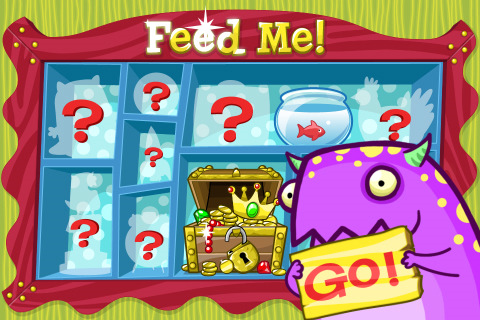
    • Feed Me. Great learning game appropriate for 2-4 year olds. Started out with identifying numbers or letters, but now focused on identifying patterns and images. image
    • NobyNobyboy. Surreal drawing game, with lots of movements and sounds. Frankly, I didn’t get it, but the kids under 5 loved doodling with it. I like this one and jellycar because they are  very constructivist and open-ended. image
    • Jellycar2 (disney)  Another action-oriented build your own car game for 4-6 year olds.
    • GearedHD. A good game about mechanical things and shapes. Probably appropriate for 5 to 9 year olds.
    • Soosiz HD. This game has minimal educational value, but it’s extremely engaging; my nieces and nephews seemed to love this game more than anything. Great music, funny effects, lots of adventures and scenery. Cost $3 i think. image
    • Cut the rope. Excellent mechanical and cause-and-effect game. For kids ages 4-10. All of them love it.
    • Memory Cards. Free memory game….like concentration with several variations. Can play with up to 3 more players. The best thing about this game is that even though the game is challenging (it’s about memory), my 3 year old can play it very well (often better than the other kids).
    • Fruit Ninjas HD. movement-oriented game that’s more about colors, how to combine them. They love the movement and excitement of this game.
    • Alphabet Car HD Lite. Sort of mindless letter-chasing game which the kids 3-5 like.
    • Pedlar Lady. Multimedia children’s book with some mild interactive effects. $5. Whenever I show adults this book/app, they flip out, but kids don’t seem to be as impressed. Probably for ages 8-10. image
    • World Factbook. Geography encyclopedia whose target audience is probably adults, but it’s easy for older kids (8 to 12 year olds) to use it to explore the world. Cost money.
    • Star Walk.. If you don’t know it already. Real time constellation guide.
    • TanZen (and Tanzen Lite). Geometry, match the pattern puzzle game. Good for 8 years and up.
    • Catcha Hd. Good strategy game where you have to enclose a mouse with mousetraps, thus  preventing  him from escaping down a  hole.
    Out of these games, here are the ones which grabbed me as an adult: Catcha HD (very tricky!) and Cut the Rope (lots of variations, and involves lots of mechanical thinking).

  • Planning to Buy Spore? I will

    After seeing Will Wright’s 2006 demo of Spore at SXSW, I was sold. I plan to pre-order it. I’m sure me and my nephew will have hours of fun playing it. (It will be released in September).

    Here’s an article by Stephen Berlin Johnson if you want to know what the fuss is about.

  • Owlcon Gaming Event (Rice University, Houston Feb 8-10)

    I don’t have the exact details but I’ll be attending Owlcon Gaming Convention in Houston to play Dungeons and Dragons all weekend. I am excited.

    I used to play Dungeons and Dragons for about 4 or 5 years. More precisely I used to be the Dungeon Master (I generally sucked as a player). In high school I organized 100-150 for a three round D&D tournament (which was a fund-raiser for my church–they had a liberal pastor there apparently).

    Truthfully I haven’t touched the game in 20 years although I recently bought the 3.5  books (DM’s Guides, Monster Manual and Player’s Handbook). I don’t have time to dig up the links, but apparently Gary Gygax had a protracted battle over ownership of the trademark, and independents have spun off with their own own version of Dungeons and Dragons (called d20)  that allows modules to be created and published without the need for licensing. A sometimes commenter on my blog Preston Dubose is involved in Midnight Cellar, a Texas-based publisher of game modules and extras for various systems (including D20 D&D).

    It’s funny. The game rules are extremely complicated, but the secret to D&D is that the players don’t need to understand the rules that well. They need merely to involve themselves in the story and their character (and contribute ideas to the other people in their party who do know the rules). 

  • Designing for Children: The Constructivist Approach

    In response to the announcement that SimCity will be ported to the One Laptop per Child platform, Alan Kay writes a long piece wondering whether Sim City is truly an example of constructivist learning. He talks about designing software environments for children and at the end concludes that Sim City might not be the best platform for that (he prefers something called etoys):

    If “children first!” is the rallying cry, then it makes sense to try to invent computer environments that use the very best ideas (and these are very hard to come up with). This is why the various groups that got interested in this romantic quest via early contact with Seymour have always been colleagues and never rivals. The hard to come by ideas for projects, representations, user interfaces, experiments, etc., have been freely traded back and forth. The notions of “thresholds below which is not worth going” have been jointly refined, etc. One of the parasitic difficulties is that computer environments, once made (with lots of effort and dedication) tend to form tribal bonds that are rather religious in nature. The amount of effort required plus the attendant religion makes it extremely difficult to take new insights and ideas and make brand new better environments for the children. The strong tendency is to use and reuse and incrementally expand the old environments.

    So, for young and youngish children (say from 4 to 12) we still have a whole world of design problems. For one thing, this is not an homogenous group. Cognitively and kinesthetically it is at least two groups (and three groupings is an even better fit). So, we really think of three specially designed and constructed environments here, where each should have graceful ramps into the next one.

    The current thresholds exclude many designs, but more than one kind of design could serve. If several designs could be found that serve, then we have a chance to see if the thresholds can be raised. This is why we encourage others to try their own comprehensive environments for children. Most of the historical progress in this area has come from a number of groups using each other’s ideas to make better attempts (this is a lot like the way any science is supposed to work). One of the difficulties today is that many of the attempts over the last 15 or so years have been done with too low a sense of threshold and thus start to clog and confuse the real issues.

    I think one of the trickiest issues in this kind of design is an analogy to the learning of science itself, and that is “how much should the learners/users have to do by themselves vs. how much should the curriculum/system do for them?” Most computer users have been mostly exposed to “productivity tools” in which as many things as possible have been done for them. The kinds of educational environments we are talking about here are at their best when the learner does the important parts by themselves, and any black or translucent boxes serve only on the side and not at the center of the learning. What is the center and what is the side will shift as the learning progresses, and this has to be accommodated.

    OTOH, the extreme build it from scratch approach is not the best way for most minds, especially young ones. The best way seems to be to pick the areas that need to be from scratch and do the best job possible to make all difficulties be important ones whose overcoming is the whole point of the educational process (this is in direct analogy to how sports and music are taught — the desire is to facilitate a real change for the better, and this can be honestly difficult for the learner).

    Specifically about Simcity he says:

    SimCity is similar but more pernicious. It is a black box of “soft somewhat arbitrary knowledge” that the children can’t look at, question or change. For example, SC gets the players to discover that the way to counter rising crime is to put in more police stations. Most anthropologists, sociologists, psychologists, and economists would disagree violently. Alternate assumptions can’t be tried, etc.

    Both of these packages have won many “educational awards” from the pop culture, but in many ways they are anti-real-education because they miss what modern knowledge and thinking and epistemology are all about. This is why being “above threshold” and really understanding what this means is the deep key to making modern curricula and computer environments that will really help children lift themselves.

    Two nuggests from the slashdot discussion about whether Simcity is a truly educational tool. First, a comic dialogue exchange:

    Is this to give the kids a virtual sense of what it’s like to live in a 1st world country? “look at all of the nice luxuries you will never experience!” how about the irony of building a nuclear powerplant on a computer you have to handcrank?

    Reply: This comment is funny, but it relies on a common misperception that the poor kids for whom the OLPC was created have no idea what modern urban life is like. Most of them live in or in the shadow of large modern cities, Johannisberg, Kolkata, Rio de Janeiro, Jakarta, Manila, and Mexico City, just to name a few. They have plenty of opportunities to see modern life, they just don’t have much opportunity to participate.

    Let me help you out with a simple analogy. You read slashdot, right? So, you have plenty of opportunities to see beautiful women, but all you get to do is watch, from a distance. That’s why you bought that stick of Axe Deoderant.

  • Yu Gi Oh for children? (A parents’ guide)

    A shout out to the blogosphere: does anyone have children who play Yu Gi Oh?

    If yes, do you have advice about how to get started? i have a 7 year old nephew who I’m thinking of buying some cards for. Here’s a parents’ guide. Here are rules about basic gameplay.

    James Paul Gee has written about this game before and spoken about it too.

  • Chicken for Losers

    I am embarrassed to say that I have never heard of Leroy Jenkins until yesterday. (Here’s the Internet video that made him worldfamous). Joel Warner wrote a great long profile about Leroy Jenkins and his reaction to his unexpected fame.

    “Alex Trebek said my name,” says Ben. “When I saw that, I realized it had gone beyond anything I could control.” He shakes his head, flabbergasted, and returns to the game — more Ghostly Essences to collect. Soon, however, there’s another whisper. “Was the video really on purpose?” a character named Lucifuge wants to know. People ask him this constantly. Did the movie capture Leeroy accidentally screwing up his guildmates’ plans? Is the rumor true that Ben was away from his computer, reheating some KFC, while his buddies planned the famous dragon attack — hence his imprudent charge and his enigmatic last line, “At least I got chicken”? Or was it all completely staged, a tongue-in-cheek commentary on the geekiness of World of Warcraft gamers? Ben smiles while reading Lucifuge’s message. “I like people to decide for themselves,” he responds. “It is more fun that way.” This is his patented response on the subject; it’s all he’ll ever say.

    Warner comments:

    That Leeroy is the game’s biggest failure rather than its highest achiever may explain why he’s transcended the self-referential sphere of World of Warcraft and moved into the realm of pop culture. Everyone everywhere has pulled a Leeroy. “There’s something more universal about this guy who screws things up for everybody than someone who is the best at something,” says Henry Lowood, curator for film and media collections at Stanford University. “If you’re not a player in the game, you are not going to be that interested in how spectacularly good a player is. But you can relate to someone who messes up.”

    These days, says Henry Jenkins, co-director of the Comparative Media Studies program at MIT, people don’t just identify with the lowly underachiever; they take subversive pleasure in using the Internet and other new social mediums to elevate him to a status previously reserved for the rich, talented or otherwise successful. As proof, Jenkins points to atrocious American Idol contestant William Hung scoring a record deal, Hank the Angry Drunken Dwarf winning the popular vote for People magazine’s most beautiful person and Leeroy Jenkins becoming enshrined in video-game history alongside Pac-Man and Mario. “For the first time, we as a society get to decide who’s famous,” he notes. “Having gained the right to project celebrities forward, we often choose losers, because in the past it was always success that connoted celebrity. If Leeroy Jenkins can become a celebrity, anybody can.”

    (BTW, it was okay to do when he wrote it in 2005, but isn’t it time for a moratorium on quotes from Henry Jenkins?)

    See also: South Park’s Make Love not Warcraft episode.

  • PS 2 Game Recommendations for Children Under 8? (As of 12/2006)

    Here’s a list of game recommendations for my nephew. Surprisingly, it took a long time to compile a kid-friendly game list. (Or I could have asked someone at a used game store–nah, that would have been too easy). He already owns Harry Potter (so so), Lego Star Wars (super great!), NBA Basketball (great!), Jak & Daxter, and a drag racing game. Feel free to add titles here. See also this discussion and this reference guide . Here’s a good list of child-friendly games. Of course, one great thing about doing the research is that I end up playing these games too.

    I ended up going with Kingdom Hearts 1. Simpsons Hit & Run and Stuart Little 3 Big Photo Adventure. Here is my list:

    1. Ratchet & Clank Up Your Arsenal (well-regarded and cheap; other games in the series are supposed to be good too). One advantage is that it allows multiple players.
    2. Jak & Daxter, cheap, 3 in the series. also highly regarded. Start with the first episode if you can. Update: They say to avoid Part 2 and Part 3.
    3. A Dog’s Life (definitely the most interesting sounding game, but also $30). You play a dog roaming through the city. Recommended, but some felt the game was too short, and way too much bathroom humor for young people.
    4. Stuart Little 3 Big Photo Adventure (based on the famous children’s novel by EB White). I eventually bought this. Some expressed reservations about the gameplay.
    5. Cookie & Cream; innovative game that needs 2 players. One is a bunny, the other is a teddy bear, and together they must solve problems. Might be a little above an 8 year old’s level, but doesn’t sound too much above. Update: This probably is NOT a good game for an 8 year old.
    6. Madagascar (well regarded, $25),
    7. simpsons hit n run ((somewhat mature and based on cartoon, but very imaginative and intellectual). Recommended. I bought this. Update: My nephew loves this game, but I didn’t find it particularly interesting. There’s a lot of movement and crashing, not much strategizing. Still, there’s a lot of complexity which is not too challenging. One player only.
    8. Sonic Mega Collection plus–not too stimulating intellectually, but very fun; classic games from the 1990s.
    9. shrek 2 (well-regarded, but some disagreement, cheap!)
    10. Godzilla Saves The Earth (rated teen, but supposed to be good clean fun suitable for younger ages,). expensive $30
    11. Kingdom Hearts & Kingdom Hearts 2, a cross between Final Fantasy using Disney characters. Supposed to be innovative and fun, though gaming purists decry the merging of these two disparate worlds. (the original was supposed to be more fun, though the sequel has better graphics and was shorter). Update: Even though I ended up buying it, I later found out it is too complex for a child of that age. I looked at it again; it is a decent game, but you have to do a lot of reading–which might weary a child who cannot read well. Also, there were a lot of cut scenes–this grew old quickly! One player only!
    12. Mega Man Anniversary Collection, a collection of several games popular in the 90s.
    13. Ico, a visually rich game about a boy trapped inside a castle who needs to solve puzzles to escape. More of a puzzle game than a twitch game. Update: A person who played it said it is too hard for an 8 year old.
    14. Mister Mosquito, innovative premise where the character is a mosquito who sucks/bites members of a Japanese family. Reviewers applaud the overall concept, though they say the novelty quickly wears off and gameplay is limited. Update: A person who played it said it is too hard for an 8 year old.
    15. Magic Pengel, innovative game with a cool effect where a creature you draw will appear to come alive and be your pet throughout the game. Some have complained about gameplay, though overall it has positive reviews.
    16. Spyro (any). Young dragon has to save friends/world from various meanies. Platformer like Mario, and perfect for the under-10 set.
    17. Worms 3D
    18. SSX. first is best.
    19. Katamari Dimacy
  • Mechanics of Sex in Second Life

    This is definitely NOT safe for work (there’s graphic images), but here’s an essay about how to program your avatar to have sex in various video games:

    First, some terminology. In Second Life, your character can be put into “poses”. Basically, this is an animation created in Poser or some other movement/animation program. You create the animation, loop it, and upload it to Second Life. These poses can be attached to what are known as Pose Balls. By having your character touch a pose ball (basically, clicking on it), you character will being using the animation that was contained in the pose ball. This is how sex is played out visually in Second Life. You touch one pose ball, your partner touches the other, and all of the sudden one is banging the other. Don’t you wish it was that easy in real life?

    Now, you’ve got to remember, when I said you could do anything in Second Life, I meant ANYTHING. This game has some of the weirdest BDSM equipment I’ve ever seen, much of which really wouldn’t work in real life. Putting a stompy industrial boy in all of it is just hours of stupid, giggly fun.

    Animations will run you somewhere between 200L$ and 500L$ ($.50-2US), sometimes upwards of 1000L$ (~$4US) depending on how drawn out they are. As with all aspects of the world, your body is scriptable. That’s right, you can program your nuts. They can do a happy little nut dance. There’s also erections and pumping and all that, but I’m totally fixated on the happy little nut dance idea now. There goes another 2 weeks of my life.

    Animations can be speed controlled by writing a script that binds animations to buttons, and hitting those buttons to change what animation is displaying. This is how sex progresses.

    From Eyder Peralta’s post about SXSW.